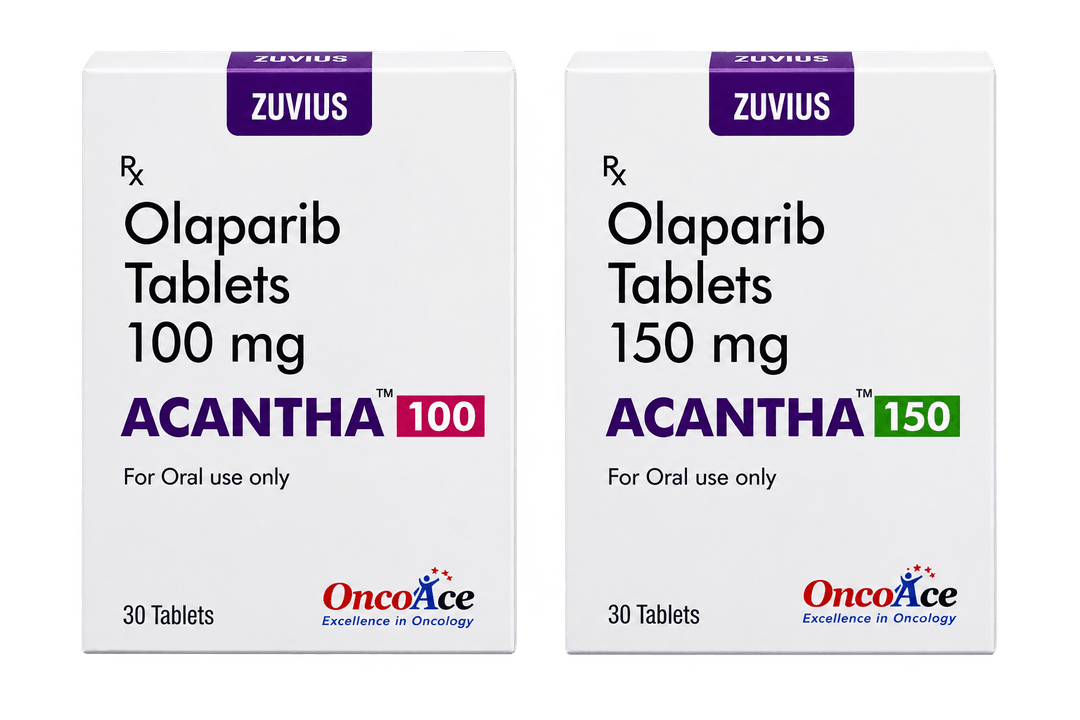
Acantha
Olaparib Tablets

Strength
✓100 mg✓150 mg

Pack Size
1 X 30

Drug Class
Poly (ADP-ribose) Polymerase (PARP) Inhibitor

Specification
USP/BP/IH Specs offered for exports
Storage
Store at 25°C to 30°C.
Acantha contains Olaparib and is supplied as film-coated tablets for oral administration.
Composition
Acantha 100
- Each film-coated tablet contains Olaparib 100 mg.
- Excipients are added in sufficient quantity.
- Colours include Yellow Oxide of Iron and Titanium Dioxide IP.
Acantha 150
- Each film-coated tablet contains Olaparib 150 mg.
- Excipients are added in sufficient quantity.
- Colours include Black Oxide of Iron, Yellow Oxide of Iron and Titanium Dioxide IP.
Dosage Form
Film-coated tablets for oral use only.
Mechanism of Action
Olaparib is an inhibitor of poly (ADP-ribose) polymerase enzymes, including PARP1, PARP2 and PARP3.
PARP enzymes are involved in normal cellular functions such as DNA transcription and DNA repair.
Olaparib inhibits the growth of selected tumour cell lines and reduces tumour growth in experimental models, both as monotherapy and after platinum-based chemotherapy.
Increased cytotoxic and antitumour activity has been observed in tumour cells with deficiencies in BRCA and non-BRCA proteins involved in homologous recombination repair of DNA damage.
Olaparib-induced cytotoxicity may involve inhibition of PARP enzymatic activity and increased formation of PARP-DNA complexes, resulting in DNA damage and cancer cell death.
Ovarian Cancer
Acantha is indicated for the maintenance treatment of adult patients with recurrent epithelial ovarian, fallopian tube or primary peritoneal cancer who are in complete or partial response to platinum-based chemotherapy.
Breast Cancer
Acantha is indicated for patients with deleterious or suspected deleterious germline BRCA-mutated, HER2-negative metastatic breast cancer who have previously received chemotherapy in the neoadjuvant, adjuvant or metastatic setting.
Patients with hormone receptor-positive breast cancer should have received prior endocrine therapy or should be considered unsuitable for endocrine treatment.
Maintenance Treatment of Recurrent Ovarian Cancer – SOLO-2 Study:
The safety and efficacy of Olaparib Tablets for maintenance treatment of platinum-sensitive germline BRCA-mutated ovarian cancer were evaluated in the placebo-controlled, double-blind SOLO-2 study involving 294 patients.
Treatment Groups
- Olaparib 300 mg twice daily: 195 patients
- Placebo: 99 patients
Median Treatment Duration
- Olaparib: 19.4 months
- Placebo: 5.6 months
Dose Interruptions Due to Adverse Reactions
- Olaparib-treated patients: 45%
- Placebo-treated patients: 18%
Dose Reductions Due to Adverse Reactions
- Olaparib-treated patients: 27%
- Placebo-treated patients: 3%
Discontinuation Due to Adverse Reactions
- Olaparib-treated patients: 11%
- Placebo-treated patients: 2%
Treatment of Germline BRCA-Mutated HER2-Negative Metastatic Breast Cancer – OlympiAD Study:
The safety and efficacy of Olaparib monotherapy were evaluated in the randomized, open-label OlympiAD study involving 296 patients.
Treatment Groups
- Olaparib 300 mg twice daily: 205 patients
- Chemotherapy: 91 patients
Median Treatment Duration
- Olaparib: 8.2 months
- Chemotherapy: 3.4 months
Dose Interruptions Due to Adverse Reactions
- Olaparib-treated patients: 35%
- Chemotherapy-treated patients: 28%
Dose Reductions Due to Adverse Reactions
- Olaparib-treated patients: 25%
- Chemotherapy-treated patients: 31%
Discontinuation Due to Adverse Reactions
- Olaparib-treated patients: 5%
- Chemotherapy-treated patients: 8%
Contraindications
- Hypersensitivity to Olaparib or any of the excipients used in the formulation.
Most Frequent Adverse Reactions Leading to Dose Interruption or Reduction:
- Anaemia
- Neutropenia
- Fatigue or asthenia
Additional Adverse Reactions
- Neutropenia
- Rash
- Cough
- Dyspepsia
- Leukopenia
- Hypomagnesaemia
- Dizziness
- Thrombocytopenia
- Increased serum creatinine
- Lymphopenia
- Oedema
Overdosage
There is no specific treatment for Olaparib overdose and the symptoms of overdose have not been established.
In the event of overdose, general supportive measures should be used and the patient should be treated symptomatically.
Recommended Dose
- The recommended dose of Olaparib Tablets is 300 mg, taken as two 150 mg tablets, orally twice daily.
- The total daily dose is 600 mg.
- The medicine may be taken with or without food.
- The 100 mg tablet is available for dose reduction.
- Continue treatment until disease progression or unacceptable toxicity.
Administration
- Swallow the tablets whole.
- Do not chew, crush, dissolve or divide the tablets.
Missed Dose
- If a dose is missed, take the next dose at the regularly scheduled time.
- Do not take an extra dose to make up for the missed dose.
Dose Adjustments for Adverse Reactions
Treatment interruption or dose reduction may be considered to manage adverse reactions.
- First dose reduction: 250 mg twice daily, taken as one 150 mg tablet and one 100 mg tablet, for a total daily dose of 500 mg.
- Further dose reduction: 200 mg twice daily, taken as two 100 mg tablets, for a total daily dose of 400 mg.
Dose Modifications with CYP3A Inhibitors
Avoid concomitant use of strong or moderate CYP3A inhibitors whenever possible.
- If a strong CYP3A inhibitor must be administered, reduce the dose to 100 mg twice daily, for a total daily dose of 200 mg.
- If a moderate CYP3A inhibitor must be administered, reduce the dose to 150 mg twice daily, for a total daily dose of 300 mg.
Dose Modifications in Renal Impairment
- Mild renal impairment with creatinine clearance of 51–80 mL/min does not require dose adjustment.
- In moderate renal impairment with creatinine clearance of 31–50 mL/min, reduce the dose to 200 mg twice daily, for a total daily dose of 400 mg.
- The pharmacokinetics of Olaparib have not been evaluated in patients with severe renal impairment or end-stage renal disease.