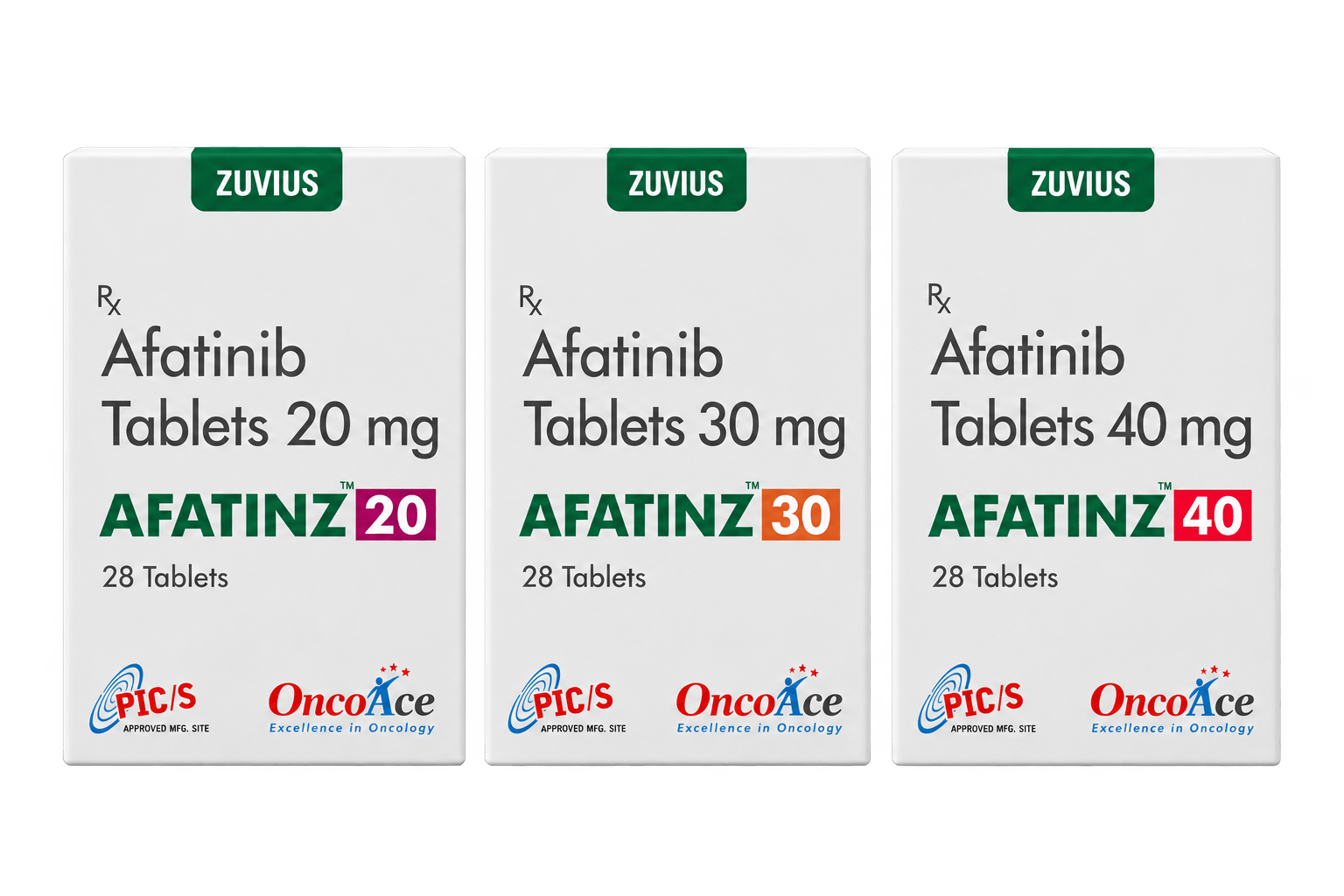
Afatinz
Afatinib Tablets

Strength
✓20 mg✓30 mg✓40 mg

Pack Size
1 x 28

Drug Class
Antineoplastics, Tyrosine Kinase Inhibitor; EGFR Inhibitor

Specification
USP/BP/IH Specs offered for exports

Storage
Store at 25°C to 30°C.
Afatinib tablets contain afatinib, a tyrosine kinase inhibitor which is a 4-anilinoquinazoline.
Afatinib is presented as the dimaleate salt, with the chemical name:
2-butenamide,N-[4-[(3-chloro-4-fluorophenyl)amino]7-[[(3S)-tetrahydro-3-furanyl]oxy]-6-quinazolinyl]-4-(dimethylamino)-,(2E)-, (2Z)-2-butenedioate (1:2).
Afatinib dimaleate is a white to brownish yellow powder, water soluble and hygroscopic, with an empirical formula of C32H33ClFN5O11, and a molecular weight of 718.1 g/mol.
Afatinib tablets for oral administration are available in 40 mg, 30 mg, or 20 mg of afatinib (equivalent to 59.12 mg, 44.34 mg, or 29.56 mg afatinib dimaleate, respectively).
EGFR Mutation-Positive, Metastatic Non-Small Cell Lung Cancer
AFATINIB is indicated for the first-line treatment of patients with metastatic non-small cell lung cancer (NSCLC) whose tumors have non-resistant epidermal growth factor receptor (EGFR) mutations as detected by an FDA-approved test.
Limitations Of Use
The safety and efficacy of AFATINIB have not been established in patients whose tumors have resistant EGFR mutations.
Previously Treated, Metastatic Squamous NSCLC
AFATINIB is indicated for the treatment of patients with metastatic squamous NSCLC progressing after platinum-based chemotherapy.
Because clinical trials are conducted under widely varying conditions, adverse reaction rates observed in the clinical trials of a drug cannot be directly compared to rates in the clinical trials of another drug and may not reflect the rates observed in practice.
The data in the Warnings and Precautions section reflect exposure to AFATINIB for clinically significant adverse reactions in 4257 patients enrolled in LUX-Lung 3 (n=229) and LUX-Lung 8 (n=392), and 3636 patients with cancer enrolled in 42 studies of AFATINIB administered alone or in combination with other anti-neoplastic drugs at AFATINIB doses ranging from 10-70 mg daily or at doses 10-160 mg in other regimens.
The mean exposure was 5.5 months.
The population included patients with various cancers, the most common of which were NSCLC, breast, colorectal, brain, and head and neck.
The data described below reflect exposure to AFATINIB as a single agent in LUX-Lung 3, a randomized, active-controlled trial conducted in patients with EGFR mutation-positive, metastatic NSCLC, and in LUX-Lung 8, a randomized, active-controlled trial in patients with metastatic squamous NSCLC progressing after platinum-based chemotherapy.
Limit your time in the sun.
AFATINIB can make your skin sensitive to sunlight.
You could get or have worsening rash or acne.
You could get a severe sunburn.
Use sunscreen and wear a hat and clothes that cover your skin if you have to be in sunlight during treatment with AFATINIB.
Keep AFATINIB and all medicines out of the reach of children.
The recommended dosage of AFATINIB is 40 mg orally once daily until disease progression or no longer tolerated by the patient.
Take AFATINIB at least 1 hour before or 2 hours after a meal.
Do not take a missed dose within 12 hours of the next dose.
The recommended dosage of AFATINIB in patients with pre-existing severe renal impairment (estimated glomerular filtration rate [eGFR] 15 to 29 mL/min/1.73 m²) is 30 mg orally once daily.
Reduce AFATINIB daily dose by 10 mg if not tolerated for patients who require therapy with a P-glycoprotein (P-gp) inhibitor.
Resume the previous dose after discontinuation of the P-gp inhibitor as tolerated.
Increase AFATINIB daily dose by 10 mg as tolerated for patients who require chronic therapy with a P-gp inducer.
Resume the previous dose 2 to 3 days after discontinuation of the P-gp inducer.