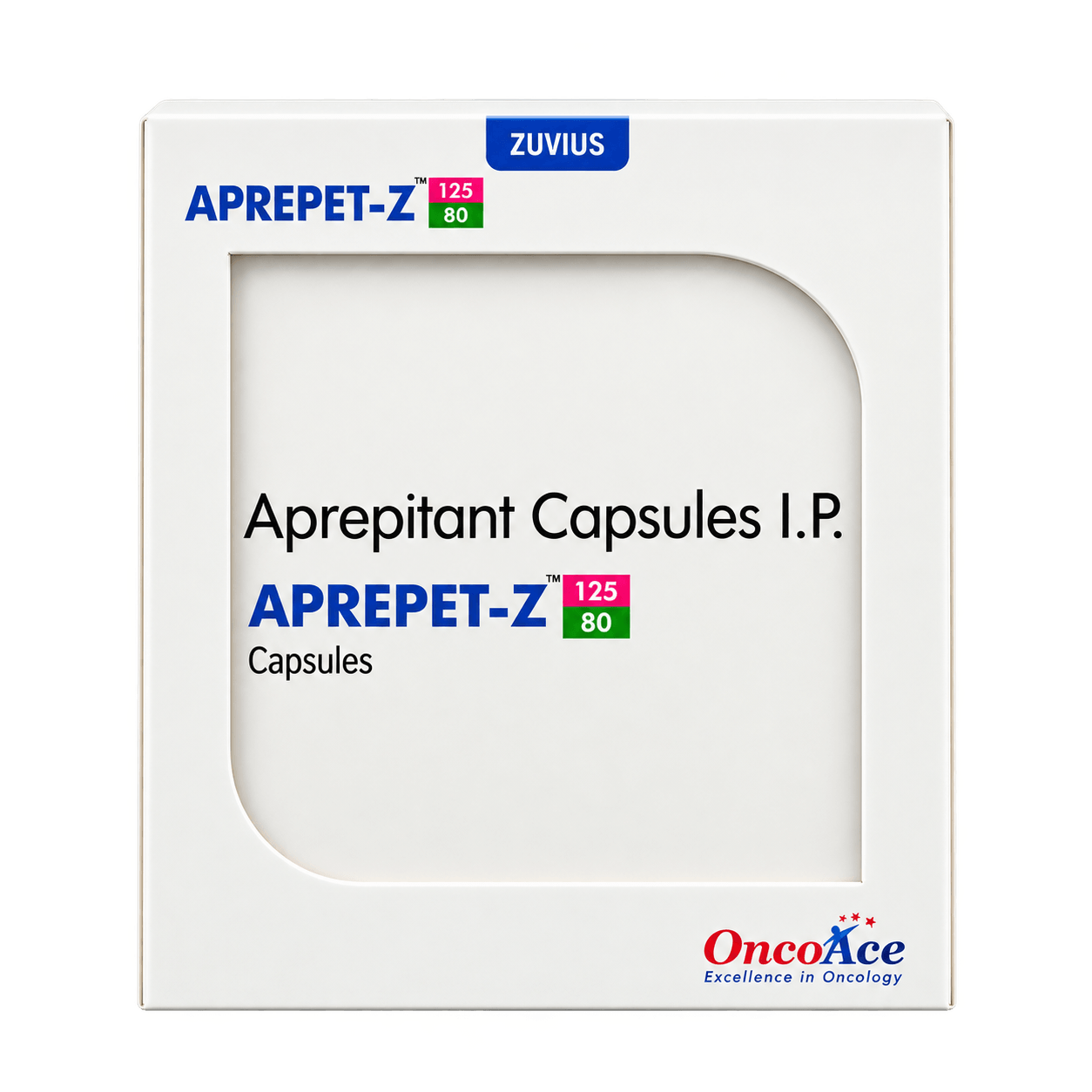
Aprepet-Z Combi Pack
Aprepitant Combi Pack Capsules

Strength
✓125/80 mg

Pack Size
1 x 3

Drug Class
Antiemetics

Specification
USP/BP/IH Specs offered for exports

Storage
Store at 25°C to 30°C.
Aprepitant is a substance P/neurokinin 1 (NK1) receptor antagonist, chemically described as:
5-[[(2R,3S)-2-[(1r)-1-[3,5-BIS (TRIFLUOROMETHYL) PHENYL] ETHOXY]-3-(4-fluorophenyl)-4-morpholinyl] methyl]-1,2-dihydro-3H-1,2,4-triazol-3-one.
Its empirical formula is
C23H21F7N4O3
Aprepitant is a white to off-white crystalline solid, with a molecular weight of 534.43.
It is practically insoluble in water.
Aprepitant is sparingly soluble in ethanol and isopropyl alcohol.
Aprepitant, for the treatment of adult patients with chemotherapy induced nausea and vomiting.
Aprepitant is a selective high-affinity antagonist of human substance P/neurokinin 1 (NK1) receptors.
Aprepitant has little or no affinity for
- Serotonin (5-HT₃) receptors
- Dopamine receptors
- Corticosteroid receptors
the targets of existing therapies for chemotherapy-induced nausea and vomiting (CINV) and postoperative nausea and vomiting (PONV).
Aprepitant has been shown in animal models to inhibit emesis induced by cytotoxic chemotherapeutic agents, such as cisplatin, via central actions.
Animal and human Positron Emission Tomography (PET) studies with aprepitant have shown that it crosses the blood brain barrier and occupies brain NK1 receptors.
Animal and human studies show that aprepitant augments the antiemetic activity of:
- The 5-HT₃ receptor antagonist ondansetron
- The corticosteroid dexamethasone
and inhibits both the acute and delayed phases of cisplatin-induced emesis.
Keep out of reach of children.
Aprepitant is given for 3 days as part of a regimen that includes a corticosteroid and a 5-HT3 antagonist.
The recommended dose of aprepitant is
- 125 mg orally 1 hour prior to chemotherapy treatment (Day 1)
- 80 mg once daily in the morning on Days 2 and 3.