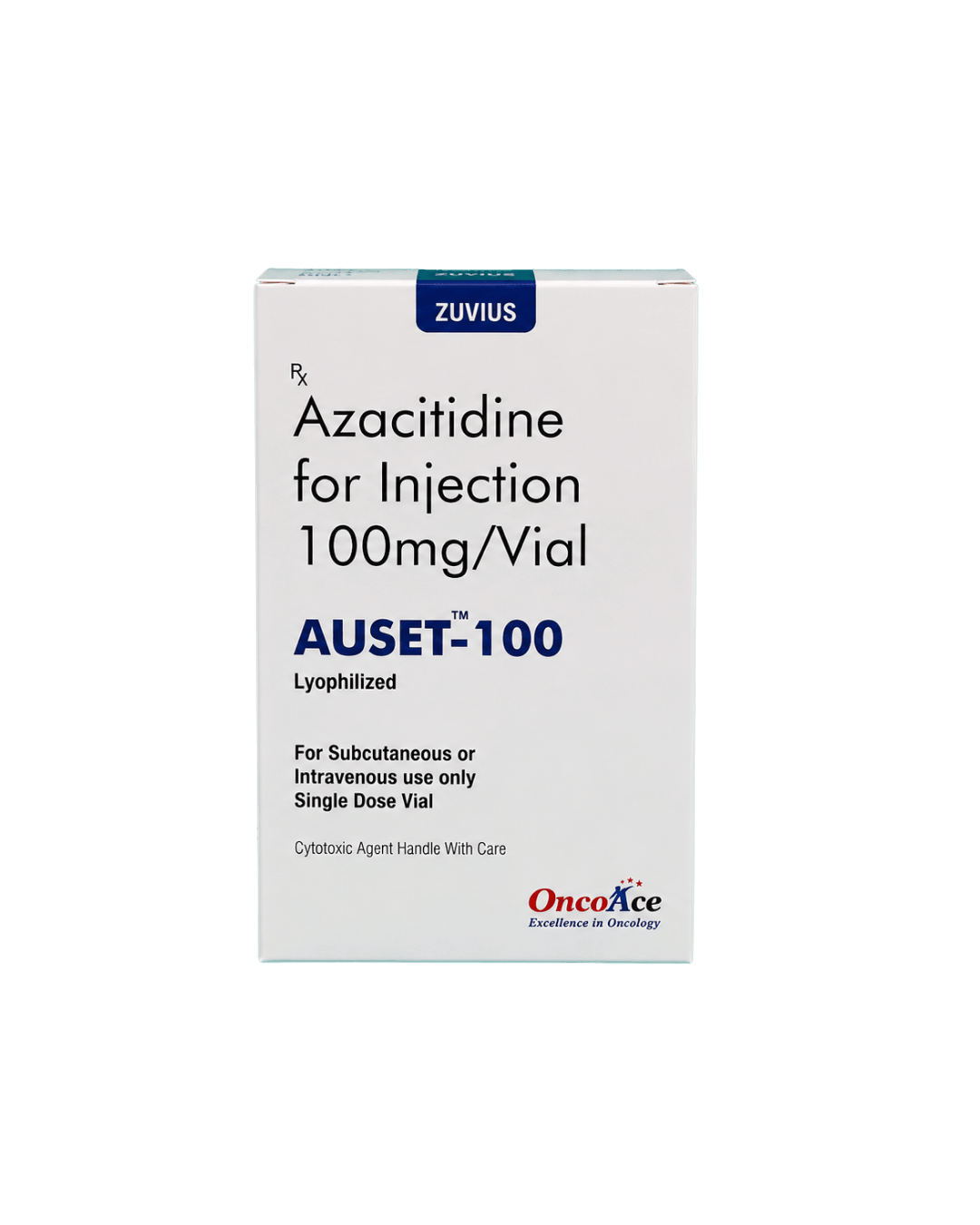
Auset
Azacitidine Injection

Strength
✓100 mg

Pack Size
Vial

Drug Class
Demethylation Agents

Specification
USP/BP/IH Specs offered for exports

Storage
Store at 25°C to 30°C.
Azacitidine is a pyrimidine nucleoside analogue used to treat certain subtypes of myelodysplastic syndrome.
Azacitidine is a pyrimidine nucleoside analogue with anti-neoplastic activity. It differs from cytosine by the presence of nitrogen in the C5-position, which is key in its hypomethylating activity.
Azacitidine for injection is a nucleoside metabolic inhibitor indicated for the treatment of patients with the following FAB myelodysplastic syndrome (MDS) subtypes:
- Refractory anemia (RA)
- Refractory anemia with ringed sideroblasts (RARS) if accompanied by neutropenia or thrombocytopenia or requiring transfusions
- Refractory anemia with excess blasts (RAEB)
- Refractory anemia with excess blasts in transformation (RAEB-T)
- Chronic myelomonocytic leukemia (CMMoL)
A clinical study compared the overall survival (OS) of azacitidine to conventional care regimens (CCR) in elderly patients with low bone marrow blast count acute myeloid leukemia (AML).
At a median follow-up of 20.1 months
- Patients treated with azacitidine had a median OS of 24.5 months.
- Patients on CCR had a median OS of 16.0 months.
- Hazard ratio = 0.47; P = 0.005.
- The 2-year OS rates were 50% for azacitidine and 16% for CCR (P = 0.001).
- Significantly higher survival was observed in patients unfit for intensive chemotherapy (P = 0.0003).
Additionally, Garcia-Manero et al. (2016) investigated the efficacy and safety of extended dosing schedules of azacitidine in patients with lower-risk myelodysplastic syndromes (MDS).
The study focused on overall response rates, including complete or partial remission and transfusion independence.
- Overall response rates were 36% for the 14-day dosing schedule.
- Overall response rates were 41% for the 21-day dosing schedule.
- Red blood cell transfusion independence rates were 31% and 38%, respectively.
The study concluded that extended dosing schedules of oral azacitidine could provide effective long-term treatment for lower-risk MDS patients.
Pregnancy
Azacitidine is classified as a pregnancy category D drug. It can cause fetal harm when administered to a pregnant woman.
Adequate contraceptive precautions should be advised for both male and female patients receiving azacitidine.
The use of azacitidine should be avoided during pregnancy, especially during the first trimester.
Breastfeeding
It is recommended that breastfeeding be discontinued during treatment with azacitidine due to the potential for serious adverse reactions in nursing infants.
Fertility
Azacitidine may impair fertility in both men and women.
Women of reproductive potential should use effective contraception during treatment with azacitidine.
Men should consider sperm preservation prior to treatment with azacitidine, as azoospermia has been observed with this therapy.
Teratogenicity
Like other cytotoxic agents, azacitidine is potentially teratogenic and can cause fetal harm if used during pregnancy.
Pregnancy testing and effective contraception are recommended during treatment with azacitidine to prevent pregnancy-related risks.
The recommended starting dose for the first treatment cycle, for all patients regardless of baseline hematology values, is Azacitidine for injection 75 mg/m² daily for 7 days to be administered by subcutaneous (SC) injection or intravenous (IV) infusion.
Premedicate for nausea and vomiting.
Repeat cycles every 4 weeks.
After 2 cycles, may increase dose to 100 mg/m² if no beneficial effect is seen and no toxicity other than nausea and vomiting has occurred.
Patients should be treated for a minimum of 4 to 6 cycles. Complete or partial response may require additional treatment cycles.
Continue treatment as long as the patient continues to benefit.
Monitor patients for hematologic response and for renal toxicity; delay or reduce dosage as appropriate.