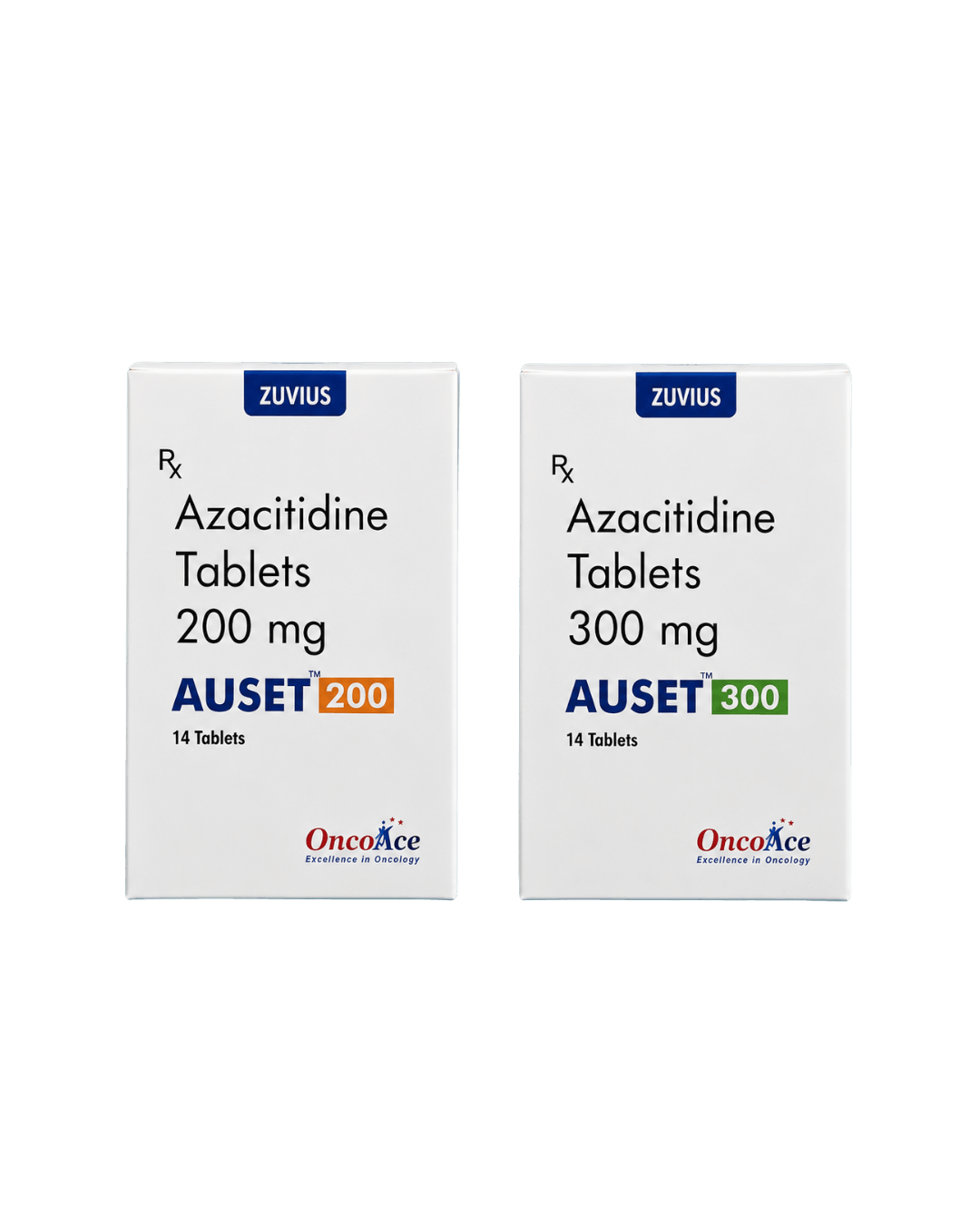
Auset
Azacitidine Tablets

Strength
✓200 mg✓300 mg

Pack Size
1 x 14

Drug Class
Antimetabolite and Demethylating Agent

Specification
USP/BP/IH Specs offered for exports

Storage
Store at 25°C to 30°C.
Auset contains Azacitidine, a pyrimidine nucleoside analogue with antimetabolite and demethylating activity.
Auset is a prescription medicine used for the continued treatment of certain adult patients with acute myeloid leukaemia.
After cellular uptake, Azacitidine undergoes enzymatic conversion into active nucleotide forms.
It is incorporated into DNA, where it reversibly inhibits DNA methyltransferase enzymes and reduces DNA methylation.
This may restore the expression of genes involved in tumour suppression and normal cell differentiation.
Azacitidine is also incorporated into RNA, where it inhibits RNA methyltransferases, reduces RNA stability and decreases protein synthesis.
Auset is indicated for the continued treatment of adult patients with acute myeloid leukaemia who:
- Achieved a first complete remission following intensive induction chemotherapy.
- Achieved complete remission with incomplete blood-count recovery following intensive induction chemotherapy.
- Are unable to complete intensive curative treatment.
Azacitidine is a pyrimidine nucleoside analogue of cytidine that inhibits DNA and RNA methyltransferases.
Following cellular uptake, Azacitidine is converted into active nucleotide triphosphates and incorporated into DNA and RNA.
Incorporation into DNA
- Inhibits DNA methyltransferases.
- Reduces DNA methylation.
- Alters gene expression.
- May restore the expression of genes involved in tumour suppression and cell differentiation.
Incorporation into RNA
- Inhibits RNA methyltransferases.
- Reduces RNA methylation.
- Decreases RNA stability.
- Reduces protein synthesis.
These actions interfere with the growth and survival of malignant cells, including acute myeloid leukaemia cells.
General Safety Information
- Read the product label carefully before use.
- Keep Auset out of the reach of children.
- Do not exceed the recommended dose.
- Use Auset only under the supervision of a doctor experienced in anticancer treatment.
Myelosuppression
Auset may cause suppression of bone-marrow function.
This may result in
- Anaemia
- Neutropenia
- Thrombocytopenia
- Increased risk of infection
- Increased risk of bleeding
Complete blood counts should be monitored before treatment and regularly during therapy.
Gastrointestinal Toxicity
Auset may cause
- Nausea
- Vomiting
- Diarrhoea
- Other gastrointestinal adverse reactions
Antiemetic or antidiarrhoeal medicines may be required during treatment.
Recommended Dosage
- The recommended dose of Auset is 200 mg or 300 mg taken orally once daily.
- Take the medicine on Days 1 through 14 of each 28-day treatment cycle.
- Auset may be taken with or without food.
- Treatment should continue until disease progression or unacceptable toxicity occurs.
Antiemetic Treatment
- Administer an antiemetic medicine approximately 30 minutes before each Auset dose during the first 2 treatment cycles.
- Antiemetic prophylaxis may be omitted after the first 2 cycles if the patient has not experienced nausea or vomiting.
The exact dose, treatment duration and any dosage modifications should be determined by the treating oncologist.