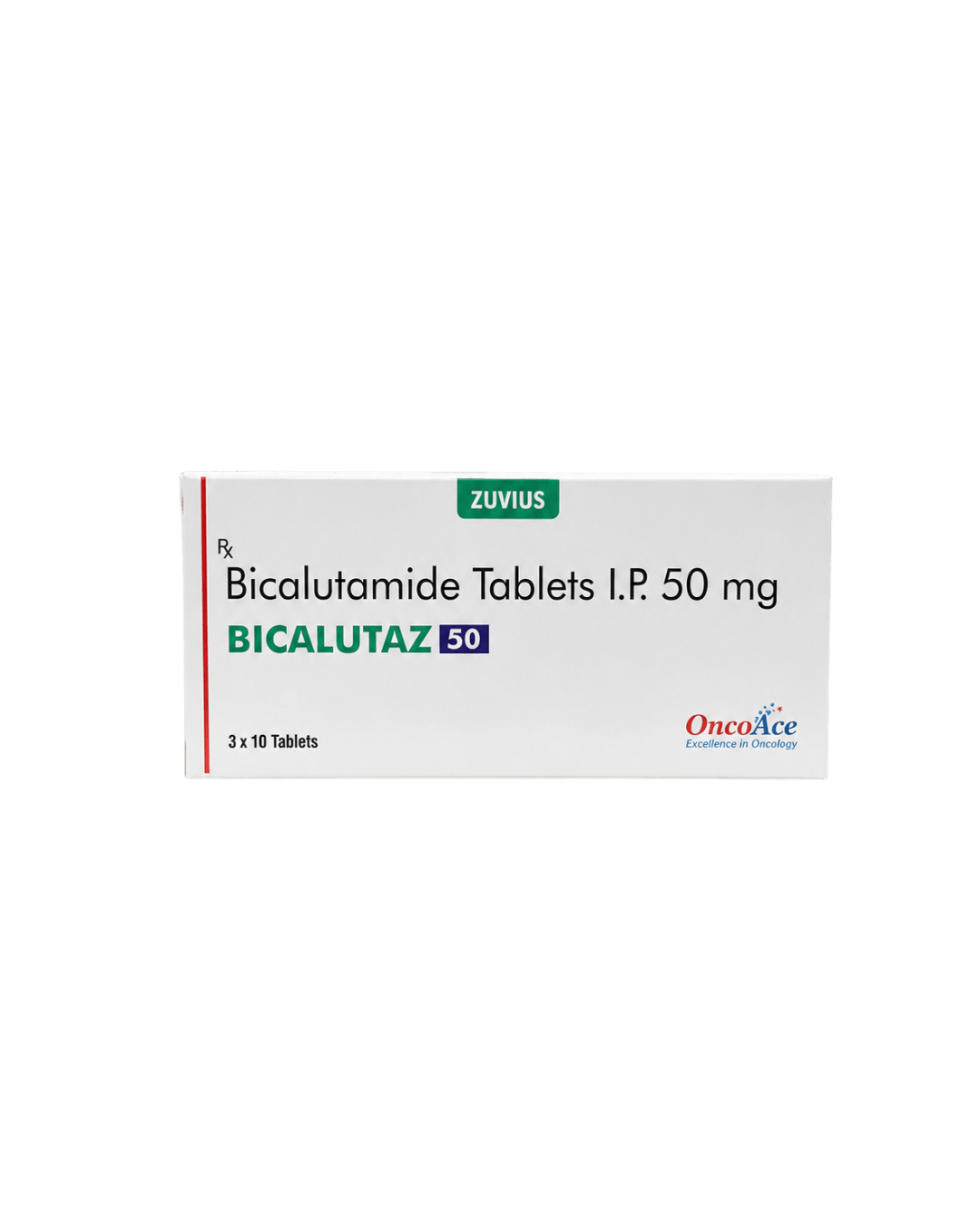
Bicalutaz
Bicalutamide Tablets

Strength
✓50 mg

Pack Size
1 x 10

Drug Class
Antineoplastics, Antiandrogen

Specification
USP/BP/IH Specs offered for exports

Storage
Store at 25°C to 30°C.
Bicalutamide tablets contain 50 mg of bicalutamide, a non-steroidal androgen receptor inhibitor with no other known endocrine activity.
The chemical name is propanamide, N [4 cyano-3-(trifluoromethyl)phenyl]-3-[(4-fluorophenyl)sulfonyl]-2-hydroxy-2-methyl-, (+-).
Bicalutamide has a molecular weight of 430.37.
The pKa’ is approximately 12.
Bicalutamide is a fine white to off-white powder which is practically insoluble in water at 37°C (5 mg per 1000 mL), slightly soluble in chloroform and absolute ethanol, sparingly soluble in methanol, and soluble in acetone and tetrahydrofuran.
Bicalutamide is a racemate with its antiandrogenic activity being almost exclusively exhibited by the R-enantiomer of bicalutamide; the S-enantiomer is essentially inactive.
The inactive ingredients of Bicalutamide tablets are lactose, magnesium stearate, hypromellose, polyethylene glycol, polyvidone, sodium starch glycollate, and titanium dioxide.
Bicalutamide is indicated in combination with a luteinizing hormone-releasing hormone (LHRH) agonist for the treatment of Stage D2 metastatic carcinoma of the prostate.
A 50-mg daily dose of bicalutamide is sufficient when given in combination with an agent, such as a LHRH-A, that lowers serum testosterone, but higher doses of bicalutamide may be needed when the drug is given as monotherapy.
Bicalutamide, 50-mg daily, is a logical first choice for antiandrogen therapy when used in combination with an LHRH-A for the treatment of patients with advanced prostate cancer.
Bicalutamide 150-mg daily is considered an effective monotherapy for use in patients with locally advanced disease.
Additional clinical trials are currently in progress to further evaluate bicalutamide as a monotherapy for advanced prostate cancer and to assess its value as adjuvant or first-line therapy for early-stage prostate cancer.
Bicalutamide is a potent antiandrogen and a mixed function oxidase enzyme inducer in animals.
Target organ changes, including tumour induction, in animals, are related to these activities.
Atrophy of seminiferous tubules of the testes is a predicted class effect with antiandrogens and has been observed for all species examined.
Reversal of testicular atrophy occurred 4 months after the completion of dosing in a 6-month rat study (at doses of approximately 1.5 times human therapeutic concentrations at the recommended dose of 50 mg).
No recovery was observed at 24 weeks after the completion of dosing in a 12-month rat study (at doses of approximately 2 times human concentrations at the recommended human dose of 50 mg).
Following 12-months of repeated dosing in dogs (at doses of approximately 7 times human therapeutic concentrations at the recommended human dose of 50 mg), the incidence of testicular atrophy was the same in dosed and control dogs after a 6 month recovery period.
In a fertility study (at doses of approximately 1.5 times human therapeutic concentrations at the recommended human dose of 50 mg), male rats had an increased time to successful mating immediately after 11 weeks of dosing; reversal was observed after 7 weeks off-dose.
Recommended Dose And Schedule
The recommended dose for Bicalutaz therapy in combination with an LHRH analog is one 50 mg tablet once daily (morning or evening), with or without food. It is recommended that Bicalutaz be taken at the same time each day.
Treatment with Bicalutaz should be started at the same time as treatment with an LHRH analog.
If a dose of Bicalutaz is missed, take the next dose at the scheduled time. Do not take the missed dose and do not double the next dose.
Dosage Adjustment In Renal Impairment
No dosage adjustment is necessary for patients with renal impairment.
Dosage Adjustment In Hepatic Impairment
No dosage adjustment is necessary for patients with mild to moderate hepatic impairment.
In patients with severe liver impairment (n=4), although there was a 76% increase in the half-life (5.9 and 10.4 days for normal and impaired patients, respectively) of the active enantiomer of bicalutamide, no dosage adjustment is necessary.