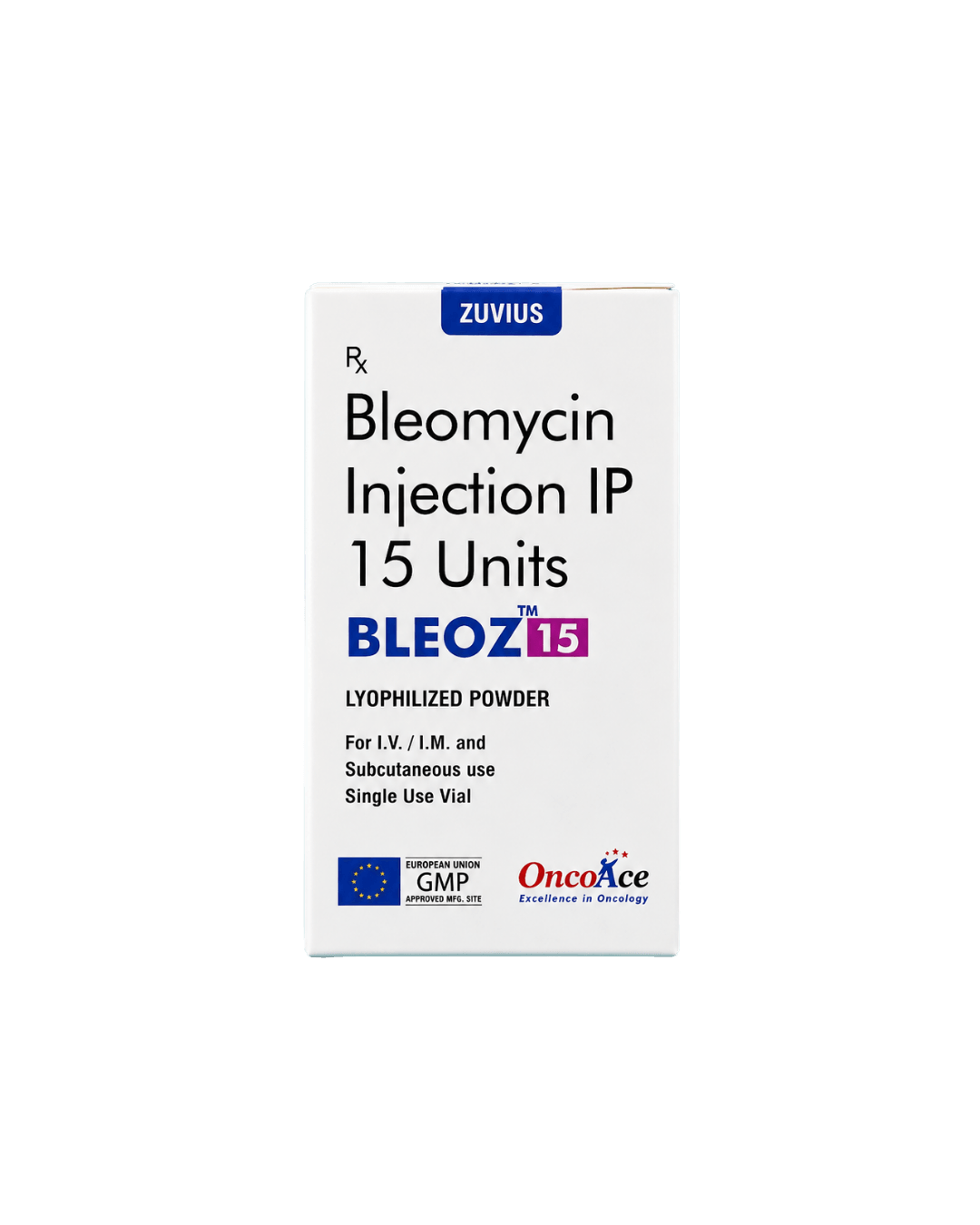
Bleoz
Bleomycin Sulphate Injection

Strength
✓15 IU

Pack Size
1 Vial

Drug Class
Antineoplastic Agent

Specification
USP/BP/IH Specs offered for exports

Storage
Store refrigerated at 2°C to 8°C.
Bleomycin for Injection USP is a mixture of cytotoxic glycopeptide antibiotics isolated from a strain of Streptomyces verticillus and is freely soluble in water.
It is available as a lyophilized powder for intramuscular, intravenous or subcutaneous injection.
Each vial contains sterile bleomycin sulfate equivalent to
- 15 units
or
- 30 units
of bleomycin.
Sulfuric acid or sodium hydroxide is used, if necessary, to adjust the pH.
Bleomycins are a group of related basic glycopeptides which differ in the terminal amine substituent of the common structural unit, bleomycin acid.
The main components of Bleomycin for Injection are
- Bleomycin A2
- Bleomycin B2
Chemically
Bleomycin A2 is
N1-[3-(dimethylsulfonio)propyl]-bleomycinamide
Bleomycin B2 is
N1-[4-(aminoiminomethyl)amino]butyl]-bleomycinamide
The molecular formula of Bleomycin A2 is
C55H84N17O21S3
with a calculated molecular weight of 1414.
The molecular formula of Bleomycin B2 is
C55H84N20O21S2
with a calculated molecular weight of 1425.
BLEOZ should be considered a palliative treatment.
It has been shown to be useful in the management of the following neoplasms either as a single agent or in proven combinations with other approved chemotherapeutic agents.
Squamous Cell Carcinoma
- Head and neck (including mouth, tongue, tonsil, nasopharynx, oropharynx, sinus, palate, lip, buccal mucosa, gingivae, skin, larynx)
- Penis
- Cervix
- Vulva
The response to BLEOZ is poorer in patients with previously irradiated head and neck cancer.
Lymphomas
- Hodgkin’s disease
- Non-Hodgkin’s lymphoma
Testicular Carcinoma
BLEOZ is indicated in the treatment of testicular carcinoma, including:
- Embryonal cell carcinoma
- Choriocarcinoma
- Teratocarcinoma
Malignant Pleural Effusion
BLEOZ is effective as a sclerosing agent in the management of malignant pleural effusion and in the prevention of recurrent pleural effusions.
Although the exact mechanism of action of BLENOXANE (bleomycin sulfate injection) is unknown, available evidence indicates that the main mode of action is the inhibition of DNA synthesis with some evidence of lesser inhibition of RNA and protein synthesis.
Bleomycin is known to cause single, and to a lesser extent, double-stranded breaks in DNA.
In in vitro and in vivo experiments, bleomycin has been shown to cause cell cycle arrest in G2 and in mitosis.
When administered into the pleural cavity in the treatment of malignant pleural effusion, BLENOXANE (bleomycin sulfate injection) acts as a sclerosing agent.
Bleomycin is a cytotoxic glycopeptide antibiotic associated with dose-related toxicities, particularly affecting the lungs, skin, and mucous membranes.
Pulmonary toxicity, including pneumonitis and pulmonary fibrosis, is the most serious adverse effect and may occur more frequently at cumulative doses exceeding 400 units, in elderly patients, and in those receiving supplemental oxygen or prior chest irradiation.
Fatal pulmonary reactions have been reported.
In animal toxicology studies, Bleomycin produced dose-dependent degenerative changes in the lungs characterized by:
- Interstitial fibrosis
- Inflammatory infiltration
Cutaneous reactions including
- Hyperkeratosis
- Skin thickening
- Alopecia
- Nail changes
have also been observed and are considered related to its cytotoxic activity on epithelial tissues.
Bleomycin has demonstrated mutagenic potential in several in vitro and in vivo test systems.
Impairment of spermatogenesis and testicular atrophy have been reported in animal studies following repeated administration.
Reduced fertility may occur as a consequence of gonadal toxicity.
Renal impairment may increase systemic exposure to Bleomycin due to reduced elimination, thereby increasing the risk of severe toxicity.
Careful monitoring of
- Pulmonary function
- Renal function
- Hematologic function
is recommended during treatment.
Anaphylactic reactions, including
- Hypotension
- Fever
- Chills
- Wheezing
have been reported, particularly in lymphoma patients receiving initial doses.
Because of the possibility of an anaphylactoid reaction, lymphoma patients should be treated with 2 units or less for the first 2 doses.
If no acute reaction occurs, then the regular dosage schedule may be followed.
The following dose schedule is recommended
Squamous Cell Carcinoma, Non-Hodgkin’s Lymphoma, Testicular Carcinoma
- 0.25 to 0.50 units/kg (10 to 20 units/m²)
- Given intravenously or subcutaneously
- Weekly or twice weekly
Hodgkin’s Disease
- 0.25 to 0.50 units/kg (10 to 20 units/m²)
- Given intravenously, intramuscularly or subcutaneously
- Weekly or twice weekly
After a 50% response, a maintenance dose of
- 1 unit daily
or
- 5 units weekly intravenously or intramuscularly
Pulmonary toxicity of BLEOZ appears to be dose-related with a striking increase when the total dose is over 400 units.
Total doses over 400 units should be given with great caution.
Note
When BLEOZ is used in combination with other antineoplastic agents, pulmonary toxicities may occur at lower doses.
Improvement of Hodgkin’s disease and testicular tumour is prompt and noted within 2 weeks.
If no improvement is seen by this time, improvement is unlikely.
Squamous cell cancer responds more slowly, sometimes requiring as long as 3 weeks before any improvement is noted.
Malignant Pleural Effusion
- 60 units administered as a single dose bolus intrapleural injection.
Use In Patients With Renal Insufficiency
The following dosing reductions are proposed for patients with creatinine clearance (CrCL) values of less than 50 ml/min:
Patient CrCL (mL/min) | BLEOZ Dose (%)
- 50 and above — 100%
- 40-50 — 70%
- 30-40 — 60%
- 20-30 — 55%
- 10-20 — 45%
- 5-10 — 40%
CrCL can be estimated from the individual patient’s measured serum creatinine (Scr) value using the Cockcroft and Gault formula:
Males
CrCL = [weight × (140 – Age)] / (72 × Scr)
Females
CrCL = 0.85 × [weight × (140 – Age)] / (72 × Scr)
Where
- CrCL in mL/min/1.73m²
- Weight in kg
- Age in years
- Scr in mg/dL
Administration
BLEOZ may be given by
- Intramuscular route
- Intravenous route
- Subcutaneous route
- Intrapleural route
Administration Precautions
Caution should be exercised when handling BLEOZ for injection.
Procedures for proper handling and disposal of anticancer drugs should be utilized.
To minimize the risk of dermal exposure, always wear impervious gloves when handling vials containing BLEOZ for injection.
If BLEOZ for injection contacts the skin, wash thoroughly with soap and water.
If contact with mucous membranes occurs, the membranes should be flushed immediately and thoroughly with water.
Intramuscular Or Subcutaneous Administration
The BLEOZ 15 units vial should be reconstituted with:
- 1 to 5 ml Sterile Water for Injection IP
or
- Sodium Chloride for Injection 0.9% USP
or
- Sterile Bacteriostatic Water for Injection USP
The BLEOZ 30 units vial should be reconstituted with:
- 2 to 10 ml of the above diluents
Intravenous Administration
The contents of the 15 units or 30 units vial should be dissolved in:
- 5 ml or 10 ml Sodium Chloride for Injection 0.9% USP
and administered slowly over a period of 10 minutes.
Intrapleural Administration
Sixty units of BLEOZ are dissolved in
- 50 to 100 ml Sodium Chloride for Injection 0.9% USP
and administered through a thoracostomy tube following drainage of excess pleural fluid and confirmation of complete lung expansion.
The thoracostomy tube is clamped after BLEOZ instillation.
The patient is moved from the supine to the left and right lateral positions several times during the next four hours.
The clamp is then removed and suction re-established.
The amount of time the chest tube remains in place following sclerosis is dictated by the clinical situation.
The intrapleural injection of topical anesthetics or systemic narcotic analgesia is generally not required.
Parenteral drug products should be inspected visually for particulate matter and discoloration prior to administration, whenever solution and container permit.