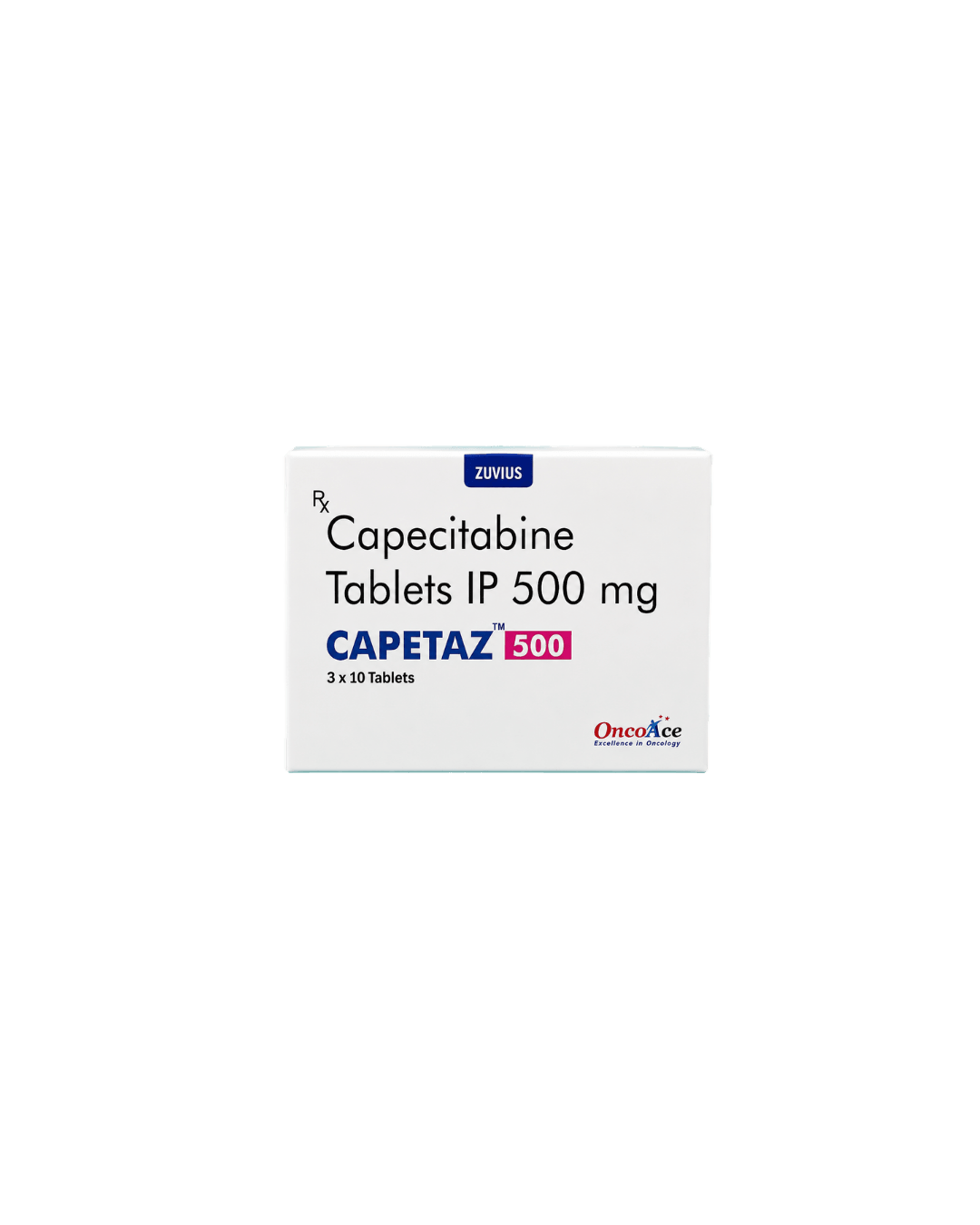
Capetaz
Capecitabine Tablets

Strength
✓500 mg

Pack Size
1 x 10

Drug Class
Cytostatic (antimetabolite)

Specification
USP/BP/IH Specs offered for exports

Storage
Store at 25°C to 30°C.
CAPETAZ 500 tablets containing Capecitabine 500 mg are peach colored capsule shaped film coated tablets.
Capecitabine is a fluoropyrimidine carbamate with antineoplastic activity.
It is an orally administered systemic prodrug of 5’-deoxy-5-fluorouridine (5’-DFUR) which is converted to 5-fluorouracil.
The chemical name for Capecitabine is 5’-deoxy-5-fluoro-N-[(pentyloxy) carbonyl]-cytidine and has a molecular weight of 359.35.
Capecitabine is indicated for the treatment of patients with metastatic breast cancer resistant to both paclitaxel and an anthracycline-containing chemotherapy regimen or resistant to paclitaxel and for whom further anthracycline therapy is not indicated.
- For the adjuvant treatment of patients following surgery of stage III (Dukes’ stage C) colon cancer.
- For the treatment of metastatic colorectal cancer.
- For first-line treatment of advanced gastric cancer in combination with a platinum based regimen.
- In combination with docetaxel for the treatment of patients with locally advanced or metastatic breast cancer after failure of cytotoxic chemotherapy.
Previous therapy should have included an anthracycline.
Enzymes convert capecitabine to 5-fluorouracil (5-FU) in vivo.
Both normal and tumor cells metabolize 5-FU to 5-fluoro-2′-deoxyuridine monophosphate (FdUMP) and 5-fluorouridine triphosphate (FUTP).
These metabolites cause cell injury by two different mechanisms.
First, FdUMP and the folate cofactor, N5-10-methylenetetrahydrofolate, bind to thymidylate synthase (TS) to form a covalently bound ternary complex.
This binding inhibits the formation of thymidylate from 2′-deoxyuridylate.
Thymidylate is the necessary precursor of thymidine triphosphate, which is essential for the synthesis of DNA, so that a deficiency of this compound can inhibit cell division.
Second, nuclear transcriptional enzymes can mistakenly incorporate FUTP in place of uridine triphosphate (UTP) during the synthesis of RNA.
This metabolic error can interfere with RNA processing and protein synthesis.
In repeat-dose toxicity studies, daily oral administration of capecitabine to cynomolgus monkeys and mice produced toxic effects on the gastrointestinal, lymphoid and haemopoietic systems, typical for fluoropyrimidines.
These toxicities were reversible.
Skin toxicity, characterised by degenerative/regressive changes, was observed with capecitabine.
Capecitabine was devoid of hepatic and CNS toxicities.
Cardiovascular toxicity (e.g. PR- and QT-interval prolongation) was detectable in cynomolgus monkeys after intravenous administration (100 mg/kg) but not after repeated oral dosing (1379 mg/m²/day).
A two-year mouse carcinogenicity study produced no evidence of carcinogenicity by capecitabine.
During standard fertility studies, impairment of fertility was observed in female mice receiving capecitabine; however, this effect was reversible after a drug-free period.
In addition, during a 13-week study, atrophic and degenerative changes occurred in the reproductive organs of male mice; however, these effects were reversible after a drug-free period.
In embryotoxicity and teratogenicity studies in mice, dose-related increases in foetal resorption and teratogenicity were observed.
In monkeys, abortion and embryolethality were observed at high doses, but there was no evidence of teratogenicity.
Capecitabine was not mutagenic in vitro to bacteria (Ames test) or mammalian cells (Chinese hamster V79/HPRT gene mutation assay).
However, similar to other nucleoside analogues (i.e. 5-FU), capecitabine was clastogenic in human lymphocytes (in vitro) and a positive trend occurred in mouse bone marrow micronucleus tests (in vivo).
The recommended dose of Capecitabine is 2500 mg/m² administered orally daily with food for 2 weeks followed by a 1 week rest period given as 3 week cycles.
The Capecitabine daily dose should be given orally in two divided doses (approximately 12 hours apart) at the end of a meal.
Capecitabine tablets should be swallowed with water.
Capecitabine Dose Calculation According to Body Surface Area
Dose level 225 mg/m²/day
Surface Area (m²) | Total Daily Dose (mg) | 150 mg Tablets | 500 mg Tablets
≤ 1.24 | 3000 | 0 | 3
1.25 - 1.36 | 3300 | 1 | 3
1.37 - 1.51 | 3600 | 2 | 3
1.52 - 1.64 | 4000 | 0 | 4
1.65 - 1.76 | 4300 | 1 | 4
1.77 - 1.91 | 4600 | 2 | 4
1.92 - 2.04 | 5000 | 0 | 5
2.05 - 2.17 | 5300 | 1 | 5
≥ 2.18 | 5600 | 2 | 5
*Total daily dose divided by 2 to allow equal morning and evening doses.
Dose Modification Guidelines
Patients should be carefully monitored for toxicity.
Toxicity due to Capecitabine administration may be managed by symptomatic treatment, dose interruptions and adjustment of Capecitabine dose.
Once dose has been reduced it should not be increased at a later time.
Recommended Dose Modifications
Grade 1
- Maintain dose level
- Maintain dose level for next cycle
Grade 2
- 1st appearance – Interrupt until resolved to grade 0-1 → 100%
- 2nd appearance – Interrupt until resolved to grade 0-1 → 75%
- 3rd appearance – Interrupt until resolved to grade 0-1 → 50%
- 4th appearance – Discontinue treatment permanently
Grade 3
- 1st appearance – Interrupt until resolved to grade 0-1 → 75%
- 2nd appearance – Interrupt until resolved to grade 0-1 → 50%
- 3rd appearance – Discontinue treatment permanently
Grade 4
- 1st appearance – Discontinue permanently or if physician deems it to be in the patient’s best interest to continue, interrupt until resolved to grade 0-1 → 50%
Adjustment of Starting Dose In Special Populations
Hepatic Impairment
In patient with mild to moderate hepatic dysfunction due to liver metastases, no starting dose adjustment is necessary however, patients should be carefully monitored.
Patients with severe hepatic dysfunction have not been studied.
Renal Impairment
Insufficient data are available in patients with renal impairment to provide a dosage recommendation.
Geriatric Population
The elderly may be pharmacodynamically more sensitive to the toxic effects of 5-FU and therefore physicians should exercise caution in monitoring the effects of Capecitabine in the elderly.
Insufficient data are available to provide a dosage recommendation.