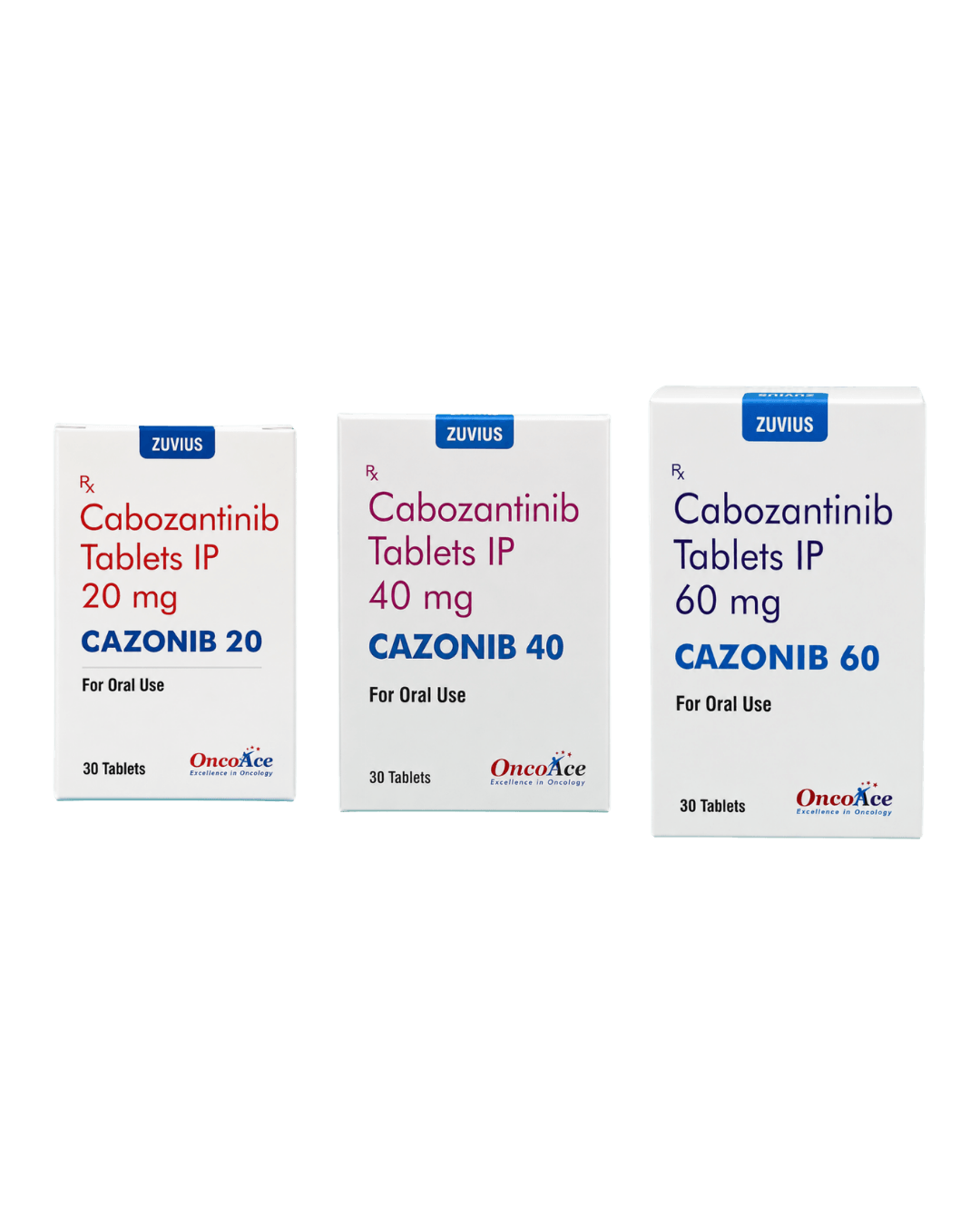
Cazonib
Cabozantinib Tablets

Strength
✓20 mg✓40 mg✓60 mg

Pack Size
1 x 30

Drug Class
Tyrosine Kinase Inhibitors

Specification
USP/BP/IH Specs offered for exports

Storage
Store at 25°C to 30°C.
Cabozantinib Tab is the (S)-malate salt of cabozantinib, a kinase inhibitor.
Cabozantinib (S)-malate is described chemically as
N-(4-(6,7-dimethoxyquinolin-4-yloxy)phenyl)-N’-(4fluorophenyl) cyclopropane-1,1-dicarboxamide, (2S)-hydroxybutanedioate.
The molecular formula is
C28H24FN3O5·C4H6O5
and the molecular weight is 635.6 Daltons as malate salt.
Cabozantinib (S)-malate salt is a white to off-white solid that is practically insoluble in aqueous media.
Cabozantinib tablets for oral use are supplied as film-coated tablets containing 20 mg, 40 mg, or 60 mg of cabozantinib, which is equivalent to 25 mg, 51 mg, or 76 mg of cabozantinib (S)-malate, respectively.
Renal Cell Carcinoma
Cabozantinib is indicated for the treatment of patients with advanced renal cell carcinoma (RCC).
Cabozantinib, in combination with nivolumab, is indicated for the first-line treatment of patients with advanced RCC.
Hepatocellular Carcinoma
Cabozantinib is indicated for the treatment of patients with hepatocellular carcinoma (HCC) who have been previously treated with sorafenib.
Differentiated Thyroid Cancer
Cabozantinib is indicated for the treatment of adult and pediatric patients 12 years of age and older with locally advanced or metastatic differentiated thyroid cancer (DTC) that has progressed following prior VEGFR-targeted therapy and who are radioactive iodine-refractory or ineligible.
As a single agent in 409 patients with RCC enrolled in randomized, active-controlled trials (CABOSUN, METEOR), 467 patients with HCC enrolled in a randomized, placebo-controlled trial (CELESTIAL), and 125 patients with DTC enrolled in a randomized, placebo-controlled trial (COSMIC-311), and in combination with nivolumab 240 mg/m² every 2 weeks in 320 patients with RCC enrolled in a randomized, active-controlled trial (CHECKMATE-9ER).
Because clinical trials are conducted under widely varying conditions, adverse reaction rates observed in the clinical trials of a drug cannot be directly compared to rates in the clinical trials of another drug and may not reflect the rates observed in practice.
Instruct patients to contact their healthcare provider to seek immediate medical attention for signs or symptoms of unusual severe bleeding or haemorrhage.
Advise patients that gastrointestinal disorders such as diarrhea, nausea, vomiting, and constipation may develop during Cabozantinib treatment and to seek immediate medical attention if they experience persistent or severe abdominal pain because cases of gastrointestinal perforation and fistula have been reported in patients taking Cabozantinib.
Advise females of reproductive potential of the potential risk to a fetus.
Advise females to inform their healthcare provider of a known or suspected pregnancy.
Advise women not to breastfeed during treatment with Cabozantinib and for 4 months following the last dose.
Advise patients to contact their healthcare provider for signs or symptoms of proteinuria.
Stop treatment with Cabozantinib at least 3 weeks prior to scheduled surgery, including dental surgery.
Do not substitute Cabozantinib tablets with cabozantinib capsules.
Swallow Cabozantinib tablets whole.
Do not crush CABOMETYX tablets.
Do not take a missed dose within 12 hours of the next dose.
Modify the Cabozantinib dose for patients taking drugs known to strongly induce or inhibit CYP3A4 and for patients with moderate hepatic impairment.