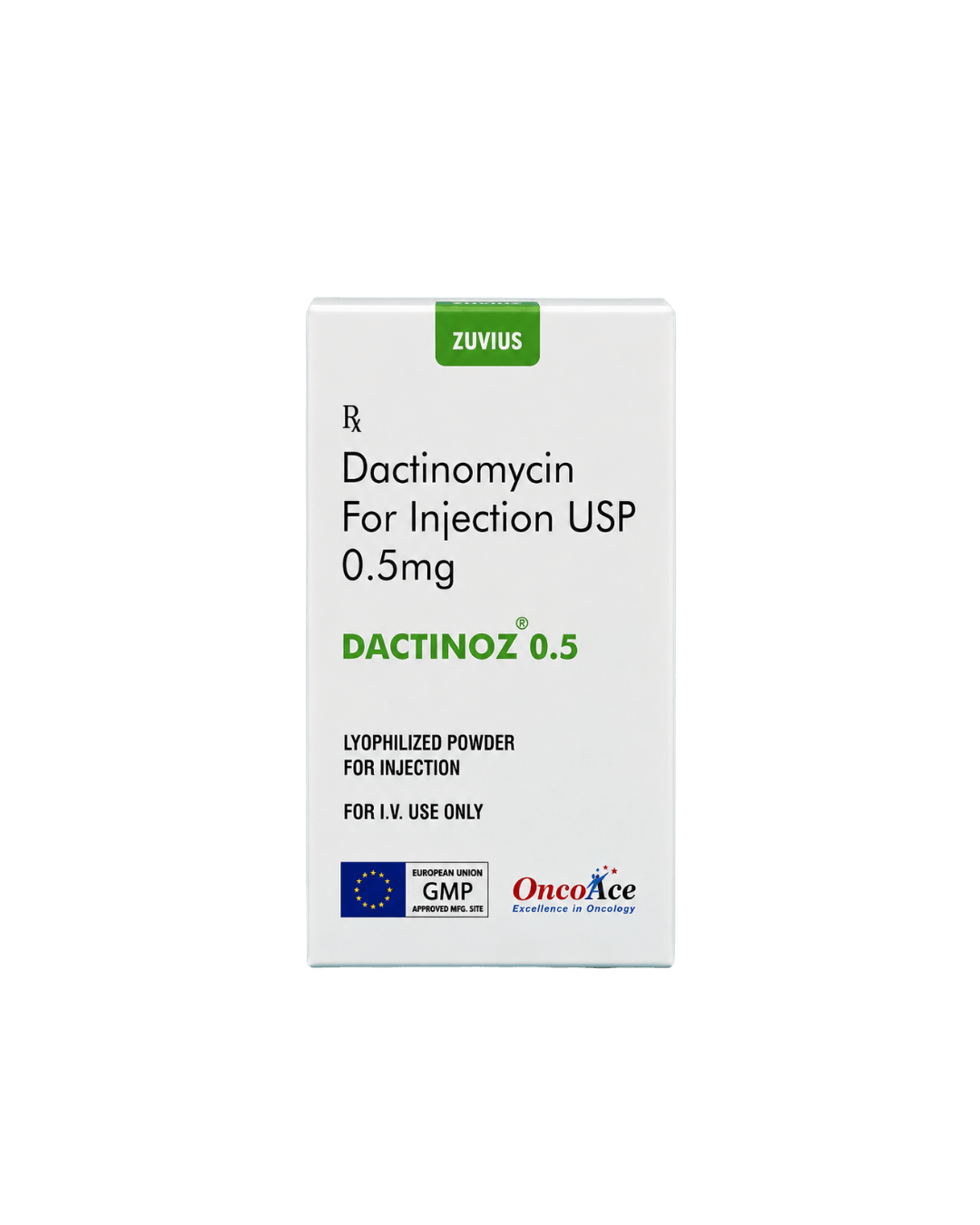
Dactinoz
Dactinomycin Injection

Strength
✓0.5 mg

Pack Size
1 Vial

Drug Class
Cytotoxic Agents

Specification
USP/BP/IH Specs offered for exports

Storage
Store at 25°C to 30°C.
Dactinomycin is one of the actinomycins, a group of antibiotics produced by various species of Streptomyces.
Dactinomycin is the principal component of the mixture of actinomycins produced by Streptomyces parvullus.
The empirical formula is C62H86N12O16.
Dactinomycin for Injection 0.5 mg is a yellow to orange colored lyophilized cake or discontinuous powder, aggregates of free flowing powder in 3 ml vials.
Dactinomycin for Injection, as part of a combination chemotherapy and/or multi-modality treatment regimen, is indicated for the treatment of:
- Wilms’ tumor
- Childhood rhabdomyosarcoma
- Ewing’s sarcoma
- Metastatic, nonseminomatous testicular cancer
Dactinomycin is indicated as a single agent, or as part of a combination chemotherapy regimen for the treatment of:
- Gestational trophoblastic neoplasia
Dactinomycin, as a component of regional perfusion, is indicated for the palliative and/or adjunctive treatment of:
- Locally recurrent solid malignancies
- Locoregional solid malignancies
Mechanism Of Action
COSMEGEN is a cytotoxic actinomycin that binds DNA and inhibits RNA synthesis.
The cytotoxic activity of dactinomycin has been demonstrated in animal models of different human cancers.
Pharmacodynamics
Dactinomycin exposure-response relationships and the time course of pharmacodynamic response are unknown.
General
Veno-occlusive disease (primarily hepatic) may result in a fatality, particularly in children younger than 48 months.
Carcinogenesis, Mutagenesis, Impairment Of Fertility
Dactinomycin has been shown to be mutagenic in a number of test systems in vitro and in vivo including:
- Human fibroblasts
- Human leukocytes
- HeLa cells
DNA damage and cytogenetic effects have been demonstrated in the mouse and the rat.
Adequate fertility studies have not been reported, although reports suggest an increased incidence of infertility following treatment with other antineoplastic agents.
Nursing Mothers
It is not known whether this drug is excreted in human milk.
Because many drugs are excreted in human milk and because of the potential for serious adverse reactions in nursing infants from Dactinomycin, a decision should be made to discontinue nursing and/or the drug, taking into account the importance of the drug to the mother.
The greater frequency of toxic effects of Dactinomycin in infants suggests that this drug should be administered to infants only over the age of 6 to 12 months.
Geriatric Use
Clinical studies of Dactinomycin did not include sufficient numbers of subjects aged 65 and over to determine whether they respond differently from younger subjects.
Other reported clinical experience has not identified differences in responses between the elderly and younger patients.
The dosage of Dactinomycin for Injection varies depending on the tolerance of the patient, the size and location of the neoplasm, and the use of other forms of therapy.
It may be necessary to decrease the usual dosages suggested below when additional chemotherapy or radiation therapy is used concomitantly or has been used previously.
The dosage for Dactinomycin is calculated in micrograms (mcg).
The dose intensity per 2-week cycle for adults or children should not exceed:
- 15 mcg/kg/day
or
- 400-600 mcg intravenously for five days
Calculation of the dosage for obese or edematous patients should be performed on the basis of surface area in an effort to more closely relate dosage to lean body mass.
A wide variety of single-agent and combination chemotherapy regimens with Dactinomycin may be employed.
Because chemotherapeutic regimens are constantly changing, dosing and administration should be performed under the direct supervision of physicians familiar with current oncologic practices and new advances in therapy.
The suggested regimens are based upon a review of current literature concerning therapy with Dactinomycin and are on a per-cycle basis.