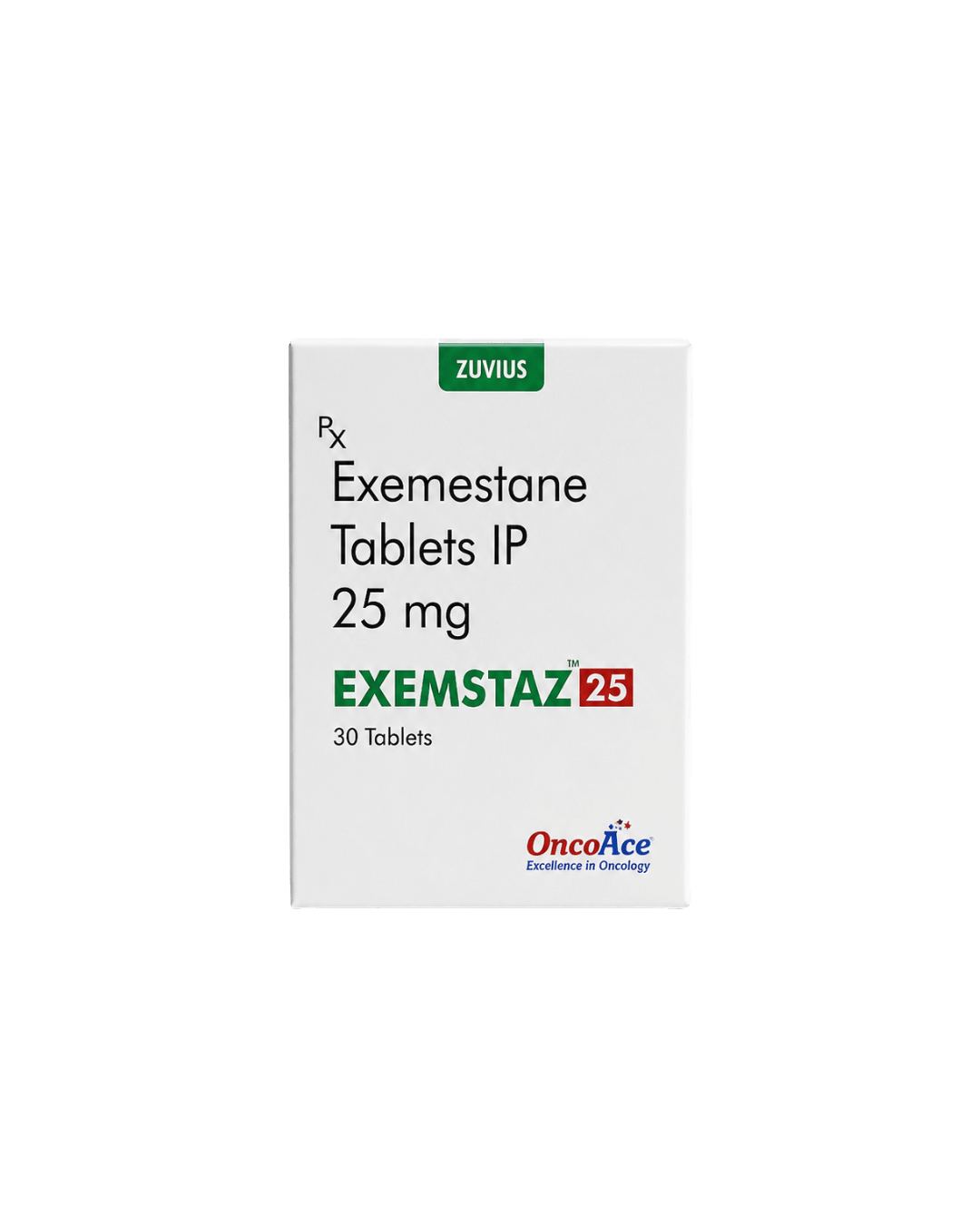
Exemestaz
Exemestane Tablets

Strength
✓25 mg

Pack Size
1 x 30

Drug Class
Antineoplastics, Aromatase Inhibitors

Specification
USP/BP/IH Specs offered for exports

Storage
Store at 25°C to 30°C.
Tablets for oral administration contain 25 mg of exemestane, an irreversible, steroidal aromatase inactivator.
Exemestane is chemically described as 6-methylenandrosta-1,4-diene-3,17-dione.
Its molecular formula is C₂₀H₂₄O.
The active ingredient is a white to slightly yellow crystalline powder with a molecular weight of 296.41.
Exemestane is freely soluble in N,N-dimethylformamide, soluble in methanol, and practically insoluble in water.
Each Tablet contains the following inactive ingredients
- Mannitol
- Crospovidone
- Polysorbate 80
- Hypromellose
- Colloidal silicon dioxide
- Microcrystalline cellulose
- Sodium starch glycolate
- Magnesium stearate
- Simethicone
- Polyethylene glycol 6000
- Sucrose
- Magnesium carbonate
- Titanium dioxide
- Methylparaben
- Polyvinyl alcohol
Adjuvant Treatment of Early Breast Cancer in Postmenopausal Women
Exemestane is indicated for the adjuvant treatment of postmenopausal women with oestrogen receptor-positive early breast cancer who have received two to three years of tamoxifen therapy and are switched to Exemestane for completion of a total of five consecutive years of adjuvant hormonal therapy.
Advanced Breast Cancer in Postmenopausal Women
Exemestane is indicated for the treatment of advanced breast cancer in postmenopausal women whose disease has progressed following anti-estrogen therapy, including tamoxifen.
Usage
Exemestane is used to treat early and advanced breast cancer in women who have already stopped menstruating (postmenopausal).
It is usually used in women who have already received a cancer medication called tamoxifen.
Many breast cancer tumors grow in response to estrogen.
Exemestane is also sometimes used to treat a certain type of breast cancer in women who have not yet experienced menopause.
Talk to your doctor about the risks of using this medication for your condition.
Aromatase inhibitors and inactivators are playing an increasing greater role in breast cancer treatment.
Exemestane, a highly specific, steroidal aromatase inactivator, is the newest agent in this class.
The drug is highly specific, and inhibits the in vivo conversion of androstenedione to oestrone (aromatization) by a mean of 97.9%.
Exemestane has shown good efficacy and tolerability in multiple clinical trials among patients with metastatic breast cancer who have failed one or more previous hormonal therapies.
Exemestane 25 mg/day slows disease progression and reduces tumour-related signs and symptoms and the drug exhibits a partial lack of cross-resistance with the non-steroidal aromatase inhibitors.
Response rates to exemestane of 14% to 29% were observed, including patients with visceral metastases, who have historically proved difficult to treat.
In a large phase III trial, exemestane was found to be superior to megestrol acetate with respect to time to progression and overall survival.
In addition, exemestane is currently under investigation as first-line therapy in metastatic disease and in sequence with tamoxifen in the adjuvant setting.
Adverse events include low-grade hot flashes, nausea, and fatigue—mostly of mild to moderate intensity—and treatment-related discontinuations are rare.
In conclusion, exemestane represents a novel and interesting drug for the treatment of advanced breast cancer, with exciting prospects for use in adjuvant therapy and, potentially, breast cancer prevention.
- Read the label carefully before use.
- Keep out of the reach of children.
Recommended Dose
The recommended dose of Exemestaz in early and advanced breast cancer is one 25 mg tablet once daily after a meal.
- Adjuvant treatment of postmenopausal women with oestrogen-receptor-positive early breast cancer who have received two to three years of tamoxifen and are switched to AROMASIN for completion of a total of five consecutive years of adjuvant hormonal therapy.
- The treatment of advanced breast cancer in postmenopausal women whose disease has progressed following tamoxifen therapy.
Dose Modifications
Concomitant use of strong CYP 3A4 inducers decreases exemestane exposure.
For patients receiving AROMASIN with a strong CYP 3A4 inducer such as rifampicin or phenytoin, the recommended dose of AROMASIN is 50 mg once daily after a meal.