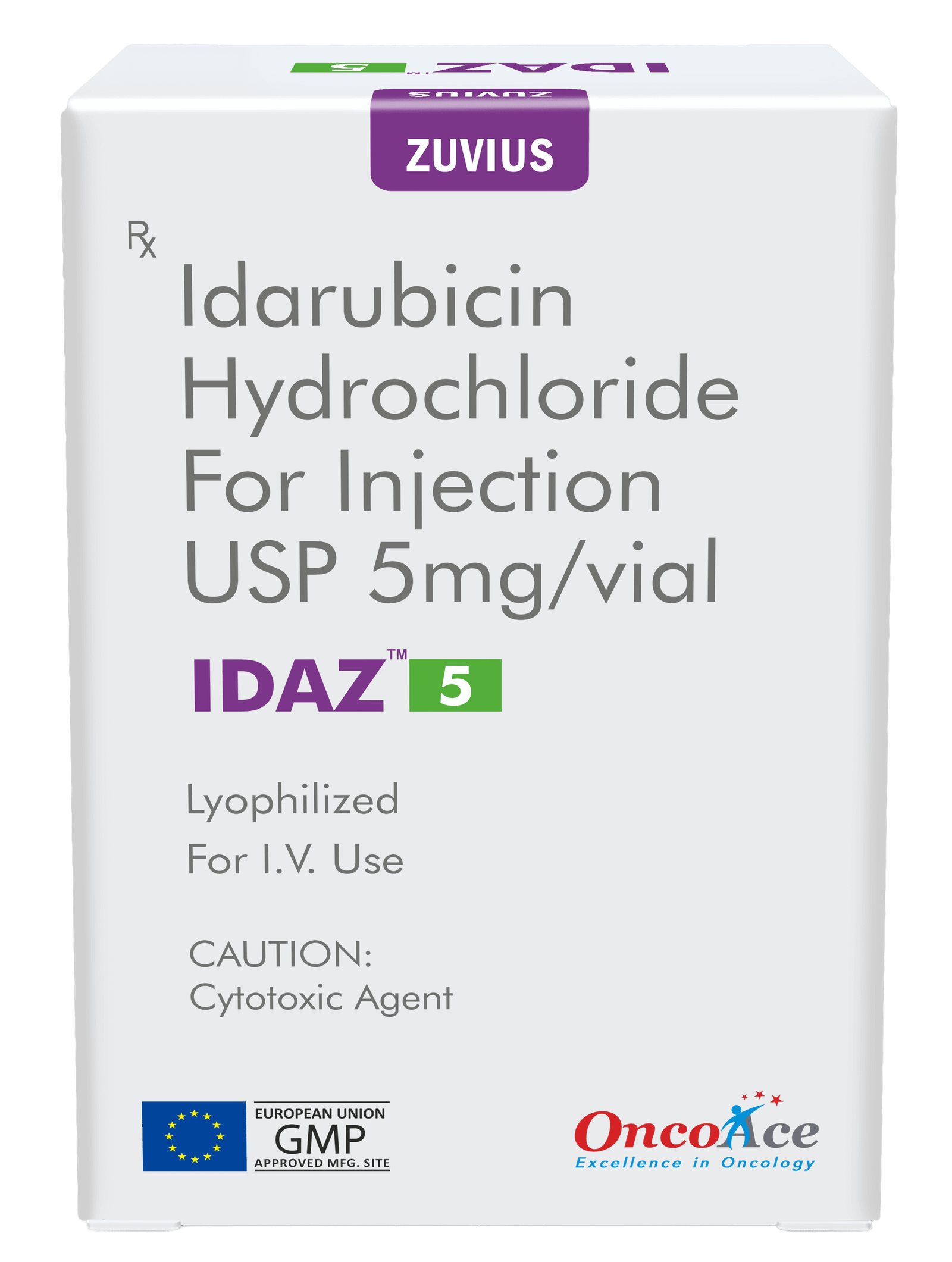
Idaz
Idarubicin Hydrochloride Injection

Strength
✓5 mg✓10 mg✓20 mg

Pack Size
Vial

Drug Class
Anthracycline Antineoplastic Agent

Specification
USP/BP/IH Specs offered for exports

Storage
Store at 25°C to 30°C.
An orally administered anthracycline antineoplastic.
The compound has shown activity against breast cancer, lymphomas, and leukemias together with the potential for reduced cardiac toxicity.
Idarubicin Hydrochloride Injection in combination with other approved antileukemic drugs is indicated for treatment of acute myeloid leukemia (AML) in adults.
This includes French-American-British (FAB) classifications M1 through M7.
Four prospective randomized studies compared the efficacy and safety of idarubicin (IDR) versus daunorubicin (DNR) combined with cytarabine as induction therapy in previously untreated adult AML patients.
Results showed significantly higher complete remission rates for IDR in two of the three U.S. studies and longer overall survival in two U.S. studies.
MSKCC Study
- 78% remission for IDR vs. 58% for DNR
- Median survival: 508 vs. 435 days (p < 0.05)
SEG Study
- 69% vs. 55% remission
- Survival: 328 vs. 277 days
U.S. Multicenter Study
- 67% vs. 58% remission
- Survival: 393 vs. 281 days (p < 0.05)
Italian GIMEMA Study
- Similar remission rates:
- 40% IDR
- 39% DNR
- Lower survival for IDR:
- 87 vs. 169 days
IDR showed higher mucositis and longer aplasia duration during consolidation with higher transfusion needs in two studies.
The studies suggest IDR's potential advantage in remission and survival but note increased toxicity and no proven benefit from intensive maintenance therapy.
Pregnancy
Idarubicin HCl can cause fetal harm when administered during pregnancy.
Women of childbearing potential should avoid becoming pregnant during treatment.
Breastfeeding
Idarubicin HCl is excreted in human milk.
Breastfeeding should be discontinued during treatment due to potential serious adverse reactions in nursing infants.
Fertility
Idarubicin HCl may cause suppression of ovarian function in women leading to amenorrhea.
In men, treatment may cause azoospermia.
Teratogenicity
Idarubicin HCl is potentially teratogenic and can cause fetal harm if used during pregnancy.
Effective contraception is recommended during treatment.
- IDAMYCIN PFS Injection 12 mg/m² daily for 3 days by slow (10 to 15 min) intravenous injection in combination with cytarabine.
- Cytarabine may be given as:
- 100 mg/m² daily by continuous infusion for 7 days
OR
- Cytarabine 25 mg/m² intravenous bolus followed by cytarabine 200 mg/m² daily for 5 days continuous infusion.
- In patients with unequivocal evidence of leukemia after the first induction course, a second course may be administered.
- Administration of the second course should be delayed in patients who experience severe mucositis until recovery has occurred.
- A dose reduction of 25% is recommended in such patients.
- In patients with hepatic and/or renal impairment, dose reduction should be considered.
- IDAMYCIN PFS should not be administered if bilirubin level exceeds 5 mg%.