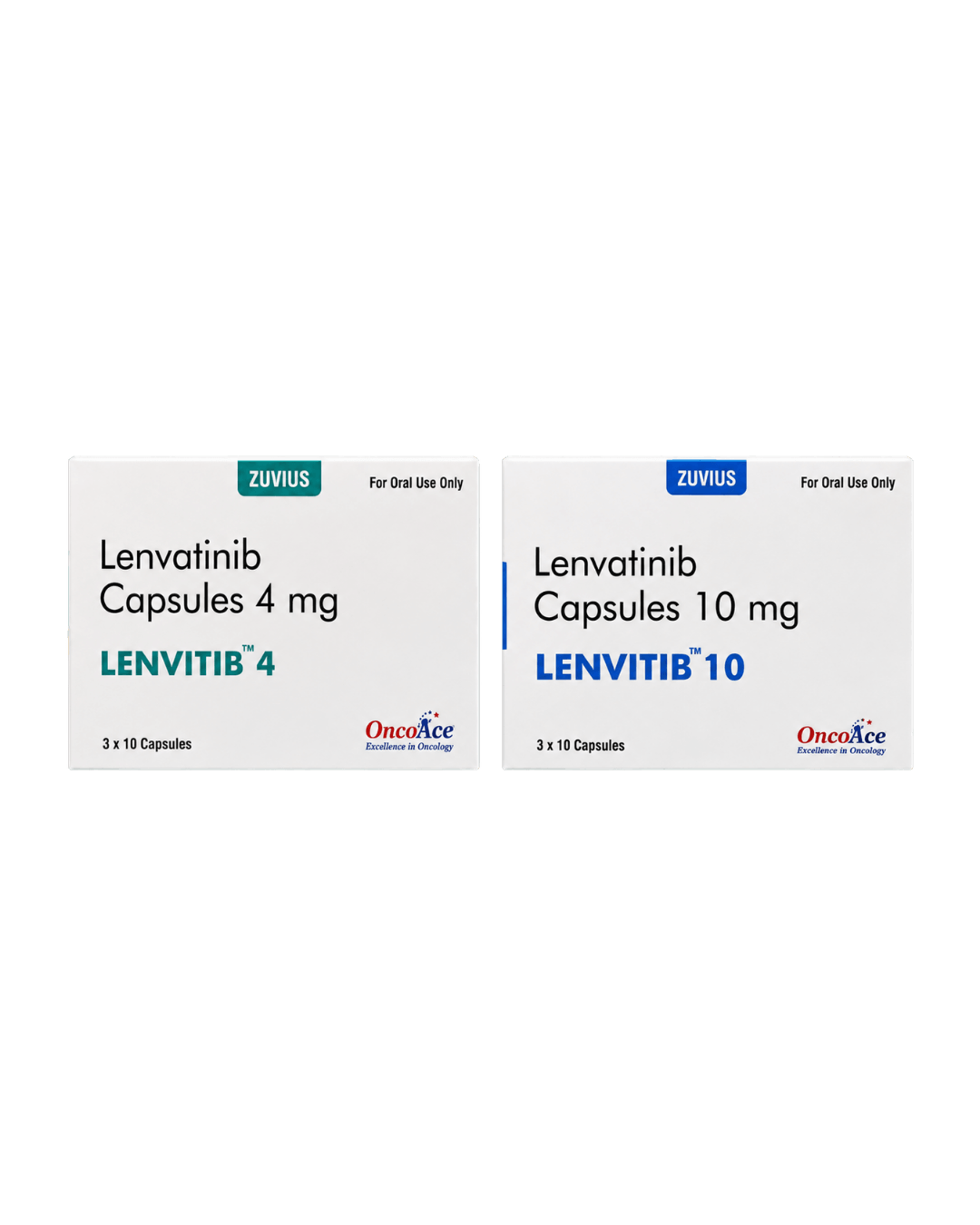
Lenvitib
Lenvatinib Capsules

Strength
✓4 mg✓10 mg

Pack Size
1 x 10

Drug Class
Antineoplastics, VEGF Inhibitor

Specification
USP/BP/IH Specs offered for exports

Storage
Store at 25°C to 30°C.
A kinase inhibitor is the mesylate salt of lenvatinib.
Its chemical name is 4-[3-chloro-4-(N’-cyclopropylureido)phenoxy]-7-methoxyquinoline-6-carboxamide methanesulfonate.
The molecular formula is C₂₁H₁₉ClN₄O₄ • CH₄O₃S, and the molecular weight of the mesylate salt is 522.96.
Lenvatinib mesylate is a white to pale reddish yellow powder.
It is slightly soluble in water and practically insoluble in ethanol (dehydrated).
The dissociation constant (pKa value) of lenvatinib mesylate is 5.05 at 25°C.
The partition coefficient (log P value) is 3.3.
Lenvitib capsules for oral administration contain 4 mg or 10 mg of lenvatinib, equivalent to 4.90 mg or 12.25 mg of lenvatinib mesylate, respectively.
The following are inactive ingredients
- Calcium Carbonate, USP
- Mannitol, USP
- Microcrystalline Cellulose, NF
- Hydroxypropyl Cellulose, NF
- Low-substituted Hydroxypropyl Cellulose, NF
- Talc, USP
The hypromellose capsule shell contains titanium dioxide, ferric oxide yellow, and ferric oxide red.
The printing ink contains shellac, black iron oxide, potassium hydroxide, and propylene glycol.
Differentiated Thyroid Cancer
Lenvatinib is indicated for the treatment of patients with locally recurrent or metastatic, progressive, radioactive iodine-refractory differentiated thyroid cancer (DTC).
Renal Cell Carcinoma
Lenvatinib in combination with pembrolizumab is indicated for the first-line treatment of adult patients with advanced renal cell carcinoma (RCC).
Lenvatinib in combination with everolimus is indicated for the treatment of adult patients with advanced RCC following one prior anti-angiogenic therapy.
Usage
Lenvatinib is used to treat progressive, differentiated thyroid cancer that can no longer be treated with radioactive iodine and has already spread to different parts of the body.
The main efficacy outcome measure was progression-free survival (PFS) as determined by blinded independent radiologic review using Response Evaluation Criteria in Solid Tumours (RECIST).
Secondary efficacy outcome measures included overall response rate and overall survival.
Patients in the placebo arm could opt to receive lenvatinib treatment at the time of confirmed disease progression.
The clinical efficacy and safety of lenvatinib have been evaluated in an international, multicenter, open-label, randomised phase 3 study (REFLECT) in patients with unresectable hepatocellular carcinoma (HCC).
The efficacy of lenvatinib in combination with pembrolizumab was investigated in Study 309, a randomised, multicentre, open-label, active-controlled study conducted in patients with advanced EC who had been previously treated with at least one prior platinum-based chemotherapy regimen in any setting, including in the neoadjuvant and adjuvant settings.
Do not take Lenvatinib if
- You are allergic to Lenvatinib or any of the other ingredients of this medicine.
- You are breast-feeding during treatment with Lenvatinib.
Important Dosage Information
Reduce the dose for certain patients with renal or hepatic impairment.
Take Lenvatinib once daily, with or without food, at the same time each day.
If a dose is missed and cannot be taken within 12 hours, skip that dose and take the next dose at the usual time of administration.
Recommended Dosage For Differentiated Thyroid Cancer (DTC)
The recommended dosage of Lenvatinib is 24 mg orally once daily until disease progression or until unacceptable toxicity.
Recommended Dosage For Renal Cell Carcinoma (RCC)
First-Line Treatment Of Patients With Advanced RCC
The recommended dosage of LENVIMA is 20 mg orally once daily in combination with pembrolizumab 200 mg administered as an intravenous infusion over 30 minutes every 3 weeks until disease progression or until unacceptable toxicity or for up to 2 years.
After completing 2 years of combination therapy, LENVIMA may be administered as a single agent until disease progression or until unacceptable toxicity.
Previously Treated RCC
The recommended dosage of Lenvatinib is 18 mg in combination with 5 mg everolimus orally once daily until disease progression or until unacceptable toxicity.
Refer to the everolimus prescribing information for recommended everolimus dosing information.