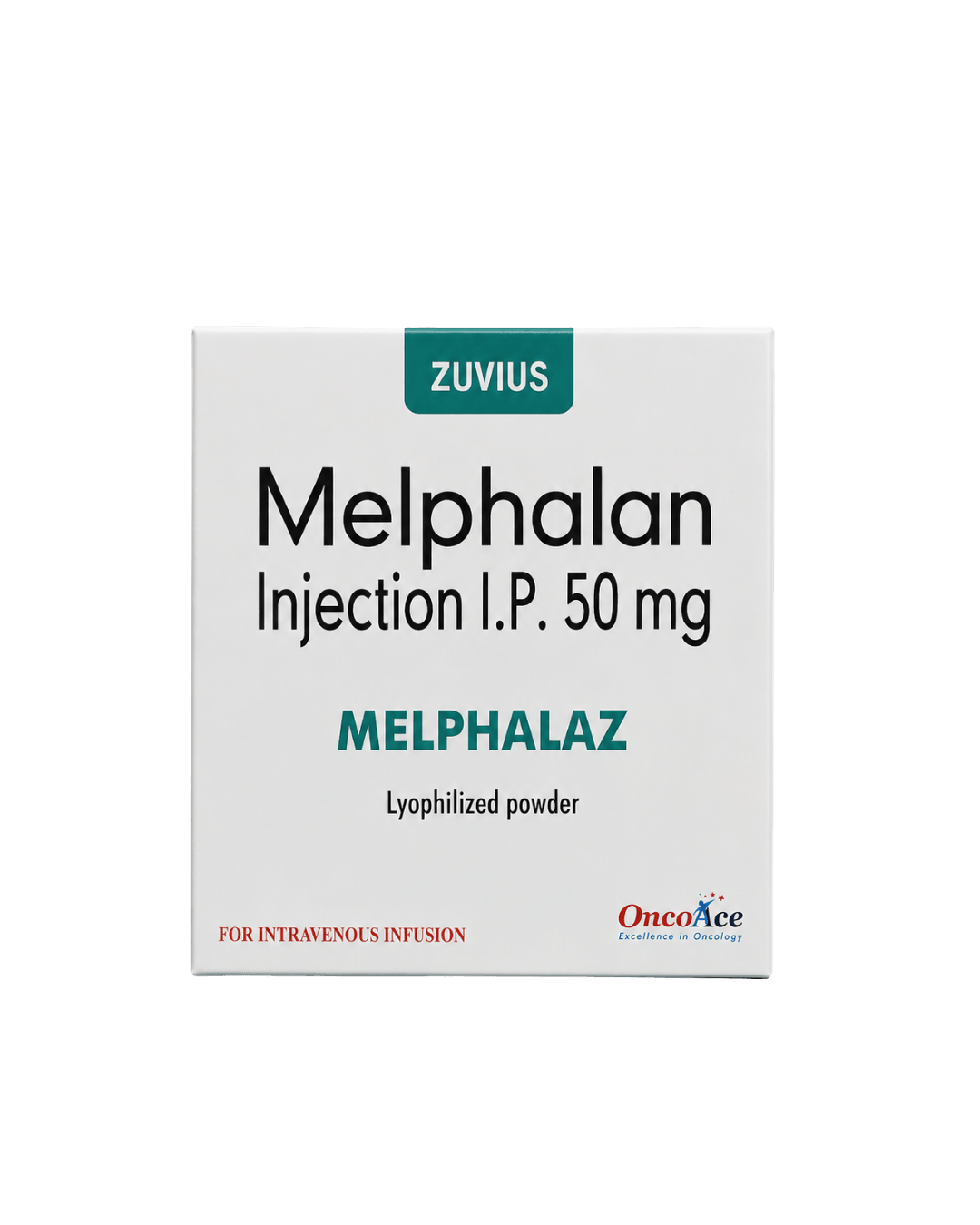
Melphalaz
Melphalan Injection

Strength
✓50 mg

Pack Size
1 Vial

Drug Class
Antineoplastics, Alkylating

Specification
USP/BP/IH Specs offered for exports

Storage
Store at 25°C to 30°C.
Melphalan, also known as L-phenylalanine mustard, phenylalanine mustard, L-PAM, or L-sarcolysin, is a phenylalanine derivative of nitrogen mustard.
Melphalan is a bifunctional alkylating agent that is active against selected human neoplastic diseases.
It is known chemically as 4-[bis(2-chloroethyl)amino]-L-phenylalanine.
The molecular formula is C₁₃H₁₈Cl₂N₂O₂ and the molecular weight is 305.20.
Melphalan is the active L-isomer of the compound and was first synthesised in 1953 by Bergel and Stock.
The D-isomer, known as "medphalan", is less active against certain animal tumors, and the dose needed to produce effects on chromosomes is larger than that required with the L-isomer.
The racemic (DL) form is known as "merphalan" or "sarcolysin".
Melphalan is practically insoluble in water and has a pKa1 of approximately 2.5.
Melphalan hydrochloride for injection is supplied as a sterile, nonpyrogenic, freeze-dried powder.
Melphalan Hydrochloride for Injection is indicated for the palliative treatment of patients with multiple myeloma for whom oral therapy is not appropriate.
High-dose Melphalan followed by autologous stem cell transplantation (ASCT) remains a standard conditioning regimen for patients with multiple myeloma (MM).
Conventional melphalan formulations are associated with limited solubility and stability and require propylene glycol as a co-solvent, which may contribute to metabolic and renal toxicities.
A novel propylene glycol-free melphalan formulation utilizing Captisol® technology demonstrated improved solubility and stability while maintaining bioequivalence to conventional melphalan formulations.
In a Phase IIb, open-label, multicenter study involving 61 patients with multiple myeloma undergoing ASCT, high-dose Melphalan (200 mg/m² administered as two doses of 100 mg/m²) demonstrated effective myeloablation and successful engraftment in all patients.
Median neutrophil and platelet engraftment times were 12 and 13 days, respectively, with treatment-related mortality of 0% at Day 100 post-transplant.
The overall response rate was 100%, including complete response rates of 21% and partial response rates of 79%.
The incidence of severe mucositis and stomatitis was low, with no Grade 4 mucositis reported.
These findings confirm the efficacy and acceptable safety profile of high-dose Melphalan as a conditioning regimen prior to ASCT in patients with multiple myeloma.
Melphalan should be used with extreme caution in patients whose bone marrow reserve may have been compromised by prior irradiation or chemotherapy or whose marrow function is recovering from previous cytotoxic therapy.
Dose reduction should be considered in patients with renal insufficiency receiving IV melphalan.
Administration of live vaccines to immunocompromised patients should be avoided.
The usual IV dose is 16 mg/m².
Dosage reduction of up to 50% should be considered in patients with renal insufficiency (BUN ≥ 30 mg/dL).
The drug is administered as a single infusion over 15 to 20 minutes.
Melphalan is administered at 2-week intervals for 4 doses, then, after adequate recovery from toxicity, at 4-week intervals.
Available evidence suggests about one third to one half of the patients with multiple myeloma show a favorable response to the drug.
Experience with oral melphalan suggests that repeated courses should be given since improvement may continue slowly over many months, and the maximum benefit may be missed if treatment is abandoned prematurely.
Dose adjustment on the basis of blood cell counts at the nadir and day of treatment should be considered.
Administration Precautions
As with other toxic compounds, caution should be exercised in handling and preparing the solution of melphalan hydrochloride.
Skin reactions associated with accidental exposure may occur.
The use of gloves is recommended.
If the solution of melphalan hydrochloride contacts the skin or mucosa, immediately wash the skin or mucosa thoroughly with soap and water.
Procedures for proper handling and disposal of anticancer drugs should be considered.
Several guidelines on this subject have been published.
There is no general agreement that all of the procedures recommended in the guidelines are necessary or appropriate.
Parenteral drug products should be visually inspected for particulate matter and discoloration prior to administration whenever solution and container permit.
If either occurs, do not use this product.
Care should be taken to avoid possible extravasation of melphalan and in cases of poor peripheral venous access, consideration should be given to use of a central venous line.
Preparation for Administration/Stability
1. Melphalan Hydrochloride for Injection must be reconstituted by rapidly injecting 10 mL of the supplied diluent directly into the vial of lyophilized powder using a sterile needle (20-gauge or larger needle diameter) and syringe.
Immediately shake vial vigorously until a clear solution is obtained.
This provides a 5 mg/mL solution of melphalan.
Rapid addition of the diluent followed by immediate vigorous shaking is important for proper dissolution.
2. Immediately dilute the dose to be administered in 0.9% Sodium Chloride Injection, USP, to a concentration not greater than 0.45 mg/mL.
3. Administer the diluted product over a minimum of 15 minutes.
4. Complete administration within 60 minutes of reconstitution.
The time between reconstitution/dilution and administration of Melphalan Hydrochloride for Injection should be kept to a minimum because reconstituted and diluted solutions of Melphalan Hydrochloride for Injection are unstable.
Over as short a time as 30 minutes, a citrate derivative of melphalan has been detected in reconstituted material from the reaction of Melphalan Hydrochloride with Sterile Diluent for Melphalan Hydrochloride for Injection.
Upon further dilution with saline, nearly 1% label strength of melphalan hydrolyzes every 10 minutes.
A precipitate forms if the reconstituted solution is stored at 5°C.
DO NOT REFRIGERATE THE RECONSTITUTED PRODUCT.
Discard unused portion.