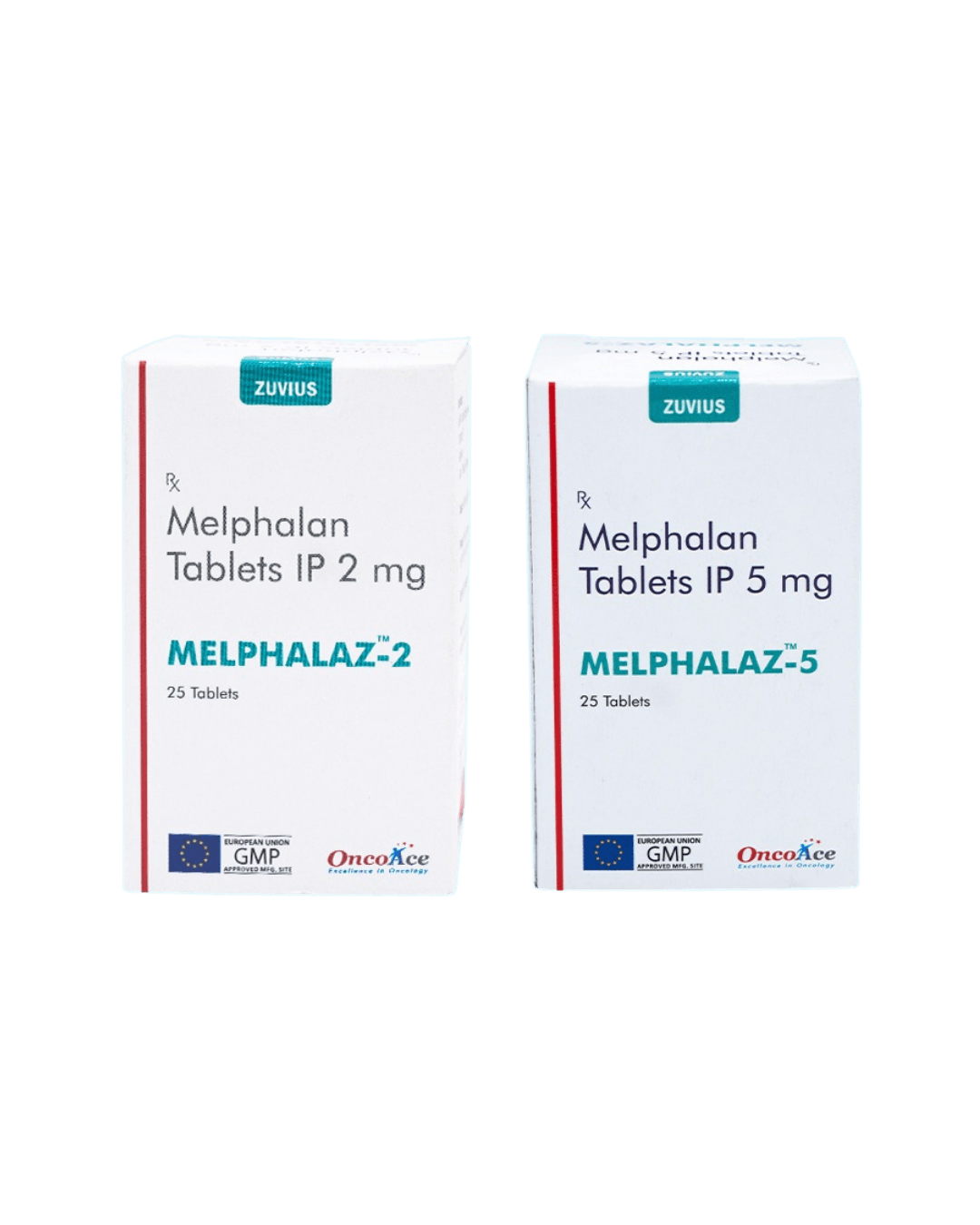
Melphalaz
Melphalan Tablets

Strength
✓2 mg✓5 mg

Pack Size
1 X 25

Drug Class
Alkylating Agent

Specification
USP/BP/IH Specs offered for exports

Storage
Store refrigerated at 2°C to 8°C.
Melphalaz contains Melphalan, a bifunctional alkylating agent used in the treatment of selected malignant diseases.
Melphalan is also known as
- L-phenylalanine mustard
- Phenylalanine mustard
- L-PAM
- L-sarcolysin
It is a phenylalanine derivative of nitrogen mustard.
Melphalan is a white to cream-coloured powder.
It is practically insoluble in water, chloroform and ether, slightly soluble in methanol and soluble in dilute mineral acids.
The chemical name of Melphalan is 4-[bis(2-chloroethyl)amino]-L-phenylalanine.
Its molecular formula is C13H18Cl2N2O2 and its molecular weight is 305.20.
Melphalaz is indicated for the palliative treatment of
- Multiple myeloma
- Advanced ovarian adenocarcinoma
Melphalan may also provide therapeutic benefit in some patients with:
- Advanced breast carcinoma
- Polycythaemia vera
Available clinical evidence suggests that approximately one-third to one-half of patients with multiple myeloma may show a favourable response to oral Melphalan treatment.
The use of Melphalan in combination with prednisone has been reported to improve the proportion of patients with multiple myeloma who achieve symptomatic relief or palliation.
Clinical response may occur gradually over several months.
Repeated treatment courses or continued maintenance therapy may therefore be required to achieve maximum clinical benefit.
In epithelial ovarian cancer, intermittent oral Melphalan treatment has also been used, with subsequent treatment courses determined by haematological recovery and patient tolerance.
General Safety Information
- Keep out of the reach of children.
- Do not exceed the recommended daily dose.
- Melphalan is a potent cytotoxic and myelosuppressive medicine.
- Treatment should only be administered under the supervision of a physician experienced in the use of anticancer medicines.
Bone Marrow Suppression
Severe bone marrow suppression may occur and can result in serious infection or bleeding.
Melphalan should be used with extreme caution in patients whose bone marrow reserve has been reduced by:
- Previous radiation therapy
- Previous chemotherapy
- Recent cytotoxic treatment from which bone marrow function has not fully recovered
Blood Monitoring
The following tests should be performed before treatment and before each subsequent treatment course:
- Platelet count
- Haemoglobin
- White blood cell count
- Differential blood count
Thrombocytopenia or leukopenia may require treatment to be withheld until blood counts recover adequately.
Frequent blood count monitoring is essential to determine the optimal dose and reduce the risk of excessive myelosuppression or irreversible bone marrow aplasia.
Dose adjustment should be considered according to blood counts at their lowest point and on the planned day of treatment.
Renal Impairment
Melphalan clearance may be reduced in patients with renal impairment.
Patients with renal disease may also have uraemic bone marrow suppression.
Dose reduction may therefore be required, and these patients should be monitored closely.
Live Vaccines
Immunisation with live organism vaccines may cause infection in immunocompromised patients.
Live vaccines are therefore not recommended during treatment.
Usual Oral Dose
- The usual oral dose is 6 mg, equivalent to three 2 mg tablets, taken once daily.
- The complete daily dose may be administered at one time.
- The dosage should be adjusted according to blood counts performed approximately once every week.
- After 2 to 3 weeks of treatment, therapy may be stopped for up to 4 weeks while blood counts are monitored carefully.
- Once white blood cell and platelet counts begin to recover, a maintenance dose of 2 mg daily may be started.
Dose Escalation
Because plasma levels of Melphalan may vary between patients following oral administration, the dose may be cautiously increased until a degree of myelosuppression is observed.
This should only be done under close medical supervision to ensure potentially therapeutic drug levels are achieved without excessive toxicity.
Alternative Treatment Regimen
- An initial dose of 10 mg daily may be administered for 7 to 10 days.
- Maximum suppression of white blood cell and platelet counts may occur within 3 to 5 weeks.
- Recovery may occur within approximately 4 to 5 weeks.
- Continuous maintenance treatment with 2 mg daily may be started when the white blood cell count is above 4,000 cells/mcL and platelet count is above 100,000 cells/mcL.
- The maintenance dose may be adjusted between 1 mg and 3 mg daily according to haematological response.
Weight-Based Regimen
- Treatment may begin with 0.15 mg/kg/day for 7 days.
- This is followed by a treatment-free period of at least 14 days, which may extend to 5 or 6 weeks.
- Maintenance therapy may begin when white blood cell and platelet counts start rising.
- The maintenance dose is generally 0.05 mg/kg/day or less and should be adjusted according to blood counts.
Combination with Prednisone for Multiple Myeloma
- One regimen consists of Melphalan 0.25 mg/kg/day for 4 consecutive days.
- Alternatively, 0.20 mg/kg/day may be administered for 5 consecutive days.
- These regimens provide a total dose of approximately 1 mg/kg per treatment course.
- Courses may be repeated every 4 to 6 weeks after granulocyte and platelet counts return to acceptable levels.
Duration of Treatment
Response may develop gradually over several months.
Repeated treatment courses or continuous maintenance therapy may be required because maximum benefit may be missed if treatment is discontinued too early.
Renal Impairment
In patients with moderate to severe renal impairment, a lower initial dose may be considered.
Patients should be monitored closely because Melphalan clearance may be reduced.
Epithelial Ovarian Cancer
- A commonly used regimen is 0.2 mg/kg daily for 5 days as one treatment course.
- Treatment courses may be repeated every 4 to 5 weeks depending on haematological tolerance.