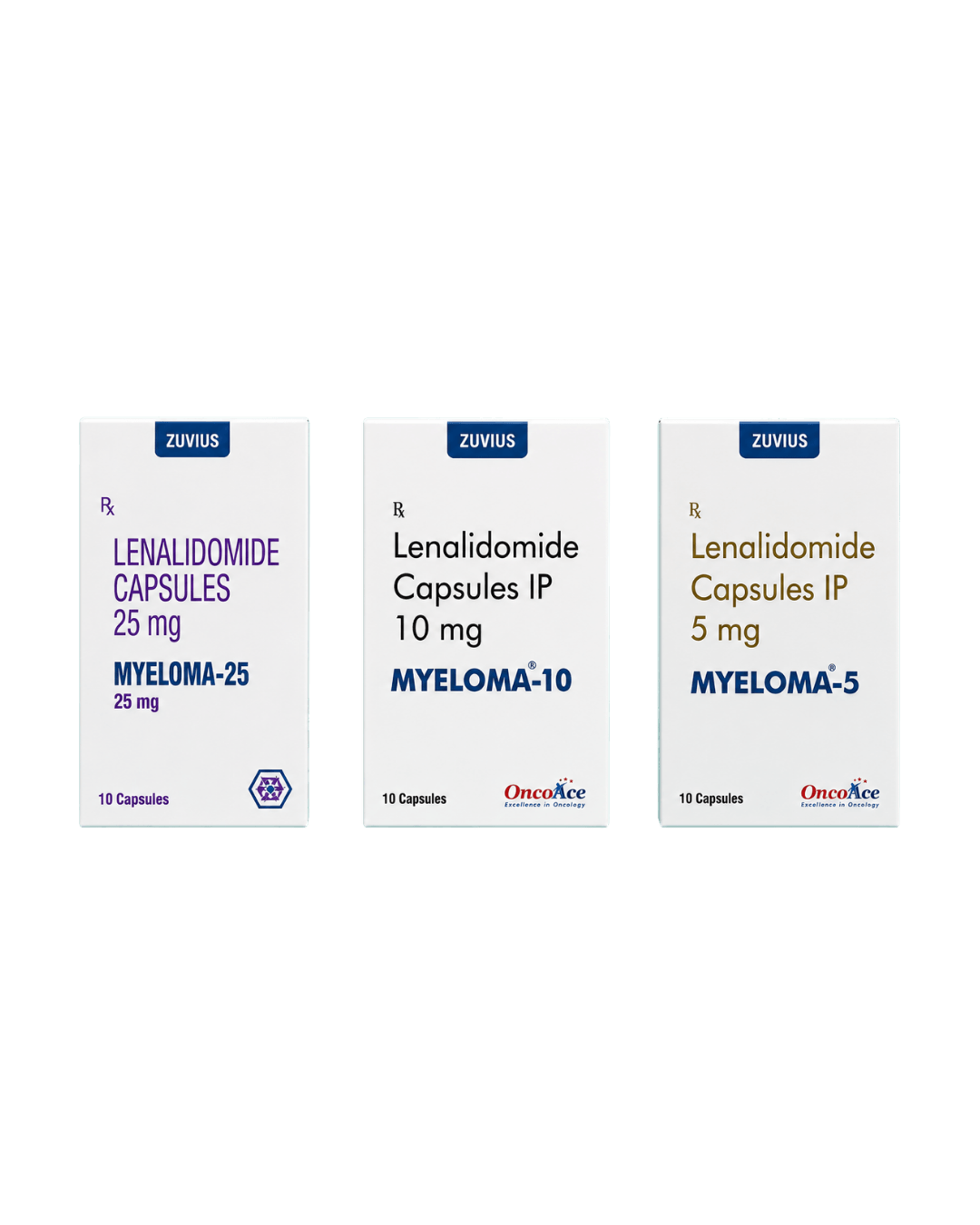
Myeloma
Lenalidomide Capsules

Strength
✓5 mg✓10 mg✓25 mg

Pack Size
1 x 10

Drug Class
Other Immunosuppressants

Specification
USP/BP/IH Specs offered for exports

Storage
Store at 25°C to 30°C.
A thalidomide analogue is an immunomodulatory agent with antiangiogenic and antineoplastic properties.
The chemical name is 3-(4-amino-1-oxo 1,3-dihydro-2H-isoindol-2-yl) piperidine-2,6-dione.
The empirical formula for lenalidomide is C13H13N3O3, and the gram molecular weight is 259.3.
Lenalidomide is an off-white to pale-yellow solid powder.
It is soluble in organic solvent/water mixtures, and buffered aqueous solvents.
Lenalidomide is more soluble in organic solvents and low pH solutions.
Solubility was significantly lower in less acidic buffers, ranging from about 0.4 to 0.5 mg/ml.
Lenalidomide has an asymmetric carbon atom and can exist as the optically active forms S(-) and R(+), and is produced as a racemic mixture with a net optical rotation of zero.
Multiple Myeloma
Lenalidomide in combination with dexamethasone is indicated for the treatment of adult patients with multiple myeloma (MM).
Lenalidomide is indicated as maintenance therapy in adult patients with MM following autologous hematopoietic stem cell transplantation (auto-HSCT).
Myelodysplastic Syndromes
Lenalidomide is indicated for the treatment of adult patients with transfusion-dependent anemia due to low- or intermediate-1-risk myelodysplastic syndromes (MDS) associated with a deletion 5q cytogenetic abnormality with or without additional cytogenetic abnormalities.
Mantle Cell Lymphoma
Lenalidomide is indicated for the treatment of adult patients with mantle cell lymphoma (MCL) whose disease has relapsed or progressed after two prior therapies, one of which included bortezomib.
Follicular Lymphoma
Lenalidomide in combination with a rituximab product is indicated for the treatment of adult patients with previously treated follicular lymphoma (FL).
Marginal Zone Lymphoma
Lenalidomide in combination with a rituximab product is indicated for the treatment of adult patients with previously treated marginal zone lymphoma (MZL).
Usage
Lenalidomide is used to treat various types of cancers.
It works by slowing or stopping the growth of cancer cells.
It is also used to treat anemia in patients with certain blood/bone marrow disorders (myelodysplastic syndromes-MDS).
Lenalidomide may lessen the need for blood transfusions.
The efficacy and safety of Myeloma-10 maintenance was assessed in two phase 3 multicentre, randomised, double-blind 2-arm, parallel group, placebo-controlled studies.
The primary efficacy endpoint in the study was progression free survival (PFS).
In total 523 patients were enrolled into the study, with 263 patients randomised to RVd and 260 patients randomised to Rd.
The demographics and disease-related baseline characteristics of the patients were well balanced between arms.
The safety and efficacy of Myeloma-10 was assessed in a phase 3, multicentre, randomised, open-label, 3-arm study (MM-020).
The primary efficacy endpoint in the study was progression-free survival (PFS).
In total 1623 patients were enrolled into the study, with 535 patients randomised to Rd, 541 patients randomised to Rd18 and 547 patients randomised to MPT.
The demographics and disease-related baseline characteristics of the patients were well balanced in all 3 arms.
In general, study subjects had advanced-stage disease.
Of the total study population
- 41% had ISS stage III
- 9% had severe renal insufficiency (creatinine clearance <30 mL/min)
The median age was 73 years.
The safety and efficacy of Myeloma-10 was assessed in a phase 3 multicentre, randomised double blind 3 arm study (MM-015) of patients who were 65 years or older and had a serum creatinine <2.5 mg/dL.
The primary efficacy endpoint in the study was progression free survival (PFS).
In total 459 patients were enrolled into the study:
- 152 patients randomised to MPR+R
- 153 patients randomised to MPR+p
- 154 patients randomised to MPp+p
- If you are pregnant, think you may be pregnant or are planning to become pregnant, as Myeloma is expected to be harmful to an unborn child.
- If you are able to become pregnant, unless you follow all the necessary measures to prevent pregnancy.
- If you are able to become pregnant, your doctor will record with each prescription that the necessary measures have been taken and provide you with this confirmation.
Recommended Dosage For Multiple Myeloma
Lenalidomide Cap Combination Therapy
The recommended starting dose of Myeloma is 25 mg orally once daily on Days 1-21 of repeated 28-day cycles in combination with dexamethasone.
For patients greater than 75 years old, the starting dose of dexamethasone may be reduced.
Treatment should be continued until disease progression or unacceptable toxicity.
In patients who are not eligible for auto-HSCT, treatment should continue until disease progression or unacceptable toxicity.
For patients who are auto-HSCT-eligible, hematopoietic stem cell mobilization should occur within 4 cycles of a Lenalidomide Cap-containing therapy.
Dose Adjustments for Hematologic Toxicities During MM Treatment
Dose modification guidelines are recommended to manage Grade 3 or 4 neutropenia or thrombocytopenia or other Grade 3 or 4 toxicity judged to be related to the Lenalidomide Cap.
Following auto-HSCT, initiate Lenalidomide Cap maintenance therapy after adequate haematologic recovery (ANC at least 1000/mcL and/or platelet counts at least 75,000/mcL).
The recommended starting dose of Lenalidomide Cap is 10 mg once daily continuously (Days 1-28 of repeated 28-day cycles) until disease progression or unacceptable toxicity.
After 3 cycles of maintenance therapy, the dose can be increased to 15 mg once daily if tolerated.
Recommended Dosage For Myelodysplastic Syndromes
The recommended starting dose is 10 mg daily.
Treatment is continued or modified based upon clinical and laboratory findings.
Continue treatment until disease progression or unacceptable toxicity.
Dose Adjustments For Hematologic Toxicities During MDS Treatment
Patients who are dosed initially at 10 mg and who experience thrombocytopenia should have their dosage adjusted accordingly.
Recommended Dosage For Mantle Cell Lymphoma
The recommended starting dose of Lenalidomide Cap is 25 mg/day orally on Days 1-21 of repeated 28-day cycles for relapsed or refractory mantle cell lymphoma.
Treatment should be continued until disease progression or unacceptable toxicity.
Treatment is continued, modified or discontinued based upon clinical and laboratory findings.
Dosage For Follicular Lymphoma Or Marginal Zone Lymphoma
The recommended starting dose is 20 mg orally once daily on Days 1-21 of repeated 28-day cycles for up to 12 cycles of treatment in combination with a rituximab product.
For dose adjustments due to toxicity with rituximab, refer to the product prescribing information.
Modifications For Non-Hematologic Adverse Reactions
For non-haematologic Grade 3/4 toxicities judged to be related to Lenalidomide, hold treatment and restart at the physician’s discretion at the next lower dose level when toxicity has resolved to Grade 2 or below.