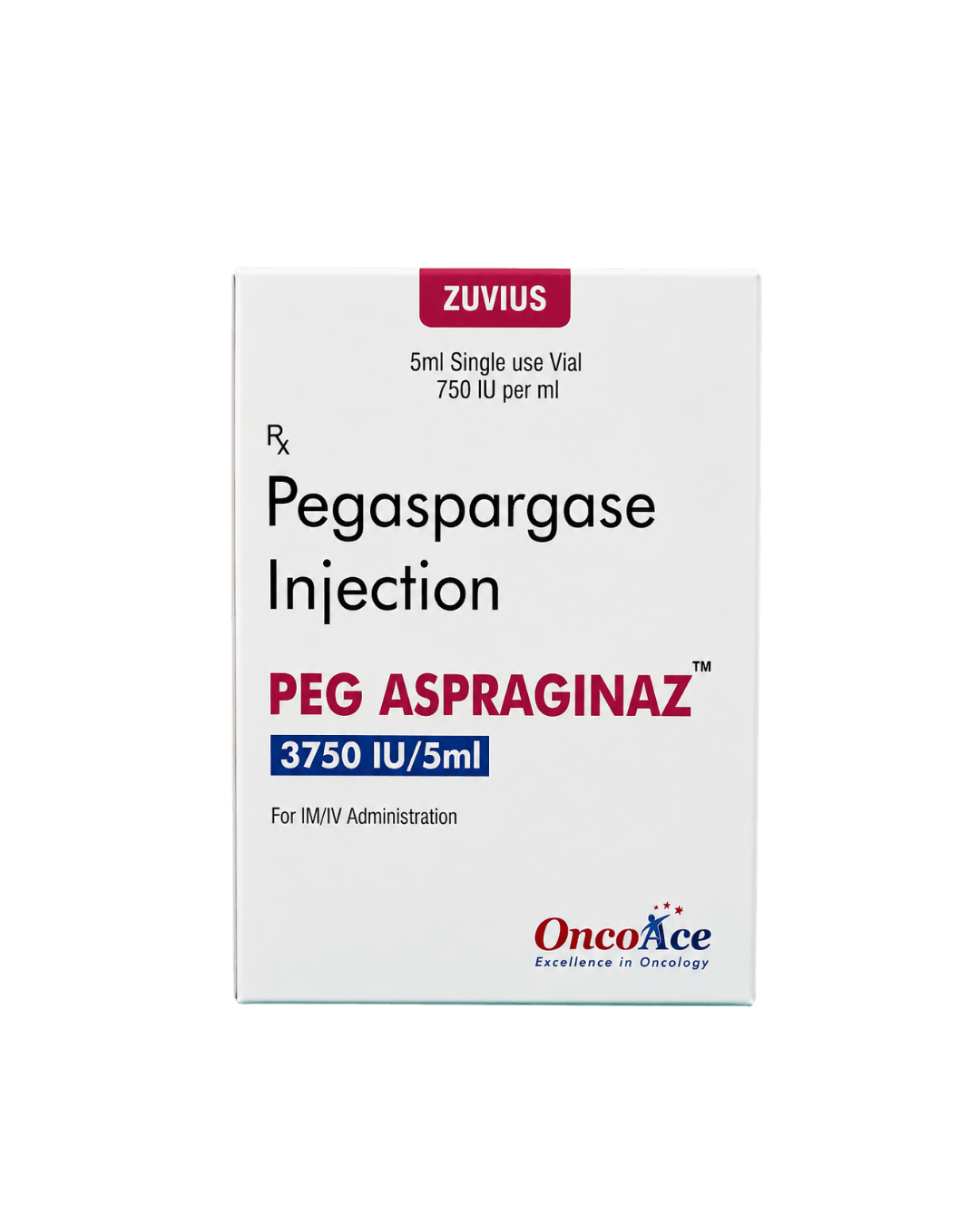
PEG - Aspraginaz
Peg L-Asparaginase Injection

Strength
✓3750 IU

Pack Size
1 Vial

Drug Class
Antineoplastic Agents

Specification
USP/BP/IH Specs offered for exports

Storage
Store refrigerated at 2°C to 8°C.
PEG – Aspraginaz (asparaginase) contains the enzyme L-asparagine amidohydrolase, type EC-2, derived from Escherichia coli.
PEG – Aspraginaz activity is expressed in terms of International Units according to the recommendation of the International Union of Biochemistry.
One International Unit of asparaginase is defined as that amount of enzyme required to generate 1 μmol of ammonia per minute at pH 7.3 and 37°C.
The specific activity of PEG – Aspraginaz is at least 225 International Units per milligram of protein.
PEG – Aspraginaz is indicated as a component of a multi-agent chemotherapeutic regimen for the treatment of patients with acute lymphoblastic leukemia (ALL).
The mechanism of action of PEG – Aspraginaz is thought to be based on selective killing of leukemic cells due to depletion of plasma asparagine.
Some leukemic cells are unable to synthesise asparagine due to a lack of asparagine synthetase and are dependent on an exogenous source of asparagine for survival.
Depletion of asparagine, which results from treatment with the enzyme L-asparaginase, kills the leukemic cells.
Normal cells, however, are less affected by the depletion due to their ability to synthesise asparagine.
- Keep out of reach of children.
- Do not exceed the recommended dose.
The recommended dose of PEG – Aspraginaz is 3750 International Units/m² intramuscularly (IM) or intravenously (IV) three times a week.
When PEG – Aspraginaz is administered IM, the volume at a single injection site should be limited to 2 mL.
If a volume greater than 2 mL is to be administered, two injection sites should be used.
Discard unused portion.