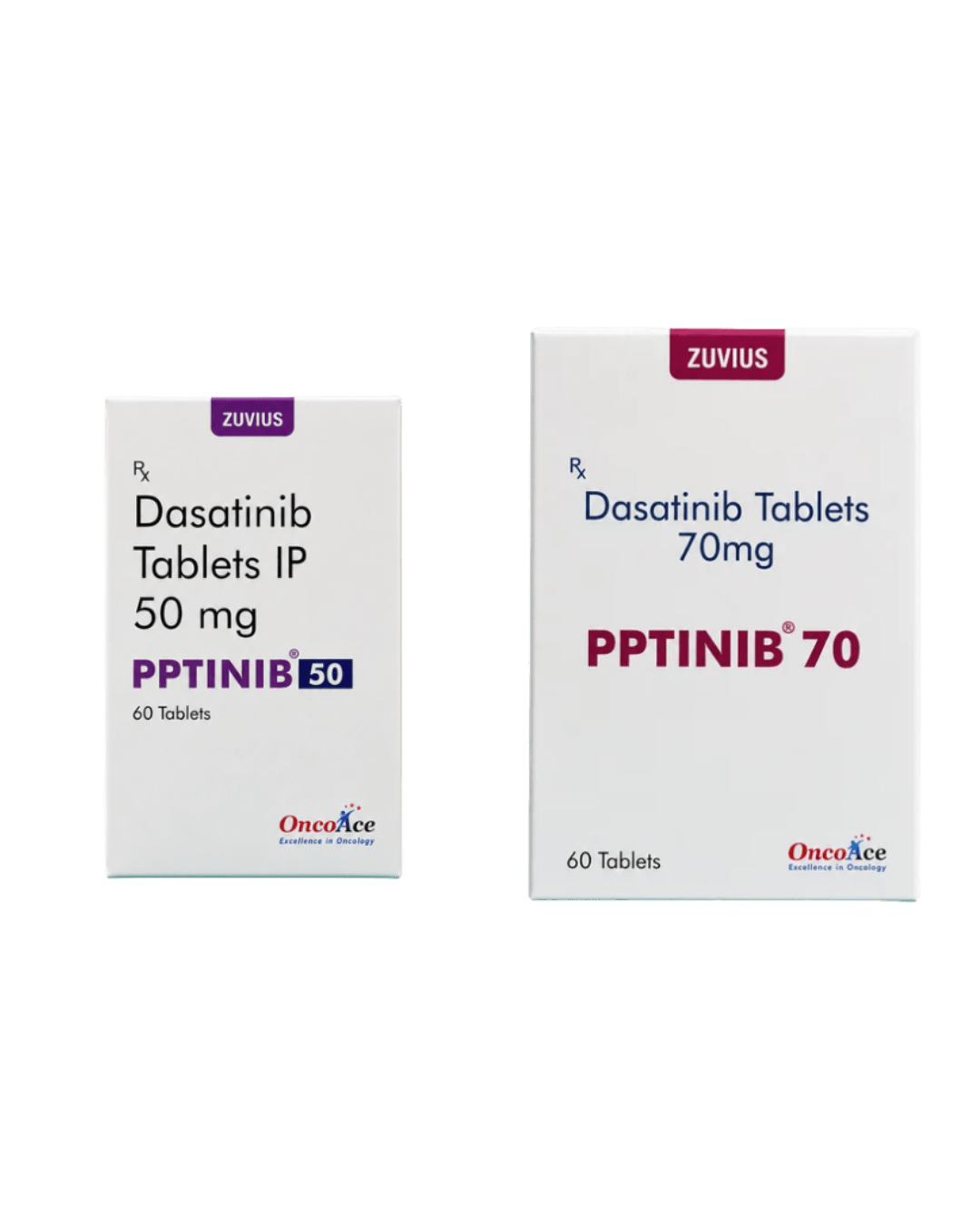
PPTINIB
Dasatinib Tablets

Strength
✓20 mg✓50 mg✓70 mg

Pack Size
1 x 60

Drug Class
Antineoplastic Agents, Protein Kinase Inhibitors

Specification
USP/BP/IH Specs offered for exports

Storage
Store at 25°C to 30°C.
PPTINIB (dasatinib) is a kinase inhibitor.
The chemical name for dasatinib is
N-(2-chloro-6-methylphenyl)-2-[[6-[4-(2-hydroxyethyl)-1-piperazinyl]-2-methyl-4-pyrimidinyl]amino]-5-thiazolecarboxamide, monohydrate.
The molecular formula is C₂₂H₂₆ClN₇O₂S • H₂O, which corresponds to a formula weight of 506.02 (monohydrate).
The anhydrous free base has a molecular weight of 488.01.
Dasatinib has the following chemical structure.
PPTINIB is a white to off-white powder.
The drug substance is insoluble in water and slightly soluble in ethanol and methanol.
PPTINIB tablets are white to off-white, biconvex, film-coated tablets containing dasatinib, with the following inactive ingredients:
- Lactose monohydrate
- Microcrystalline cellulose
- Croscarmellose sodium
- Hydroxypropyl cellulose
- Magnesium stearate
The tablet coating consists of
- Hypromellose
- Titanium dioxide
- Polyethylene glycol
Dasatinib is indicated for the treatment of adult patients with:
- Ph+ acute lymphoblastic leukaemia (ALL) with resistance or intolerance to prior therapy.
Dasatinib is indicated for the treatment of paediatric patients with:
- Newly diagnosed Ph+ ALL in combination with chemotherapy.
- Newly diagnosed adults with Philadelphia chromosome-positive (Ph+) chronic myeloid leukemia (CML) in chronic phase.
- Adults with chronic, accelerated, or myeloid or lymphoid blast phase Ph+ CML with resistance or intolerance to prior therapy including imatinib.
- Adults with Philadelphia chromosome-positive acute lymphoblastic leukemia (Ph+ ALL) with resistance or intolerance to prior therapy.
Clinical Efficacy And Safety
In the Phase I study, haematologic and cytogenetic responses were observed in Ph+ ALL in the first 84 patients treated and followed for up to 27 months.
Responses were durable across Ph+ ALL.
The efficacy of dasatinib is based on haematological and cytogenetic response rates.
Durability of response and estimated survival rates provide additional evidence of dasatinib clinical benefit.
A total of 2,712 patients were evaluated in clinical studies.
Of these
- 23% were 65 years of age or older
- 5% were 75 years of age or older
Ph+ ALL
An open-label, single-arm, multicentre study was conducted in patients with Ph+ ALL who were resistant or intolerant to prior imatinib therapy.
In addition, 46 patients with Ph+ ALL received dasatinib 70 mg twice daily (44 resistant and 2 intolerant to imatinib).
The median time from diagnosis to start of treatment was 18 months.
Median duration of treatment on dasatinib was 3 months with 7% of patients treated for more than 24 months.
The rate of major molecular response (all 25 treated patients with a CCyR) was 52% at 24 months.
Major haematologic responses (MaHR) were achieved quickly (within 55 days for patients with Ph+ ALL).
Phase III Clinical Studies In Patients With Ph+ ALL Who Were Resistant Or Intolerant To Imatinib
Two randomised, open-label studies were conducted to evaluate the efficacy of dasatinib administered once daily compared with dasatinib administered twice daily.
Results are based on a minimum of 2 years and 7 years follow-up after the start of dasatinib therapy.
Study 2
In the study in Ph+ ALL, the primary endpoint was MaHR.
A total of 611 patients were randomised to either the dasatinib 140 mg once daily or 70 mg twice daily group.
Median duration of treatment was approximately 6 months (range 0.03–31 months).
The once daily schedule demonstrated comparable efficacy (non-inferiority) to the twice daily schedule on the primary efficacy endpoint (difference in MaHR 0.8%; 95% confidence interval [-7.1% – 8.7%]).
The 140 mg once daily regimen demonstrated improved safety and tolerability.
The non-clinical safety profile of dasatinib was assessed in a battery of in vitro and in vivo studies in mice, rats, monkeys, and rabbits.
The primary toxicities occurred in the gastrointestinal, haematopoietic, and lymphoid systems.
Gastrointestinal toxicity was dose-limiting in rats and monkeys, as the intestine was a consistent target organ.
In rats, minimal to mild decreases in erythrocyte parameters were accompanied by bone marrow changes.
Similar changes occurred in monkeys at a lower incidence.
Lymphoid toxicity in rats consisted of lymphoid depletion of the lymph nodes, spleen, and thymus, and decreased lymphoid organ weights.
Changes in the gastrointestinal, haematopoietic and lymphoid systems were reversible following cessation of treatment.
Renal changes in monkeys treated for up to 9 months were limited to an increase in background kidney mineralisation.
Cutaneous haemorrhage was observed in an acute, single-dose oral study in monkeys but was not observed in repeat-dose studies in either monkeys or rats.
In rats, dasatinib inhibited platelet aggregation in vitro and prolonged cuticle bleeding time in vivo, but did not invoke spontaneous haemorrhage.
Dasatinib activity in vitro in hERG and Purkinje fibre assays suggested a potential for prolongation of cardiac ventricular repolarisation (QT interval).
However, in an in vivo single-dose study in conscious telemetered monkeys, there were no changes in QT interval or ECG wave form.
Dasatinib was not mutagenic in in vitro bacterial cell assays (Ames test) and was not genotoxic in an in vivo rat micronucleus study.
Dasatinib was clastogenic in vitro to dividing Chinese Hamster Ovary (CHO) cells.
Dasatinib did not affect male or female fertility in a conventional rat fertility and early embryonic development study but induced embryolethality at dose levels approximating human clinical exposures.
In embryofoetal development studies, dasatinib likewise induced embryolethality with associated decreases in litter size in rats, as well as foetal skeletal alterations in both rats and rabbits.
Dasatinib is a selective reproductive toxicant from implantation through the completion of organogenesis.
In mice, dasatinib induced immunosuppression, which was dose-related and effectively managed by dose reduction and/or changes in dosing schedule.
Dasatinib had phototoxic potential in vitro.
Dasatinib was considered non-phototoxic in vivo after a single oral administration to female hairless mice at exposures up to 3-fold the human exposure following administration of the recommended therapeutic dose.
In a two-year carcinogenicity study, rats were administered oral doses of dasatinib at 0.3, 1, and 3 mg/kg/day.
A statistically significant increase in the combined incidence of squamous cell carcinomas and papillomas in the uterus and cervix of high-dose females and of prostate adenoma in low-dose males was noted.
The relevance of these findings in humans is not known.
Dosage Of PPTINIB Tab In Adult Patients
The recommended starting dosage of PPTINIB for chronic phase CML in adults is 100 mg administered orally once daily.
The recommended starting dosage of PPTINIB for accelerated phase CML, myeloid or lymphoid blast phase CML, or Ph+ ALL in adults is 140 mg administered orally once daily.
Tablets should not be crushed, cut, or chewed; they should be swallowed whole.
PPTINIB can be taken with or without a meal, either in the morning or in the evening.
Dosage Of PPTINIB Tab In Pediatric Patients
The recommended dose should be administered orally once daily with or without food.
Recalculate the dose every 3 months based on changes in body weight, or more often if necessary.
Do not crush, cut or chew tablets.
Swallow tablets whole.
The exposure in patients receiving a crushed tablet is lower than in those swallowing an intact tablet.