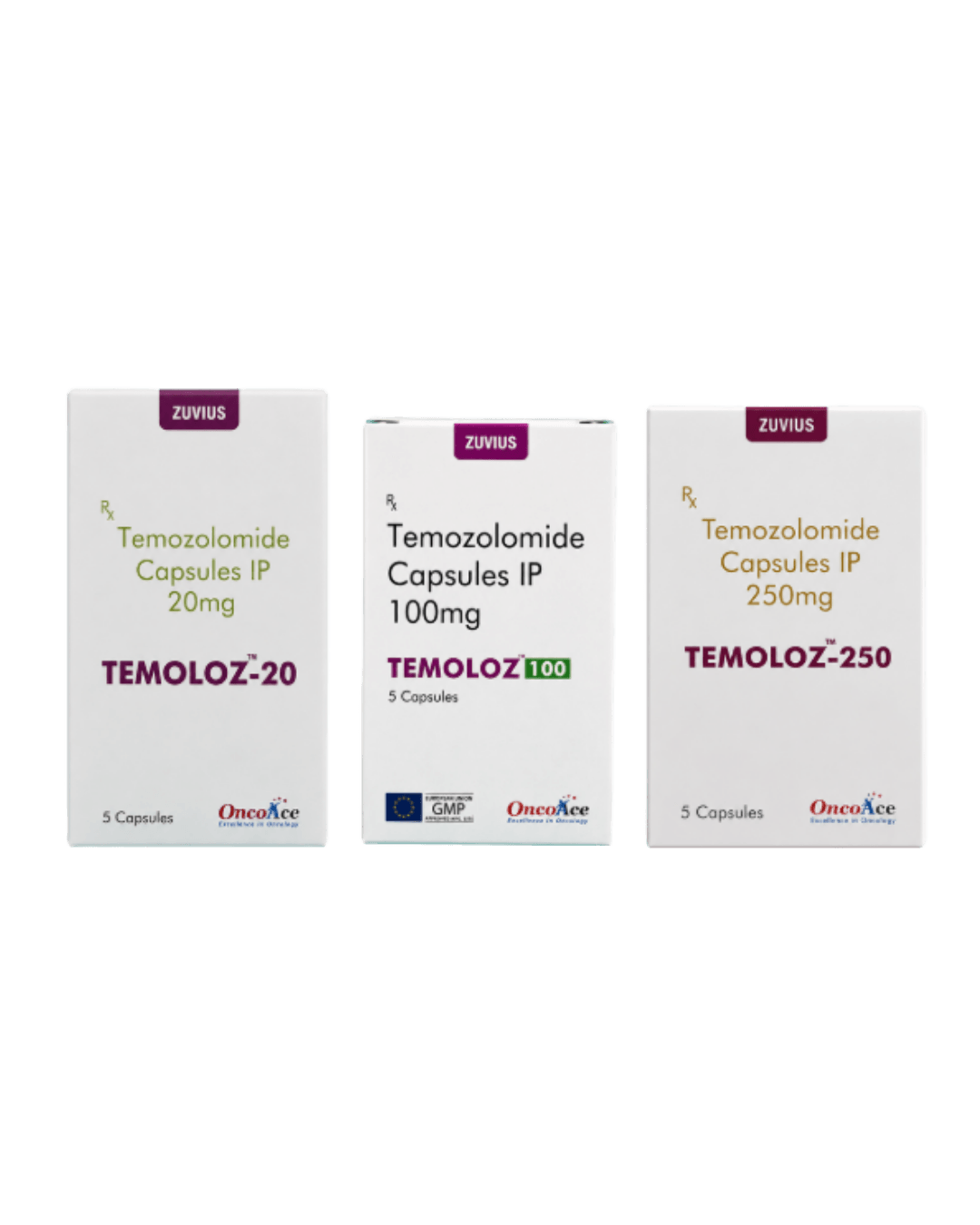
Temoloz
Temozolamide Capsules

Strength
✓20 mg✓100 mg✓250 mg

Pack Size
1 x 5

Drug Class
Alkylating Agents

Specification
USP/BP/IH Specs offered for exports

Storage
Store at 25°C to 30°C.
Temozolomide capsules for oral administration contain Temozolomide, an imidazotetrazine derivative.
The chemical name of Temozolomide is
3,4-dihydro-3-methyl-4-oxoimidazo[5,1-d]-as-tetrazine-8-carboxamide.
TEMOLOZ (Temozolomide) Capsules are indicated for the treatment of adult patients with newly diagnosed glioblastoma multiforme concomitantly with radiotherapy and then as maintenance treatment.
TEMOLOZ Capsules are indicated for the treatment of adult patients with refractory anaplastic astrocytoma, i.e., patients who have experienced disease progression on a drug regimen containing nitrosourea and procarbazine.
- Adult patients with newly diagnosed glioblastoma multiforme concomitantly with radiotherapy (RT) and subsequently as monotherapy treatment.
- Children from the age of three years, adolescents and adult patients with malignant glioma, such as glioblastoma multiforme or anaplastic astrocytoma, showing recurrence or progression after standard therapy.
Patients With Severe Hepatic Or Renal Impairment
Caution should be exercised when TEMOLOZ capsules are administered to patients with severe hepatic or renal impairment.
Geriatrics
Caution should be exercised when treating elderly patients.
In newly diagnosed patients with glioblastoma multiforme the adverse event profile was similar in younger patients (<65 years) versus older patients (>65 years).
Laboratory Tests
For the concomitant treatment phase with RT, a complete blood count should be obtained weekly.
For the 28-day treatment cycles, a complete blood count should be obtained on Day 22 (21 days after the first dose).
Blood counts should be performed weekly until recovery if the ANC falls below 1.5 x 10⁹/L and the platelet count falls below 100 x 10⁹/L.
Carcinogenesis, Mutagenesis, And Impairment Of Fertility
Standard carcinogenicity studies were not conducted with temozolomide.
In rats treated with 200 mg/m² temozolomide on 5 consecutive days every 28 days for 3 cycles, mammary carcinomas were found.
Temozolomide was mutagenic in vitro in bacteria (Ames assay) and clastogenic in mammalian cells (human peripheral blood lymphocyte assays).
Reproductive function studies have not been conducted with temozolomide.
However, multicycle toxicology studies in rats and dogs have demonstrated testicular toxicity (syncytial cells/immature sperm and testicular atrophy).
Nursing Mothers
It is not known whether this drug is excreted in human milk.
Because many drugs are excreted in human milk and because of the potential for serious adverse reactions in nursing infants from TEMOLOZ Capsules, patients receiving TEMOLOZ should discontinue nursing.
Pediatric Use
TEMOLOZ effectiveness in children has not been demonstrated.
The TEMOLOZ toxicity profile in children is similar to adults.
Dosage of TEMOLOZ Capsules must be adjusted according to nadir neutrophil and platelet counts in the previous cycle and the neutrophil and platelet counts at the time of initiating the next cycle.
Patients With Newly Diagnosed High-Grade Glioma
Concomitant Phase
TEMOLOZ is administered orally at 75 mg/m² daily for 42 days concomitant with focal radiotherapy (60 Gy administered in 30 fractions) followed by maintenance TEMOLOZ for 6 cycles.
Focal RT includes the tumor bed or resection site with a 2-3 cm margin.
No dose reductions are recommended during the concomitant phase; however, dose interruptions or discontinuation may occur based on toxicity.
The TEMOLOZ dose should be continued throughout the 42-day concomitant period up to 49 days if all of the following conditions are met:
- Absolute neutrophil count > 1.5 x 10²/L
- Platelet count > 100 x 10²/L
- Common toxicity criteria (CTC) non-haematological toxicity < Grade 1 (except for alopecia, nausea and vomiting)
Maintenance Phase Cycle 1
Four weeks after completing the TEMOLOZ + RT phase, TEMOLOZ is administered for an additional 6 cycles of maintenance treatment.
Dosage in Cycle 1 (maintenance) is 150 mg/m² once daily for 5 days followed by 23 days without treatment.
Cycles 2-6
At the start of Cycle 2, the dose is escalated to 200 mg/m² if:
- The CTC non-haematologic toxicity for Cycle 1 is Grade <2 (except for alopecia, nausea and vomiting)
- Absolute neutrophil count (ANC) is >1.5 x 10²/L
- Platelet count is >100 x 10²/L
The dose remains at 200 mg/m² per day for the first 5 days of each subsequent cycle except if toxicity occurs.
If the dose was not escalated at Cycle 2, escalation should not be done in subsequent cycles.
Dose Reduction During Maintenance Treatment
Table 1: Temozolomide Dose Levels For Maintenance Treatment
Dose Level -1 Dose: 100 mg/m²/day Remarks: Reduction for prior toxicity
Dose Level 0 Dose: 150 mg/m²/day Remarks: Dose during Cycle 1
Dose Level 1 Dose: 200 mg/m²/day Remarks: Dose during Cycles 2–6 in absence of toxicity
Table 2: Dose Reduction Or Discontinuation Criteria
Absolute Neutrophil Count (ANC)
- <1.0 × 10⁹/L → Reduce TMZ by 1 dose level
Platelet Count
- <50 × 10⁹/L → Reduce TMZ by 1 dose level
Non-Hematological Toxicity*
- CTC Grade 3 → Reduce TMZ by 1 dose level
- CTC Grade 4 → Discontinue TMZ
*Except alopecia, nausea, and vomiting.
Note
Temozolomide should be discontinued if dose reduction below 100 mg/m² is required or if the same Grade 3 non-haematological toxicity recurs after dose reduction.
If ANC is >1.5 × 10⁹/L and platelet count is >100 × 10⁹/L at the start of the next cycle, the dose may be increased to 200 mg/m²/day for 5 consecutive days every 28 days.
Complete blood counts should be monitored during therapy.
Treatment may continue until disease progression; however, the optimal duration of therapy remains unknown.
Handling And Disposal
Temozolomide is a cytotoxic anticancer agent.
Capsules should not be opened or crushed.
In case of accidental exposure to capsule contents, precautions should be taken to avoid inhalation or contact with skin or mucous membranes.
Appropriate procedures for handling and disposal of anticancer drugs should be followed according to institutional guidelines.
Administration Of TEMOLOZ
Patients should take each dose with a full glass of water at the same time each day.
Taking the medication on an empty stomach or at bedtime may help ease nausea.
If patients are also taking antinausea or other medications to relieve the side effects associated with TEMOLOZ, they should be advised to take these medications 30 minutes before they take TEMOLOZ.
Patients should not open or split the capsules.
If capsules are accidentally opened or damaged, rigorous precautions should be taken with the capsule contents to avoid inhalation or contact with the skin or mucous membranes.
The medication should be kept away from children and pets.
The TEMOLOZ capsules should be swallowed whole and NEVER CHEWED.