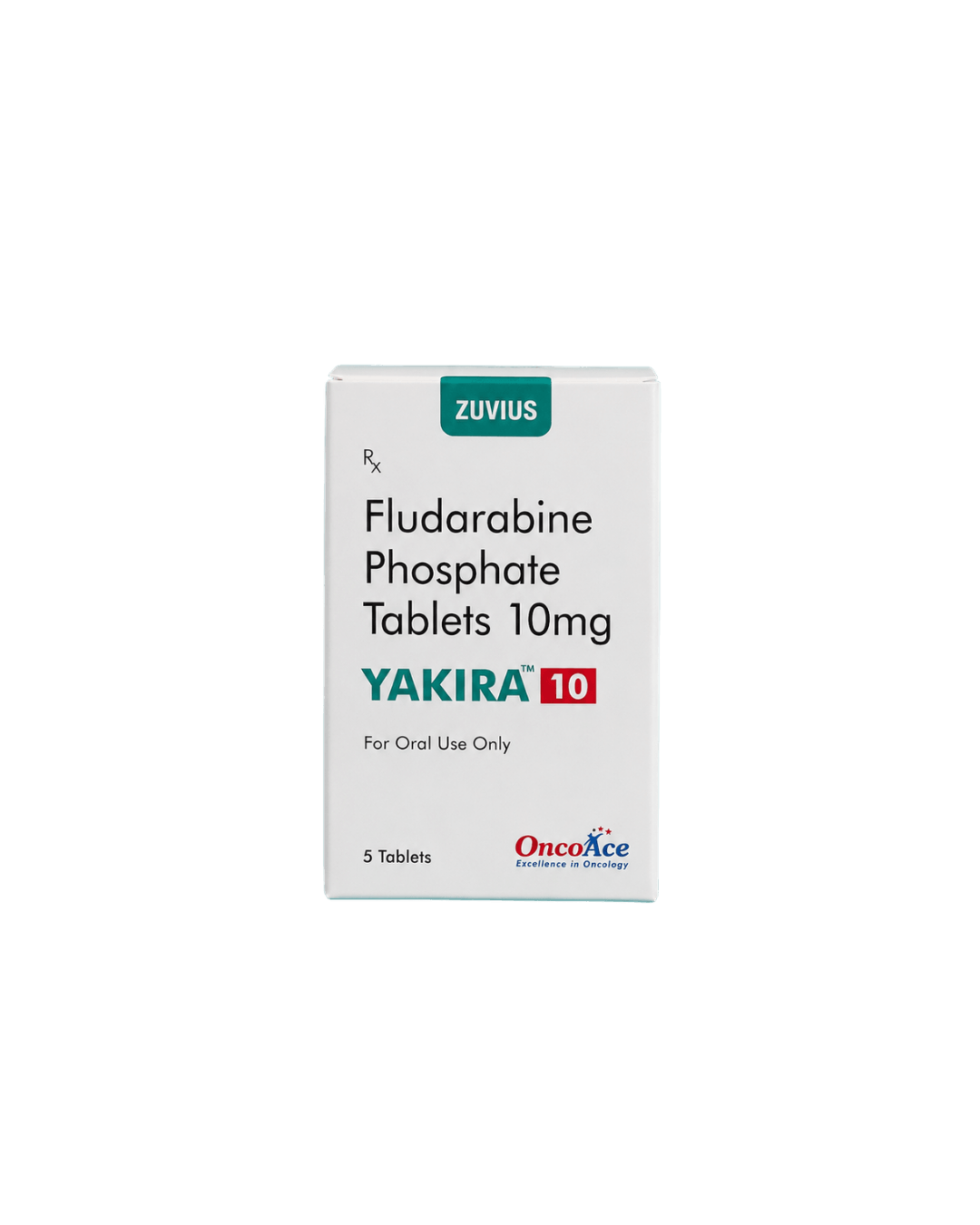
Yakira
Fludarabine Phosphate Tablets

Strength
✓10 mg

Pack Size
1 x 5

Drug Class
Antimetabolite

Specification
USP/BP/IH Specs offered for exports

Storage
Store at 25°C to 30°C.
Yakira contains Fludarabine Phosphate, a water-soluble fluorinated nucleotide analogue of the antiviral agent Vidarabine.
Fludarabine Phosphate is rapidly dephosphorylated to 2F-ara-A after administration.
It is then taken up by cells and converted intracellularly into its active metabolite, 2F-ara-ATP.
The active metabolite inhibits several enzymes involved in DNA synthesis, including:
- Ribonucleotide reductase
- DNA polymerase alpha, delta and epsilon
- DNA primase
- DNA ligase
These actions result in
- Inhibition of DNA synthesis
- Partial inhibition of RNA polymerase II
- Reduction in protein synthesis
- Inhibition of cell growth
- Induction of apoptosis in chronic lymphocytic leukaemia cells
Yakira is indicated for the treatment of B-cell chronic lymphocytic leukaemia in adult patients with sufficient bone-marrow reserves.
First-Line Treatment
First-line treatment should be initiated only in adult patients with advanced disease, including:
- Rai Stage III or IV disease, corresponding to Binet Stage C.
- Rai Stage I or II disease, corresponding to Binet Stage A or B, when disease-related symptoms or evidence of progressive disease are present.
Previously Treated Patients
Yakira may be used as single-agent treatment in adult patients with B-cell chronic lymphocytic leukaemia who:
- Have not responded to treatment with at least one standard alkylating-agent-containing regimen.
- Have experienced disease progression during or after such treatment.
Fludarabine Phosphate demonstrates antileukaemic activity after intracellular conversion to its active metabolite, 2F-ara-ATP.
This metabolite inhibits DNA synthesis and promotes apoptosis in malignant lymphocytes.
Clinical pharmacodynamic observations include
- Suppression of multiple enzymes required for DNA replication.
- Extensive DNA fragmentation in chronic lymphocytic leukaemia cells.
- Induction of apoptosis following exposure to the active Fludarabine metabolite.
Cardiac electrophysiology studies demonstrated that the maximum increase in the corrected QT interval was less than 10 milliseconds.
Pharmacokinetic observations include
- Oral bioavailability of approximately 50% to 65%.
- Peak plasma concentrations approximately 1 to 2 hours after oral administration.
- Dose-dependent suppression of blood-cell production corresponding with its cytotoxic activity.
Contraindications
Yakira should not be used in patients with
- Hypersensitivity to Fludarabine Phosphate or any ingredient in the formulation.
- Severe renal impairment with creatinine clearance below 30 mL/min.
- Decompensated haemolytic anaemia.
- Lactation or breastfeeding.
Common Adverse Reactions
- Bone-marrow suppression
- Anaemia
- Leukopenia
- Neutropenia
- Thrombocytopenia
- Pneumonia
- Cough
- Fever
- Fatigue
- Weakness
- Nausea
- Vomiting
- Diarrhoea
- Chills
- Oedema
- Malaise
- Peripheral neuropathy
- Visual disturbances
- Loss of appetite
- Mucositis
- Stomatitis
- Skin rash
Serious opportunistic infections and fatalities associated with serious adverse reactions have also been reported.
Overdose
High doses may cause
- Leukoencephalopathy
- Acute toxic leukoencephalopathy
- Reversible posterior leukoencephalopathy syndrome
- Headache
- Nausea and vomiting
- Seizures
- Visual disturbances
- Altered consciousness
- Focal neurological deficits
- Confusion
- Drowsiness
- Agitation
- Muscle spasticity
- Incontinence
- Severe thrombocytopenia
- Severe neutropenia
- Severe bone-marrow suppression
- Irreversible central nervous system toxicity
- Blindness
- Coma
- Death
Recommended Dosage
- The recommended oral dose is 40 mg/m² of body surface area once daily for 5 consecutive days.
- The treatment cycle is repeated every 28 days.
- This oral dose corresponds to approximately 1.6 times the recommended intravenous dose of 25 mg/m² per day.
Daily Dose According to Body Surface Area
- BSA 0.75 to 0.88 m²: 30 to 35 mg daily, equivalent to 3 tablets.
- BSA 0.89 to 1.13 m²: 36 to 45 mg daily, equivalent to 4 tablets.
- BSA 1.14 to 1.38 m²: 46 to 55 mg daily, equivalent to 5 tablets.
- BSA 1.39 to 1.63 m²: 56 to 65 mg daily, equivalent to 6 tablets.
- BSA 1.64 to 1.88 m²: 66 to 75 mg daily, equivalent to 7 tablets.
- BSA 1.89 to 2.13 m²: 76 to 85 mg daily, equivalent to 8 tablets.
- BSA 2.14 to 2.38 m²: 86 to 95 mg daily, equivalent to 9 tablets.
- BSA 2.39 to 2.50 m²: 96 to 100 mg daily, equivalent to 10 tablets.
Duration of Treatment
- Treatment should continue until the best clinical response is achieved.
- Complete or partial remission is generally achieved after approximately 6 treatment cycles.
- Treatment should then be discontinued according to the treating doctor's assessment.
Haematological Dose Adjustment
Patients should be monitored closely for treatment response and toxicity.
If blood cell counts are too low before a subsequent cycle and treatment-related bone-marrow suppression is present, the treatment cycle should be postponed.
Treatment may resume when
- Granulocyte count is above 1.0 × 10⁹/L.
- Platelet count is above 100 × 10⁹/L.
Treatment should generally not be postponed for more than 2 weeks.
If blood counts do not recover after 2 weeks, the following dose reductions may be considered:
- Granulocytes 0.5 to 1.0 × 10⁹/L or platelets 50 to 100 × 10⁹/L: Reduce dose to 30 mg/m² daily.
- Granulocytes below 0.5 × 10⁹/L or platelets below 50 × 10⁹/L: Reduce dose to 20 mg/m² daily.
The dose should not be reduced when thrombocytopenia is caused by the underlying disease.
Renal Impairment
- For creatinine clearance between 30 and 70 mL/min, reduce the dose by up to 50%.
- Close haematological monitoring is required.
- Yakira is contraindicated when creatinine clearance is below 30 mL/min.
Hepatic Impairment
No adequate clinical data are available for patients with liver impairment.
Yakira should therefore be used cautiously in these patients.
Paediatric Use
Safety and effectiveness have not been established in patients younger than 18 years.
Yakira is not recommended for children or adolescents.
Elderly Patients
Use cautiously in patients older than 75 years.
Creatinine clearance should be measured before treatment in patients aged 65 years or older.