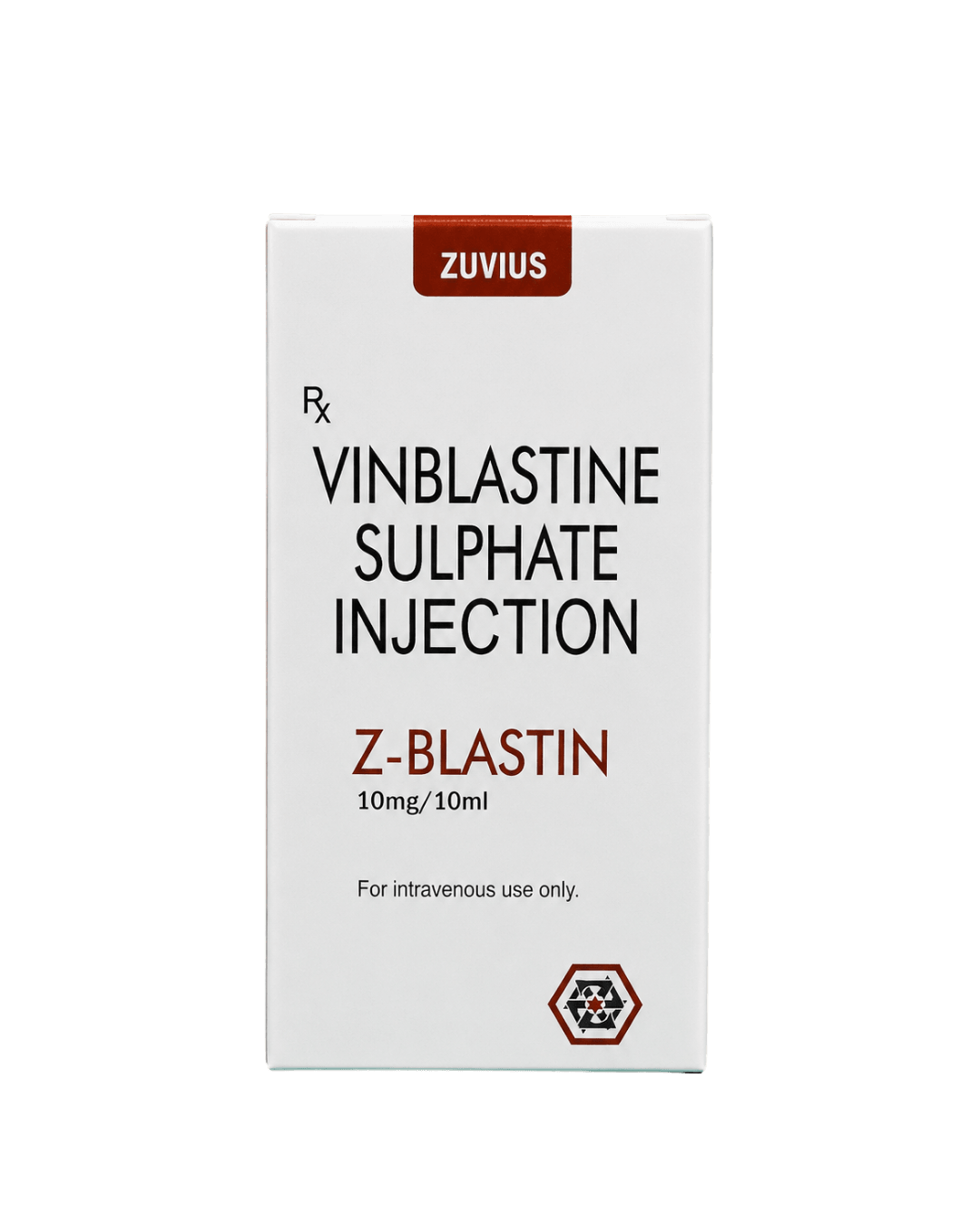
Z-Blastin
Vinblastine Injection

Strength
✓10 mg

Pack Size
1 Vial

Drug Class
Antineoplastics, Vinca Alkaloid

Specification
USP/BP/IH Specs offered for exports

Storage
Store refrigerated at 2°C to 8°C.
Vinblastine Sulphate for Injection USP is vincaleukoblastine sulphate (1:1) (salt).
It is the salt of an alkaloid extracted from Vinca rosea Linn., a common flowering herb known as the periwinkle (more properly known as Catharanthus roseus G. Don).
Previously, the generic name was vincaleukoblastine, abbreviated VLB.
It is a stathmokinetic, oncolytic agent.
When treated in vitro with this preparation, growing cells are arrested in metaphase.
Chemical and physical evidence indicates that vinblastine sulphate has the molecular formula:
C₄₆H₅₈O₉N₄ • H₂SO₄
and that it is a dimeric alkaloid containing both indole and dihydroindole moieties.
Vinblastine sulphate is a white to off-white powder.
It is
- Freely soluble in water
- Soluble in methanol
- Slightly soluble in ethanol
- Insoluble in benzene, ether, and naphtha
The clinical formulation is supplied in a sterile form for intravenous use only.
Vials of Vinblastine Sulphate for Injection USP contain 10 mg (0.011 mmol) of vinblastine sulphate, in the form of a white, amorphous, solid lyophilised plug, without excipients.
After reconstitution with sodium chloride solution, the pH of the resulting solution lies in the range of 3.5 to 5.
Vinblastine sulphate (vinblastine sulphate injection) is indicated in the palliative treatment of the following:
Frequently Responsive Malignancies
- Generalized Hodgkin’s disease (Stages III and IV, Ann Arbor modification of Rye staging system)
- Lymphocytic lymphoma (nodular and diffuse, poorly and well differentiated)
- Histiocytic lymphoma
- Mycosis fungoides (advanced stages)
- Advanced carcinoma of the testis
- Kaposi’s sarcoma
- Letterer-Siwe disease (histiocytosis X)
Less Frequently Responsive Malignancies
- Choriocarcinoma resistant to other chemotherapeutic agents
- Carcinoma of the breast, unresponsive to appropriate endocrine surgery and hormonal therapy
Current principles of chemotherapy for many types of cancer include the concurrent administration of several antineoplastic agents.
For enhanced therapeutic effect without additive toxicity, agents with different dose-limiting clinical toxicities and different mechanisms of action are generally selected.
Therefore, although vinblastine sulfate (vinblastine sulfate injection) is effective as a single agent in the aforementioned indications, it is usually administered in combination with other antineoplastic drugs.
Such combination therapy produces a greater percentage of response than does a single-agent regimen.
These principles have been applied, for example, in the chemotherapy of Hodgkin’s disease.
Hodgkin’s Disease
Vinblastine sulfate (vinblastine sulfate injection) has been shown to be one of the most effective single agents for the treatment of Hodgkin’s disease.
Advanced Hodgkin’s disease has also been successfully treated with several multiple-drug regimens that included vinblastine sulfate (vinblastine sulfate injection).
Patients who had relapses after treatment with the MOPP program:
- Mechlorethamine hydrochloride (nitrogen mustard)
- Vincristine sulfate
- Prednisone
- Procarbazine
have likewise responded to combination-drug therapy that included vinblastine sulfate (vinblastine sulfate injection).
A protocol using cyclophosphamide in place of nitrogen mustard and vinblastine sulfate (vinblastine sulfate injection) instead of vincristine sulfate is an alternative therapy for previously untreated patients with advanced Hodgkin’s disease.
Advanced testicular germinal-cell cancers (embryonal carcinoma, teratocarcinoma, and choriocarcinoma) are sensitive to vinblastine sulfate (vinblastine sulfate injection) alone, but better clinical results are achieved when vinblastine sulfate (vinblastine sulfate injection) is administered concomitantly with other antineoplastic agents.
The effect of bleomycin is significantly enhanced if vinblastine sulfate (vinblastine sulfate injection) is administered 6 to 8 hours prior to the administration of bleomycin.
This schedule permits more cells to be arrested during metaphase, the stage of the cell cycle in which bleomycin is active.
The action of vinblastine sulfate is different from that of other recognized antineoplastic agents.
Tissue-culture studies suggest an interference with metabolic pathways of amino acids leading from glutamic acid to the citric acid cycle and to urea.
In vivo experiments tend to confirm the in vitro results.
A number of in vitro and in vivo studies have demonstrated that vinblastine sulfate (vinblastine sulfate injection) produces a stathmokinetic effect and various atypical mitotic figures.
The therapeutic responses, however, are not fully explained by the cytologic changes, since these changes are sometimes observed clinically and experimentally in the absence of any oncolytic effects.
- Read the label carefully before use.
- Store in a cool and dry place, away from sunlight.
- Keep out of the reach of children.
It is wise to initiate therapy for adults by administering a single intravenous dose of 3.7 mg/m² of body surface area (BSA).
Thereafter, white-blood-cell counts should be made to determine the patient’s sensitivity to vinblastine sulphate.
A simplified and conservative incremental approach to dosage at weekly intervals for adults may be outlined as follows:
- First dose – 3.7 mg/m² BSA
- Second dose – 5.5 mg/m² BSA
- Third dose – 7.4 mg/m² BSA
- Fourth dose – 9.25 mg/m² BSA
- Fifth dose – 11.1 mg/m² BSA
Paediatric Patients
Doses of vinblastine sulphate in paediatric patients varied depending on the schedule used and whether vinblastine sulphate was administered as a single agent or incorporated within a particular chemotherapeutic regimen.
As a single agent for Letterer-Siwe disease (histiocytosis X), the initial dose of vinblastine sulphate was reported as 6.5 mg/m².
When vinblastine sulphate was used in combination with other chemotherapeutic agents for the treatment of Hodgkin’s disease, the initial dose was reported as 6 mg/m².
For testicular germ cell carcinomas, the initial dose of vinblastine sulphate was reported as 3 mg/m² in a combination regimen.
Dose modifications should be guided by haematologic tolerance.
Patients With Renal Or Hepatic Impairment
A reduction of 50% in the dose of vinblastine sulphate is recommended for patients having a direct serum bilirubin value above 3 mg/100 mL.
Since metabolism and excretion are primarily hepatic, no modification is recommended for patients with impaired renal function.