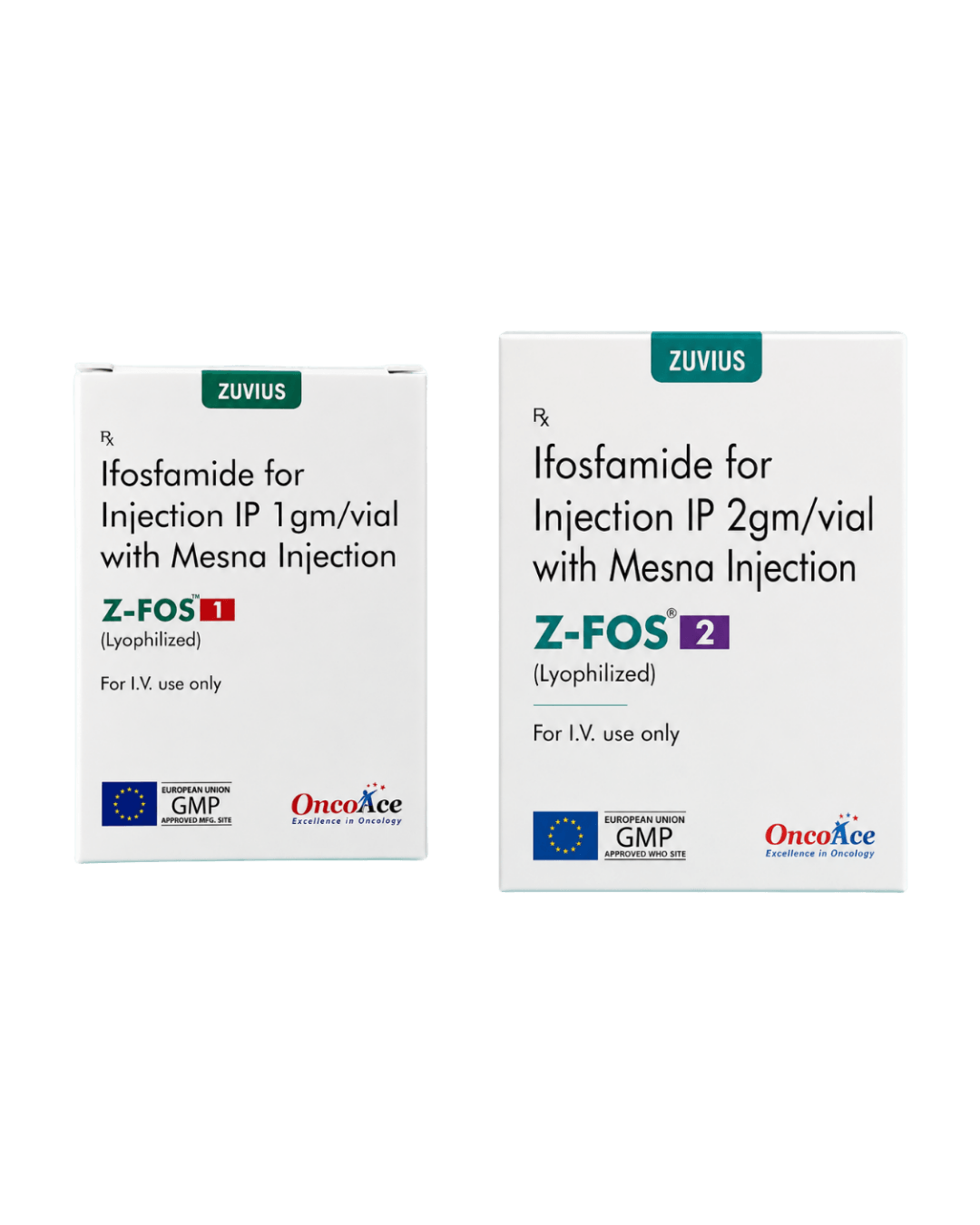
Z-Fos
Ifosfamide Injection

Strength
✓1 gm✓2 gm

Pack Size
1 Vial

Drug Class
Alkylating Agent

Specification
USP/BP/IH Specs offered for exports

Storage
Store at 20°C to 25°C
Z-Fos contains Ifosfamide, an antineoplastic cytotoxic alkylating agent.
Ifosfamide is a prodrug and does not demonstrate cytotoxic activity until it is activated by microsomal enzymes, primarily within the liver.
Its cytotoxic activity is associated with activation of the oxazaphosphorine ring at the C4 position.
The activated metabolites interact with DNA and form DNA-to-DNA cross-links.
This action interferes with DNA replication and blocks cancer cells during the late S and early G2 phases of the cell cycle.
Ifosfamide is rapidly absorbed from the administration site and is primarily activated in the liver by microsomal mixed-function oxidases.
Its metabolites are mainly eliminated through the kidneys.
The serum half-life ranges from approximately 4 to 8 hours depending on the dose and treatment regimen.
More than 80% of a single dose may be excreted in urine within 24 hours.
Because of its high lipid solubility, significant amounts of unchanged Ifosfamide may also enter the cerebrospinal fluid.
Z-Fos is used for the treatment of malignant diseases.
As a single anticancer medicine, Ifosfamide has produced objective responses in a range of malignant conditions.
It is also commonly used in combination with
- Other cytotoxic medicines
- Radiotherapy
- Surgery
Clinical use has been documented in malignancies including
- Ewing's sarcoma
- Rhabdomyosarcoma
- Non-rhabdomyosarcoma soft-tissue sarcoma
- Germ-cell tumours
- Osteosarcoma
- Non-Hodgkin lymphoma
- Hodgkin lymphoma
- Acute lymphoblastic leukaemia
- Neuroblastoma
- Wilms tumour
- Malignant central nervous system tumours
In patients with non-metastatic Ewing's sarcoma, treatment containing Ifosfamide and Etoposide demonstrated improved outcomes compared with standard treatment alone.
Reported clinical outcomes included
- Five-year event-free survival of approximately 69% with Ifosfamide and Etoposide compared with 54% with standard treatment.
- Five-year overall survival of approximately 72% compared with 61%.
Similar overall toxicity was observed between the treatment groups.
In patients with metastatic Ewing's sarcoma, no significant improvement in five-year event-free survival or overall survival was demonstrated.
A comparative study in standard-risk Ewing's sarcoma found no significant difference in event-free or overall survival between an Ifosfamide-containing regimen and a Cyclophosphamide-containing regimen.
However, the Ifosfamide-containing regimen demonstrated lower toxicity.
Clinical activity, including complete and partial responses, has also been documented in paediatric malignancies such as:
- Rhabdomyosarcoma
- Soft-tissue sarcoma
- Germ-cell tumours
- Osteosarcoma
- Lymphomas
- Acute lymphoblastic leukaemia
- Neuroblastoma
- Wilms tumour
- Malignant central nervous system tumours
Commonly Reported Adverse Reactions
Blood and Bone Marrow
- Myelosuppression
- Reduced white blood cell count
- Reduced platelet count
Central Nervous System
- Confusion
- Drowsiness
- Neurological toxicity
- Impaired consciousness
Kidney and Urinary System
- Nephrotoxicity
- Haemorrhagic cystitis
- Blood in the urine
- Kidney dysfunction
- Acute kidney failure
Gastrointestinal System
- Nausea
- Vomiting
- Diarrhoea
- Constipation
- Mucositis
- Stomatitis
- Enterocolitis
- Pancreatitis
- Intestinal obstruction
- Gastrointestinal bleeding
- Abdominal pain
Liver
- Hepatotoxicity
Skin
- Hair loss
- Dermatitis
- Skin rash
- Itching
Reproductive System
- Infertility
- Ovarian failure
- Premature menopause
- Absence of menstrual periods
- Azoospermia
- Reduced sperm count
General and Administration-Site Reactions
- Fatigue
- Fever
- Chills
- Inflammation of a vein
- Injection-site reactions
Cardiac Disorders
- Cardiomyopathy
- Heart failure
- Angina
Pulmonary Disorders
- Respiratory failure
- Pulmonary oedema
- Pneumonitis
- Pulmonary fibrosis
Overdose
Serious effects of overdose may include
- Dose-dependent central nervous system toxicity
- Kidney toxicity
- Bone-marrow suppression
- Mucositis
There is no specific antidote.
Management consists of supportive care, treatment of infections or other toxicities, consideration of haemodialysis in severe overdose and administration of Mesna for urinary protection.
General Administration
Z-Fos should be administered only under the supervision of physicians experienced in anticancer treatment and where regular clinical, biochemical and haematological monitoring is available.
The dosage should be individualised according to
- Therapeutic indication
- Combination-treatment regimen
- Patient's general health
- Organ function
- Laboratory-monitoring results
- Previous response and toxicity
When used with medicines that produce similar toxicities, dose reduction or a longer treatment-free interval may be required.
Common Dosage Regimens
- 8 to 12 g/m², divided equally into single daily doses over 3 to 5 days, repeated every 2 to 4 weeks.
Alternatively
- 5 to 6 g/m², up to a maximum of 10 g, administered as a continuous 24-hour infusion every 3 to 4 weeks.
- Treatment frequency depends on the degree of bone-marrow suppression and the time required for adequate bone-marrow recovery.
- The usual number of treatment courses is 4, although up to 7 courses may be administered.
Mesna Uroprotection
- Ifosfamide must be administered with Mesna to reduce the risk of haemorrhagic cystitis and urothelial toxicity.
- Increased Mesna doses may be required in children, patients with previous urothelial damage or patients who are not adequately protected by standard Mesna dosing.
Renal Impairment
Reduced renal excretion in patients with kidney impairment may increase plasma concentrations of Ifosfamide and its metabolites.
This can increase the risk of
- Neurotoxicity
- Nephrotoxicity
- Haematological toxicity
Dose selection should therefore be undertaken cautiously.
Ifosfamide and its metabolites can be removed by dialysis.
Hepatic Impairment
Severe liver impairment may reduce activation of Ifosfamide and alter treatment effectiveness.
Liver impairment and low serum albumin may also increase the risk of:
- Central nervous system toxicity
- Kidney toxicity
These factors should be considered when selecting the dose and assessing the response.
Paediatric Patients
The dose should be determined according to
- Tumour type and stage
- General condition
- Previous cytotoxic therapy
- Concurrent chemotherapy or radiotherapy
Dosage regimens used in clinical studies include
- 5 g/m² over 24 hours
- 9 g/m² divided into daily doses over 5 days
- 9 g/m² administered as a continuous 72-hour infusion and repeated every 3 weeks
Elderly Patients
Dose selection should be cautious because elderly patients may have reduced liver, kidney or cardiac function and may be receiving other medicines.
Reconstitution
The vial contents should be dissolved in Water for Injection using an aseptic technique.
For a 1 gm vial
- Add 12.5 mL of Water for Injection.
- The resulting 8% Ifosfamide solution should not be injected directly into a vein without further dilution.
The reconstituted solution may be
- Diluted to less than a 4% solution using 0.9% Sodium Chloride Injection and administered intravenously.
- Infused in 0.9% Sodium Chloride Injection over 30 to 120 minutes.
- Administered into a rapidly running intravenous infusion.
- Diluted in three 1-litre containers of 0.9% Sodium Chloride Injection and infused over 24 hours, with each litre administered over 8 hours.
Hydration and Monitoring
- The patient should remain adequately hydrated and maintain proper fluid balance.
- Patients receiving an intermittent regimen should generally receive at least 2 litres of fluid over 24 hours.
- A diuretic may be required to ensure adequate urine output.
- Urine should be analysed before and after every treatment course.
- Monitor regularly for proteinuria, haematuria and reduced urine output.
- Patients should immediately report symptoms of cystitis.
- Ifosfamide should not be administered to patients with active cystitis until it has been treated.
Blood Count Requirements
Treatment should be withheld when
- White blood cell count is below 4,000/mm³.
- Platelet count is below 100,000/mm³.
Treatment may be resumed after blood counts have adequately recovered.
Antiemetic treatment may be administered before, during and after therapy to reduce nausea and vomiting.