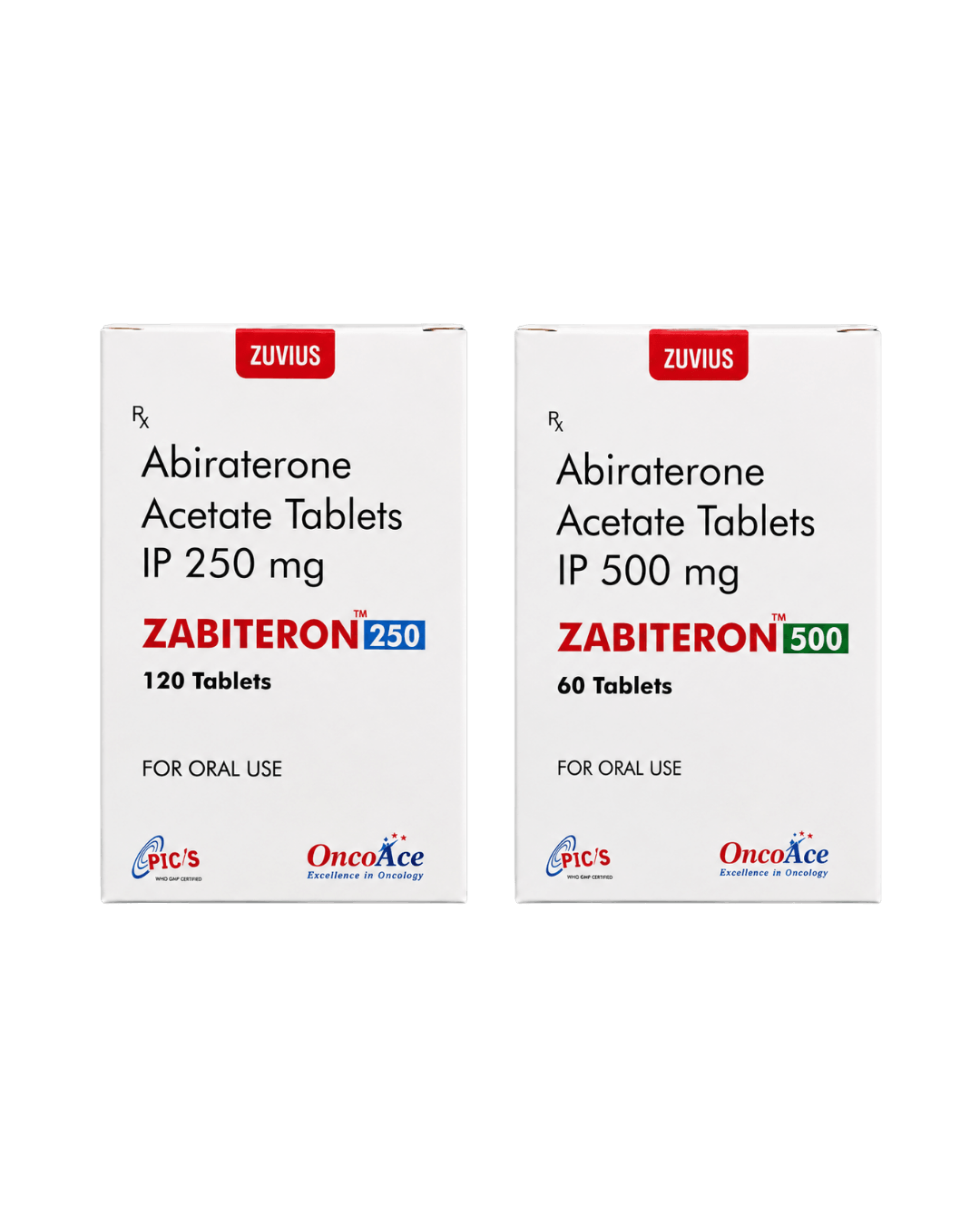
Zabiteron
Abiraterone Acetate Tablets

Strength
✓250 mg✓500 mg

Pack Size
1 x 120

Drug Class
Endocrine Therapy

Specification
USP/BP/IH Specs offered for exports

Storage
Store at 25°C to 30°C.
Abiraterone acetate, the active ingredient, is the acetyl ester of abiraterone.
Abiraterone is an inhibitor of CYP17 (17α-hydroxylase/C17,20-lyase).
Each tablet contains 250 mg of abiraterone acetate.
Abiraterone acetate is designated chemically as (3β)17-(3-pyridinyl) androsta-5,16-dien-3-yl acetate.
Abiraterone acetate is a micronised (smaller particle size), white to off-white, non-hygroscopic, crystalline powder.
Its molecular formula is C₂₆H₃₃NO₂, and it has a molecular weight of 391.55.
Abiraterone acetate is a lipophilic compound with an octanol-water partition coefficient of 5.12 (Log P) and is practically insoluble in water.
The pKa of the aromatic nitrogen is 5.19.
Inactive ingredients in the tablets are
- Lactose monohydrate
- Microcrystalline cellulose
- Croscarmellose sodium
- Sodium lauryl sulfate
- Sodium stearyl fumarate
- Butylated hydroxyanisole
- Butylated hydroxytoluene
A CYP17 inhibitor, Abiraterone in combination with prednisone is indicated for the treatment of patients with:
- Metastatic castration-resistant prostate cancer (CRPC)
- Metastatic high-risk castration-sensitive prostate cancer (CSPC)
Usage
Abiraterone is used in combination with prednisone to treat a certain type of prostate cancer that has spread to other parts of the body.
Abiraterone is in a class of medications called androgen biosynthesis inhibitors.
It works by decreasing the amount of certain hormones in the body.
The pooled analysis reported abiraterone acetate showed significant efficacy in high-risk prostate cancer patients, including:
- Overall survival (OS) [HR 0.66, 95% confidence interval (CI), 0.61–0.73, P < 0.001]
- Time to prostate-specific antigen (PSA) progression (HR 0.45, 95% CI, 0.34–0.59, P < 0.001)
- Progression-free survival (PFS) according to radiographic evidence (HR 0.55, 95% CI, 0.45–0.68, P < 0.001)
- PSA response rate (RR 2.49, 95% CI, 1.47–4.22, P < 0.001)
A subgroup analysis was carried out due to the significant heterogeneity between the studies.
The incidence of
- Arthralgia (RR 1.19)
- Hypokalaemia (RR 2.47)
- Cardiac disorder (RR 1.48)
- Hypertension (RR 1.57)
in the abiraterone acetate group was moderately higher than the control group.
Hypertension, Hypokalaemia and Fluid Retention
Due to mineralocorticoid excess, abiraterone acetate may cause hypertension, hypokalaemia, and fluid retention as a consequence of increased mineralocorticoid levels resulting from CYP17 inhibition.
Adrenocortical Insufficiency
Adrenocortical insufficiency was reported in patients receiving Abiraterone acetate in combination with prednisone, following interruption of daily steroids and/or with concurrent infection or stress.
Use caution and monitor for symptoms and signs of adrenocortical insufficiency, particularly if patients are withdrawn from prednisone, have prednisone dose reductions, or experience unusual stress.
Hepatotoxicity
In the two randomized clinical trials, grade 3 or 4 ALT or AST increases (at least 5× ULN) were reported in 4% of patients who received Abiraterone acetate, typically during the first 3 months after starting treatment.
Patients whose baseline ALT or AST were elevated were more likely to experience liver test elevation than those beginning with normal values.
Treatment discontinuation due to liver enzyme increases occurred in 1% of patients taking Abiraterone acetate.
No deaths clearly related to Abiraterone acetate were reported due to hepatotoxicity events.
- Abiraterone acetate inhibits the enzyme CYP17, which can result in mineralocorticoid excess, very often leading to hypertension, hypokalemia, and fluid retention or oedema; patients should be monitored at least monthly for these effects and treated appropriately.
- Use with a glucocorticoid can reduce the incidence and severity of these adverse effects.
- Adrenocortical insufficiency has been reported in those treated with abiraterone acetate plus prednisone or prednisolone and patients should be monitored for manifestations of this, particularly after withdrawal from the corticosteroid.
- Caution is needed when treating patients with heart failure, recent myocardial infarction, ventricular arrhythmia, or with any underlying medical conditions which are likely to be adversely affected by mineralocorticoid effects.
- Cardiac disorders are common with abiraterone acetate and include cardiac failure, chest pain, angina pectoris, arrhythmias, atrial fibrillation and tachycardia.
- Hepatotoxicity can occur, and treatment may need to be stopped or the dose adjusted.
- Serum transaminases and bilirubin levels should be measured before starting treatment, then every two weeks for the first three months and monthly thereafter.
- Abiraterone Acetate should not be taken with food and no food should be consumed for at least two hours before the dose of Abiraterone Acetate is taken and for at least one hour after the dose of Abiraterone Acetate is taken.
- Taking Abiraterone Acetate with food causes increased exposure and this may result in adverse reactions.
Recommended Dosage
The recommended dose of Abiraterone Acetate is 1,000 mg (four 250 mg tablets) administered orally once daily in combination with prednisone 5 mg administered orally twice daily.
Administration
Abiraterone Acetate must be taken on an empty stomach.
No food should be consumed for at least two hours before the dose of Abiraterone Acetate is taken and for at least one hour after the dose of Abiraterone Acetate is taken.
The tablets should be swallowed whole with water.
Do not crush or chew tablets.
Dose Modifications
Hepatic Impairment
- In patients with mild hepatic impairment (Child-Pugh Class A): No dose modification.
- In patients with moderate hepatic impairment (Child-Pugh Class B): Use with caution in patients with hepatic impairment. Dose should be reduced to 250 mg PO once daily.
- In patients with severe hepatic impairment (Child-Pugh Class C): Should be avoided.
- For patients who develop increases in liver enzymes above 5 times the upper limit of normal (ULN) or total bilirubin >3 times ULN during treatment, abiraterone therapy should be interrupted, and only restarted at a dose of 500 mg once these values have fallen to acceptable levels (baselines or no more than half the increased values above).
- If hepatotoxicity recurs at the reduced dose of 500 mg daily, treatment with Abiraterone should be discontinued.
- If patients develop increases in enzymes 20 times the ULN at any time while on therapy, abiraterone should be stopped permanently.
- In patients who develop severe hepatotoxicity: Abiraterone should be discontinued.
Renal Impairment
- No dosage modifications are necessary.
Clinical Studies
Abiraterone has been adequately studied for its efficacy in different settings, such as patients with metastatic castration-resistant prostate cancer (CRPC) that has progressed on androgen deprivation therapy, patients with metastatic CRPC who had not received prior chemotherapy, as well as patients with metastatic high-risk Castration Sensitive Prostate cancer (CSPC).
The results of several phase III clinical trials demonstrated Abiraterone to significantly prolong the overall survival and progression free survival along with a high PSA response rate as compared to placebo.
Monitoring Parameters
- Monitor patients for hypertension, hypokalaemia and fluid retention at least once a month.
- Monitor for symptoms and signs of adrenocortical insufficiency, particularly if patients are withdrawn from prednisone, have prednisone dose reductions or experience unusual stress.
- Monitor LFTs – serum transaminases (ALT and AST) and serum bilirubin levels prior to starting treatment with Abiraterone, every two weeks for the first three months of treatment and monthly thereafter.
- Monitor Prostate-specific antigen (PSA).