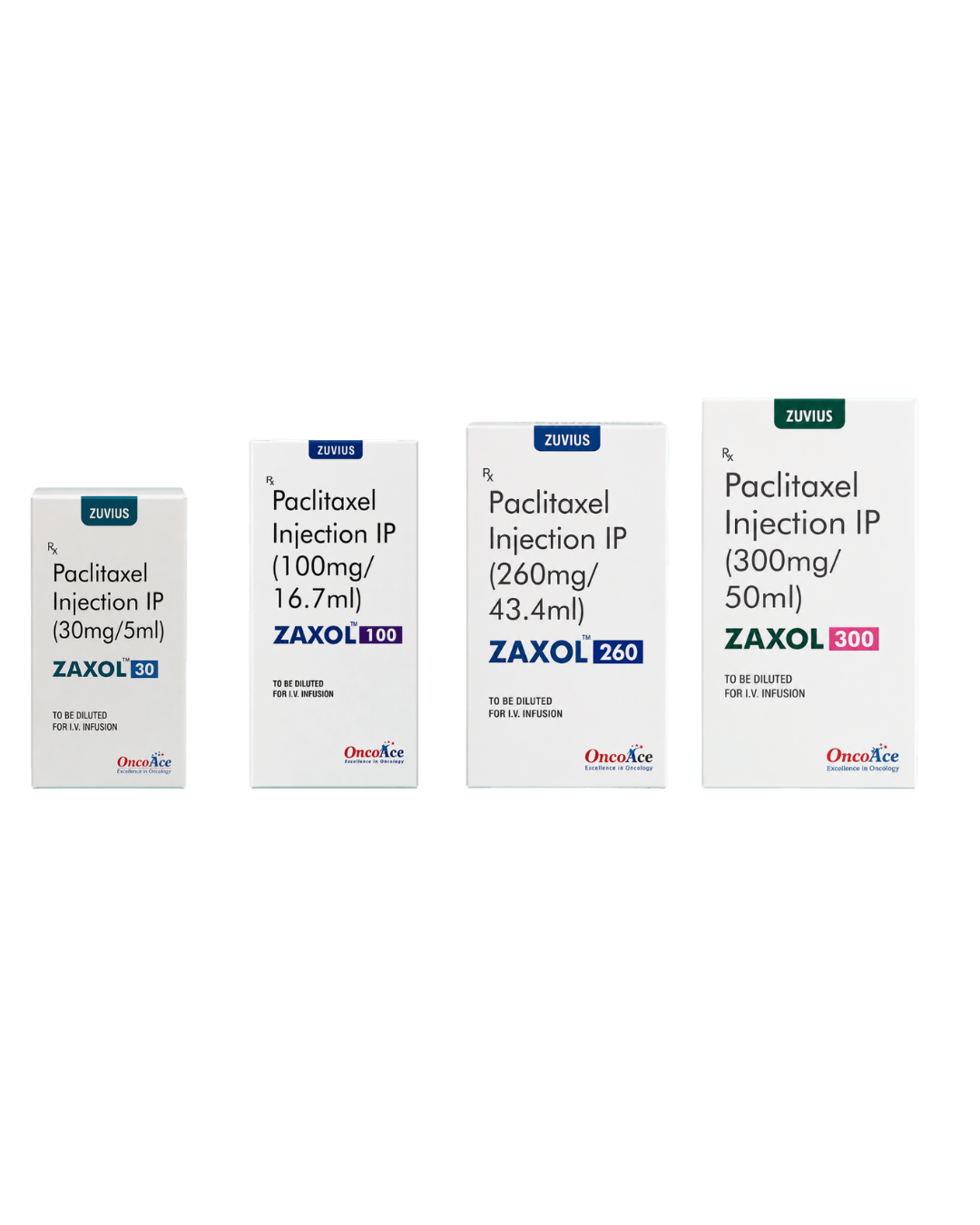
Zaxol
Paclitaxel Injection

Strength
✓30 mg✓100 mg✓260 mg✓300 mg

Pack Size
1 Vial

Drug Class
Antineoplastic Agent / Taxanes

Specification
USP/BP/IH Specs offered for exports

Storage
Store at 25°C to 30°C.
Paclitaxel is a natural product with antitumor activity.
Paclitaxel is obtained via a semisynthetic process from Taxus baccata.
The chemical name for paclitaxel is
5β,20-Epoxy-1,2α,4,7β,10β,13α-hexahydroxytax-11-en-9-one 4,10-diacetate 2-benzoate 13-ester with (2R,3S)-N-benzoyl-3-phenylisoserine.
Paclitaxel is a white to off-white crystalline powder with the empirical formula C47H51NO14 and a molecular weight of 853.9.
It is highly lipophilic, insoluble in water, and melts at around 216-217°C.
ZAXOL (Paclitaxel) is indicated for the treatment of
- Metastatic carcinoma of the ovary after failure of standard therapy
- Metastatic carcinoma of the breast after failure of standard therapy
The standard therapy means an anthracycline-containing regimen for ovarian cancer unless clinically contraindicated.
Usage
As directed by the Oncologist.
Paclitaxel is an antimicrotubule agent that promotes the assembly of microtubules from tubulin dimers and stabilises microtubules by preventing depolymerisation.
This stability inhibits the normal dynamic reorganisation of the microtubule network, which is essential for vital interphase and mitotic cellular functions.
In addition, paclitaxel induces abnormal arrays or bundles of microtubules throughout the cell cycle and multiple asters of microtubules during mitosis.
Paclitaxel helps in improving bone metastasis of lung cancer and has an important significance in clinical treatment of bone metastasis of lung cancer.
- Read the label carefully before use.
- Store in a cool and dry place, away from sunlight.
- Keep out of the reach of children.
All patients should be pre-medicated prior to ZAXOL administration in order to minimize severe hypersensitivity reactions.
Such pre-medication may consist of
- Dexamethasone 20 mg orally approximately 12 and 6 hours before ZAXOL
- Diphenhydramine (or its equivalent) 50 mg IV 30 to 60 minutes prior to ZAXOL
- Cimetidine (300 mg) or Ranitidine (50 mg) IV 30 to 60 minutes before ZAXOL
ZAXOL at a dose of 175 mg/m² administered intravenously over 3 hours every three weeks has been shown to be effective in patients with metastatic carcinoma of the ovary or breast who have failed standard therapy.
A single course of ZAXOL should not be repeated until:
- Neutrophil count is at least 1500 cells/mm²
- Platelet count is at least 100,000 cells/mm²
A patient who experiences severe neutropenia (neutrophil <500 cells/mm²) or severe peripheral neutropenia during ZAXOL therapy should have the dosage reduced by 20% for subsequent courses of ZAXOL.
Preparation For Intravenous Administration
ZAXOL for injection must be diluted prior to infusion.
ZAXOL should be diluted in
- 0.9% Sodium Chloride Injection
- 5% Dextrose Injection
- 5% Dextrose and 0.9% Sodium Chloride Injection
- 5% Dextrose in Ringer’s Injection
to a final concentration of 0.3 to 1.2 mg/ml.
The solutions are physically and chemically stable for up to 27 hours at ambient temperature (15–30°C).
Upon preparation solution may show haziness, which is attributed to the formulation vehicle.
No significant loss in potency has been noted following simulated delivery of the solution through I.V. tubing containing an in-line (0.22 micron) filter.
Data collected for the presence of the extractable plasticizer DEHP (di(2-ethylhexyl) phthalate) show that levels increase with time and concentration when dilutions are prepared in PVC containers.
Consequently the use of plasticised PVC containers and administration sets are not recommended.
ZAXOL solution should be prepared and stored in
- Glass containers
- Polypropylene containers
- Polyolefin containers
Non-PVC containing administration sets, such as those which are polyethylene-lined, should be used.