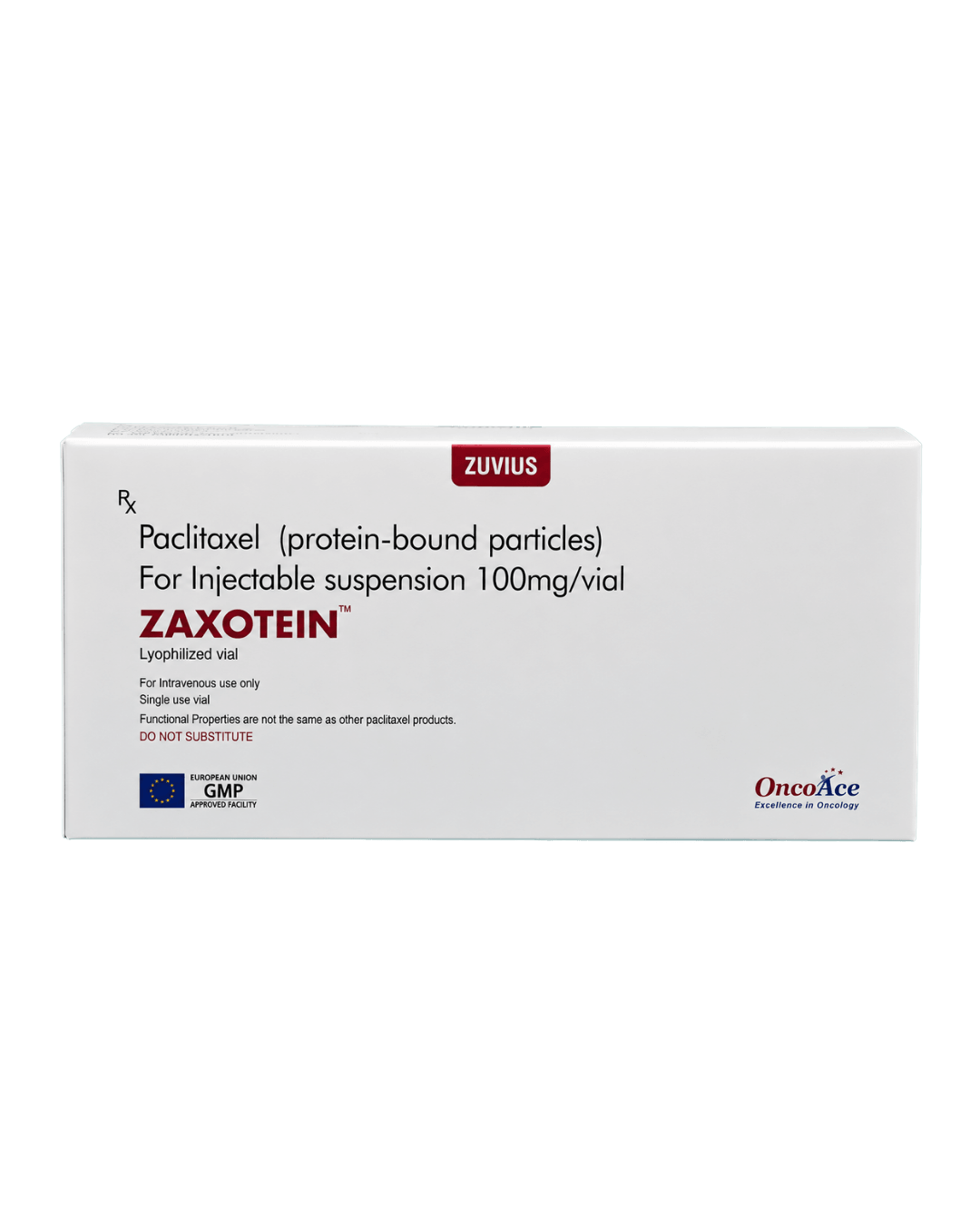
Zaxotein
Albumin Bound Paclitaxel Injection

Strength
✓100 mg

Pack Size
1 Vial

Drug Class
Chemotherapy Drug

Specification
USP/BP/IH Specs offered for exports

Storage
Store at 25°C to 30°C.
Paclitaxel protein-bound particles for Injectable suspension is an albumin-bound form of Paclitaxel with a mean particle size of approximately 130 nanometers.
Each single-use vial contains
- 100 mg of paclitaxel
- Approximately 900 mg of human albumin
This product is available as lyophilized powder which needs to be reconstituted as described in the package insert.
The active agent in Paclitaxel protein-bound particles for injectable suspension is paclitaxel, a natural product with antitumor activity.
Paclitaxel is obtained from Taxus media.
The chemical name for paclitaxel is
5β,20-Epoxy-1,2α,4,7β,10β,13α-hexahydroxytax-11-en-9-one 4,10-diacetate 2-benzoate 13-ester with (2R,3S)-N-benzoyl-3-phenylisoserine.
Paclitaxel is a white to off-white crystalline powder with the empirical formula:
C47H51NO14
and a molecular weight of 853.91.
It is highly lipophilic, insoluble in water, and melts at approximately 216°C to 217°C.
Metastatic Breast Cancer
Paclitaxel protein-bound particle for injectable suspension is indicated for the treatment of breast cancer after failure of combination chemotherapy for metastatic disease or relapse within 6 months of adjuvant chemotherapy.
Prior therapy should have included an anthracycline unless clinically contraindicated.
Non-Small Cell Lung Cancer
Paclitaxel protein-bound particles for injectable suspension is indicated for the first-line treatment of locally advanced or metastatic non-small cell lung cancer, in combination with carboplatin, in patients who are not candidates for curative surgery or radiation therapy.
Adenocarcinoma Of The Pancreas
Paclitaxel protein-bound particles for injectable suspension is indicated for the first-line treatment of patients with metastatic adenocarcinoma of the pancreas, in combination with gemcitabine.
Efficacy of albumin-bound paclitaxel in the treatment of advanced refractory breast cancer and its effect on serum resistin.
Carcinogenesis, Mutagenesis, Impairment Of Fertility
The carcinogenic potential of Paclitaxel protein-bound particles for injectable suspension has not been studied.
Paclitaxel has been shown to be clastogenic in vitro (chromosome aberrations in human lymphocytes) and in vivo (micronucleus test in mice).
A Paclitaxel protein-bound particle for injectable suspension was not mutagenic in the Ames test or the CHO/HGPRT gene mutation assay.
Hematology
Paclitaxel protein-bound particles for injectable suspension therapy should not be administered to patients with baseline neutrophil counts of less than 1,500 cells/mm³.
In order to monitor the occurrence of myelotoxicity, it is recommended that frequent peripheral blood cell counts be performed on all patients receiving Paclitaxel protein-bound particles for injectable suspension.
Patients should not be retreated with subsequent cycles until:
- Neutrophils recover to a level >1,500 cells/mm³
- Platelets recover to a level >100,000 cells/mm³
In the case of severe neutropenia (<500 cells/mm³ for seven days or more) during therapy, a dose reduction for subsequent courses of therapy is recommended.
Nervous System
Sensory neuropathy occurs frequently with Paclitaxel protein-bound particles for injectable suspension.
The occurrence of grade 1 or 2 sensory neuropathy does not generally require dose modification.
If grade 3 sensory neuropathy develops, treatment should be withheld until resolution to grade 1 or 2 followed by a dose reduction for all subsequent courses.
Hepatic Impairment
Because the exposure and toxicity of Paclitaxel can be increased with hepatic impairment, administration of Paclitaxel protein-bound particles for injectable suspension in patients with hepatic impairment should be performed with caution.
The starting dose should be reduced for patients with moderate and severe hepatic impairment.
Nursing Mothers
It is not known whether Paclitaxel is excreted in human milk.
Following intravenous administration of carbon-14 labeled Paclitaxel to rats on days 9 to 10 postpartum, concentrations of radioactivity in milk were higher than in plasma and declined in parallel with the plasma concentrations.
Because many drugs are excreted in human milk and because of the potential for serious adverse reactions in nursing infants, it is recommended that nursing be discontinued when receiving Paclitaxel protein-bound particles for injectable suspension therapy.
Pediatric Use
The safety and effectiveness of Paclitaxel protein-bound particles for injectable suspension in pediatric patients have not been evaluated.
Geriatric Use
Of the 229 patients in the randomized study who received Paclitaxel protein-bound particles for injectable suspension, 11% were at least 65 years of age and less than 2% were 75 years or older.
No toxicities occurred notably more frequently among elderly patients who received Paclitaxel protein-bound particles for injectable suspension.
After failure of combination chemotherapy for metastatic breast cancer or relapse within 6 months of adjuvant chemotherapy, the recommended regimen for paclitaxel protein-bound particles for injectable suspension is 260 mg/m² administered intravenously over 30 minutes every 3 weeks.
Hepatic Impairment
No dose adjustment is necessary for patients with mild hepatic impairment.
Patients with moderate and severe hepatic impairment treated with Paclitaxel protein-bound particles for injectable suspension may be at increased risk of toxicities known to paclitaxel.
Patients should not receive Paclitaxel protein-bound particles for injectable suspension if:
- AST > 10 x ULN
or
- Bilirubin > 5.0 x ULN
Recommendations For Dosage Adjustment For The First Course Of Therapy
Mild
- SGOT (AST) <10 x ULN
- Bilirubin >ULN to 1.25 x ULN
- Paclitaxel Protein-Bound Particles ≤260 mg/m²
Moderate
- SGOT (AST) <10 x ULN
- Bilirubin 1.26 to 2.0 x ULN
- 200 mg/m²
Severe
- SGOT (AST) <10 x ULN
- Bilirubin 2.01 to 5.0 x ULN
- 130 mg/m²
Not Eligible
- AST >10 x ULN
- Bilirubin >5.0 x ULN
Dosage recommendations are for the first course of therapy.
The need for further dose adjustments in subsequent courses should be based on individual tolerance.
A dose increase to 200 mg/m² in subsequent courses should be considered based on individual tolerance.
Dose Reduction
Patients who experience severe neutropenia (neutrophils <500 cells/mm³ for a week or longer) or severe sensory neuropathy during Paclitaxel protein-bound particles for injectable suspension therapy should have dosage reduced to 220 mg/m² for subsequent courses.
For recurrence of severe neutropenia or severe sensory neuropathy, additional dose reduction should be made to 180 mg/m².
For grade 3 sensory neuropathy, hold treatment until resolution to grade 1 or 2, followed by a dose reduction for all subsequent courses of Paclitaxel protein-bound particles for injectable suspension.
Preparation For Intravenous Administration
A Paclitaxel protein-bound particle for injectable suspension is supplied as a sterile lyophilized powder for reconstitution before use.
AVOID ERRORS, READ ENTIRE PREPARATION INSTRUCTIONS PRIOR TO RECONSTITUTION.
Aseptically, reconstitute each vial by injecting 20 mL of 0.9% Sodium Chloride Injection, USP.
Slowly inject the 20 mL of 0.9% Sodium Chloride Injection, USP, over a minimum of 1 minute, using the sterile syringe to direct the solution flow onto the INSIDE WALL OF THE VIAL.
DO NOT INJECT the 0.9% Sodium Chloride Injection, USP, directly onto the lyophilized cake as this will result in foaming.
Once the injection is complete, allow the vial to stand for a minimum of 5 minutes to ensure proper wetting of the lyophilized cake/powder.
Gently swirl and/or invert the vial slowly for at least 2 minutes until complete dissolution of any cake/powder occurs.
Avoid generation of foam.
If foaming or clumping occurs, stand solution for at least 15 minutes until foam subsides.