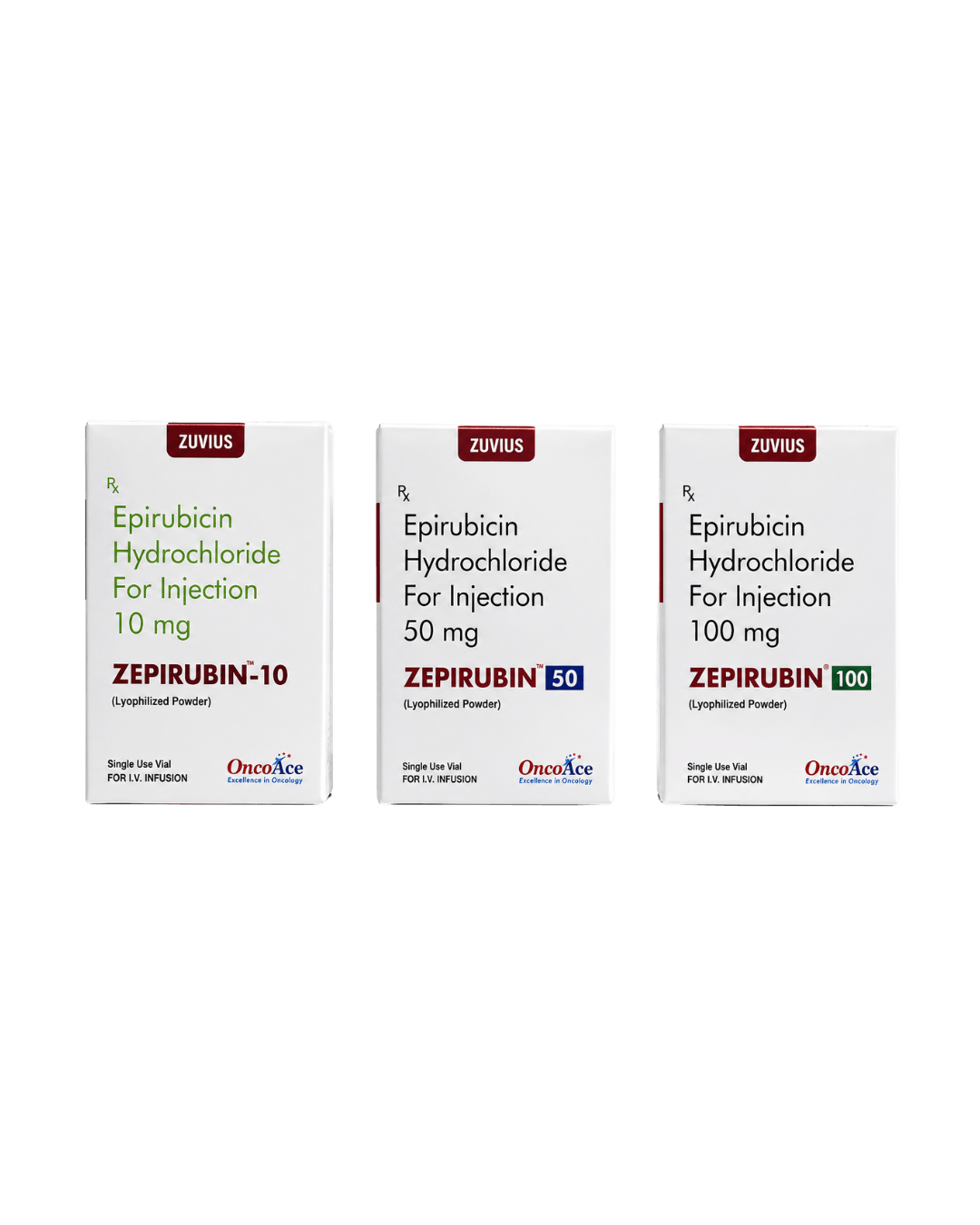
Zepirubin
Epirubicin Injection

Strength
✓10 mg✓50 mg✓100 mg

Pack Size
1 Vial

Drug Class
Anthracyclines and Related Substances

Specification
USP/BP/IH Specs offered for exports

Storage
Store at 25°C to 30°C.
Epirubicin is an anthracycline cytotoxic agent and forms a complex with DNA by intercalation of its planar rings between nucleotide base pairs, with consequent inhibition of nucleic acid (DNA & RNA) and protein synthesis.
Such intercalation triggers DNA cleavage by topoisomerase II, resulting in cytocidal activity.
Epirubicin also inhibits DNA helicase activity, preventing the enzymatic separation of double-stranded DNA and interfering with replication and transcription.
Epirubicin is also involved in oxidation/reduction reactions by generating cytotoxic free radicals.
Epirubicin HCl Injection is indicated as a component of adjuvant therapy in patients with evidence of axillary node tumor involvement following resection of primary breast cancer.
Renal Function
Serum creatinine should be assessed before and during therapy.
Dosage adjustment is necessary in patients with serum creatinine >5 mg/dL.
Patients undergoing dialysis have not been studied.
Tumor Lysis Syndrome
As with other cytotoxic agents, Epirubicin HCl may induce hyperuricemia as a consequence of extensive purine catabolism that accompanies drug-induced rapid lysis of highly chemosensitive neoplastic cells (tumor lysis syndrome).
Other metabolic abnormalities may also occur.
While not generally a problem in patients with breast cancer, physicians should consider the potential for tumor lysis syndrome in potentially susceptible patients and should consider monitoring:
- Serum uric acid
- Potassium
- Calcium
- Phosphate
- Creatinine
immediately after initial chemotherapy administration.
Hydration, urine alkalinization and prophylaxis with allopurinol to prevent hyperuricemia may minimize potential complications of tumor lysis syndrome.
Epirubicin has been extensively investigated in patients with breast cancer and has been found to be a highly effective agent, both for the treatment of patients with metastatic disease and as an adjuvant therapy.
General
Epirubicin HCl injection is administered by intravenous infusion.
Venous sclerosis may result from an injection into a small vessel or from repeated injections into the same vein.
Extravasation of Epirubicin during the infusion may cause local pain, severe tissue lesions and necrosis.
It is recommended that Epirubicin HCl be slowly administered into the tubing of a freely running intravenous infusion.
If possible, veins over joints or in extremities with compromised venous or lymphatic drainage should be avoided.
The dose should be administered over 3-5 minutes.
A burning or stinging sensation may be indicative of perivenous infiltration and the infusion should be immediately terminated and restarted in another vein.
Perivenous infiltration may occur without causing pain.
Facial flushing as well as local erythematous streaking along the vein may be indicative of excessively rapid administration.
It may precede local phlebitis or thrombophlebitis.
Patients administered the 120 mg/m² regimen of Epirubicin HCl as a component of combination chemotherapy should also receive prophylactic antibiotic therapy with trimethoprim-sulfamethoxazole.
Laboratory Tests
Blood counts, including absolute neutrophil counts, and liver function should be assessed before and during each cycle of therapy with Epirubicin.
Repeated evaluations of LVEF should be performed during therapy.
There are known interactions between Epirubicin HCl and laboratory tests.
Carcinogenesis, Mutagenesis And Impairment Of Fertility
Treatment-related acute myelogenous leukemia has been reported in women treated with Epirubicin-based adjuvant chemotherapy regimens.
Conventional long-term animal studies to evaluate carcinogenic potential are not available.
Epirubicin HCl could induce chromosomal damage in human spermatozoa due to its genotoxic potential.
Men undergoing treatment with Epirubicin HCl should use effective contraceptive methods.
Epirubicin HCl may cause irreversible amenorrhoea (premature menopause) in premenopausal women.
Pregnancy Category D
Epirubicin HCl may cause fetal harm when administered to a pregnant woman.
Administration of 0.8 mg/kg/day intravenously of Epirubicin to rats during days 5-15 of gestation was embryotoxic and caused fetal harm.
Administration of 2 mg/kg/day intravenously of Epirubicin to rats on days 9 and 10 of gestation was embryotoxic, retarded fetal growth, decreased placental weight and was teratogenic causing numerous external, visceral and skeletal malformations.
Administration of intravenous Epirubicin to rabbits at doses up to 0.2 mg/kg/day during days 6 to 18 of gestation was not embryotoxic, but maternally toxic doses increased abortion and delayed ossification.
When Epirubicin is used as a single agent, the recommended dosage in adults is 60-90 mg/m² body area.
The drug should be injected intravenously over 3-5 minutes and depending on the patient's haematological status, the dose should be repeated at 21 day intervals.
Lower doses (60-75 mg/m²) are recommended for patients whose bone marrow function has already been impaired by:
- Previous chemotherapy
- Previous radiotherapy
- Advanced age
- Neoplastic bone marrow infiltration
The total dose per cycle may be divided over 2-3 successive days.
When the drug is used in combination with other antitumor agents, the doses need to be adequately reduced.
Since the major route of elimination of Epirubicin is the hepatobiliary system, the dosage should be reduced in patients with impaired liver function in order to avoid an increase of overall toxicity.
Moderate liver impairment
- Bilirubin: 1.4-3 mg/100 ml
- BSP retention: 9-15%
Requires a 50% reduction of dose.
Severe liver impairment
- Bilirubin >3 mg/100 ml
- BSP retention >15%
Necessitates further dose reduction.
Directions For Administration
Epirubicin should be administered by intravenous injection.
It is not active when given orally and should not be injected intramuscularly or intrathecally.
It is advisable to give the drug via the tubing of a freely running IV saline infusion after checking that the needle is well placed in the vein.
This method minimizes the risk of drug extravasation and ensures that the vein is flushed with saline after administration.
Extravasation of Epirubicin during injection may give rise to severe tissue lesions, even necrosis.
Venous sclerosis may result from injection into the same vein repeatedly.
Epirubicin should not be mixed with heparin due to chemical incompatibility, which may lead to precipitation when the drugs are in certain proportions.
Epirubicin can be used in combination with other antitumor agents, but it is not recommended that it be mixed with these drugs in the same syringe.
Preparation Of Infusion Solution
Zepirubin 10 mg should be reconstituted to 5 ml by adding Sterile Water for Injection I.P. and used within 24 hours after preparation.
Zepirubin 50 mg should be reconstituted to 25 ml by adding Sterile Water for Injection I.P. and used within 24 hours after preparation.
Intravenous administration of Epirubicin HCl should be performed with caution.
It is recommended that Epirubicin HCl be administered into the tubing of a freely flowing intravenous infusion (0.9% Sodium Chloride or 5% Glucose solution) over a period of 3-5 minutes.
The technique is intended to minimize the risk of thrombosis or perivenous extravasation.
A direct push injection is not recommended due to the risk of extravasation despite adequate blood return upon needle aspiration.
Venous sclerosis may result from injection into small vessels or repeated injection into the same vein.
Besides the above regimens, several other protocols have been discussed in different published articles.