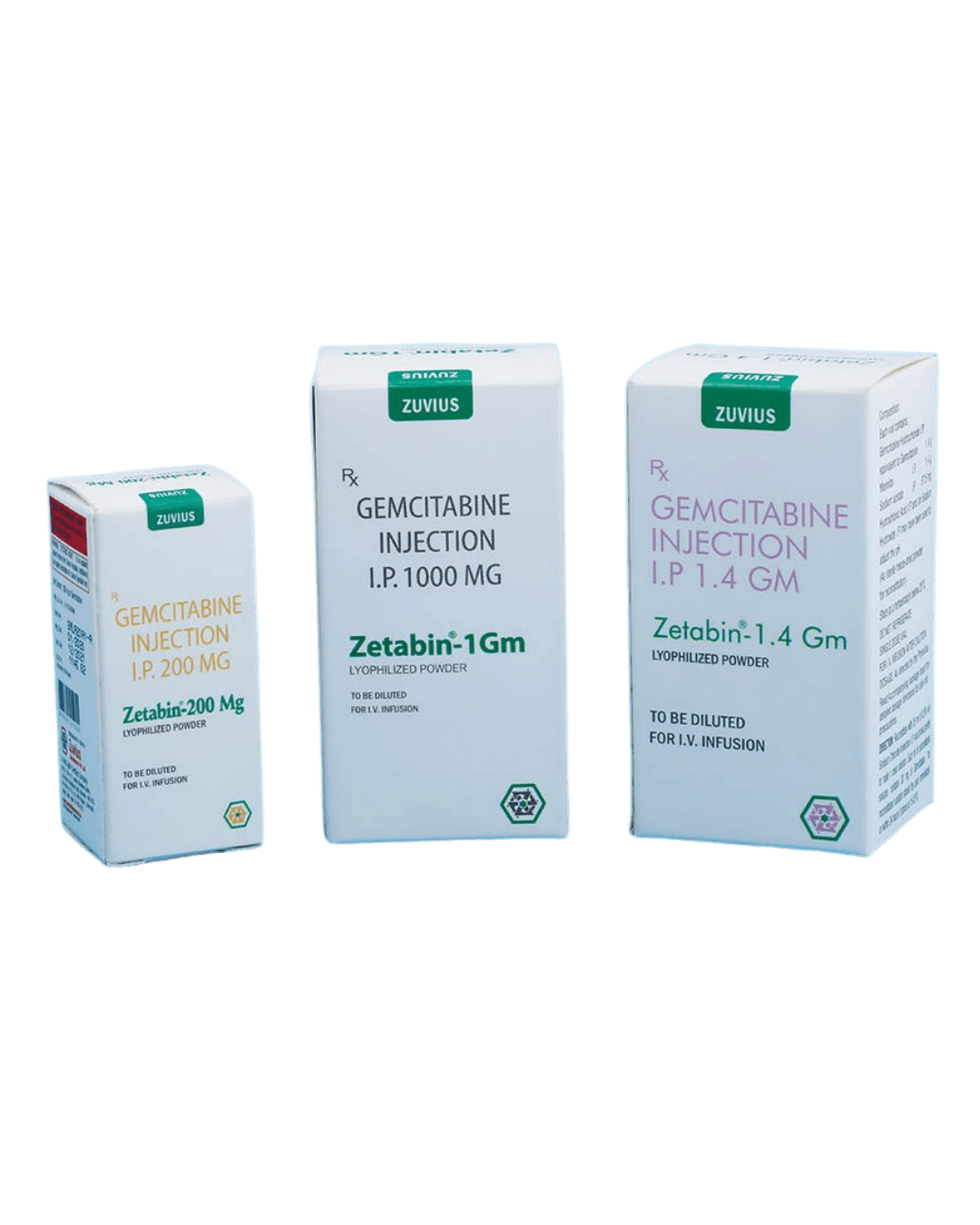
Zetabin
Gemcitabine Injection

Strength
✓200 mg✓1 gm✓1.4 gm

Pack Size
1 Vial

Drug Class
Anthracyclines and Related Substances

Specification
USP/BP/IH Specs offered for exports

Storage
Store at 25°C to 30°C.
Gemcitabine is a nucleoside metabolic inhibitor and antineoplastic agent belonging to the pyrimidine analogue class.
It exhibits potent antitumor activity by inhibiting DNA synthesis, leading to apoptosis of rapidly dividing cells.
Gemcitabine is active against a broad range of solid tumors and is widely used in the treatment of:
- Pancreatic cancer
- Non-small cell lung cancer
- Breast cancer
- Ovarian cancer
- Bladder cancer
First-line treatment of locally advanced or metastatic pancreatic adenocarcinoma in patients previously treated with 5-fluorouracil.
First-line treatment of locally advanced or metastatic non-small cell lung cancer (NSCLC).
Treatment of advanced ovarian cancer that has relapsed at least 6 months after completion of platinum-based therapy.
First-line treatment of metastatic breast cancer after failure of prior anthracycline-containing adjuvant chemotherapy, unless anthracyclines are clinically contraindicated.
Unlabelled Uses
- Biliary cancer
- Bladder cancer
- Relapsed or refractory testicular cancer
- Squamous cell carcinoma of the head and neck
Usage
Reconstitute with Sodium Chloride Injection I.P. and shake gently to make a clear solution.
Gemcitabine kills cells undergoing DNA synthesis and blocks the progression of cells through the G1/S-phase boundary.
Gemcitabine is metabolized by nucleoside kinases to diphosphate (dFdCDP) and triphosphate (dFdCTP) nucleosides.
It works by slowing or stopping the growth of cancer cells in your body.
- Read the label carefully before use.
- Do not exceed the recommended dose.
Pancreatic Adenocarcinoma
Adults
I.V. 1,000 mg/m² once weekly for 7 weeks, followed by 1 week of rest.
Dosage Adjustment
Based on degree of hematologic toxicity.
If marrow suppression is detected, modify gemcitabine dosage as follows:
- Absolute granulocyte count (AGC) is at least 1,000 × 10⁶/L and platelet count is at least 100,000 × 10⁶/L, give 100% of full dose.
- AGC is 500 to 999 × 10⁶/L or platelet count is 50,000 to 99,999 × 10⁶/L, give 75% of full dose.
- AGC is less than 500 × 10⁶/L or platelet count is less than 50,000 × 10⁶/L, hold dose.
Subsequent Cycles
Give the same dose once weekly for 3 consecutive weeks, followed by 1 week of rest.
After at least 7 doses (1 cycle), the dose may be increased to 1,250 mg/m² once weekly for 3 weeks, followed by 1 week of rest, if the following criteria are met:
- Nonhematologic toxicity is no greater than WHO Grade 1
- Platelet nadirs are greater than 100,000 × 10⁶/L
- AGC nadir is more than 1,500 × 10⁶/L
If patient still meets the above criteria after receiving 3 doses of the higher regimen, the gemcitabine dose may be increased to 1,500 mg/m² I.V. once weekly for 3 weeks, followed by 1 week of rest.
NSCLC
Adults
I.V. in combination with cisplatin, gemcitabine 1,000 mg/m² on Days 1, 8 and 15 of each 28-day cycle.
Alternatively, gemcitabine 1,250 mg/m² may be given I.V. on Days 1 and 8 of a 21-day cycle.
Dosage Adjustment
Reduce or delay the gemcitabine dose in patients with neutropenia or thrombocytopenia on the day of treatment.
- AGC is 500 to 999 × 10⁶/L or platelet count is 50,000 to 99,999 × 10⁶/L, give 75% of the prior dose.
- AGC is less than 500 × 10⁶/L or platelet count is less than 50,000 × 10⁶/L, hold dose.
For Grade 3 or 4 nonhematologic toxicity, hold gemcitabine or reduce the dose by 50%.
Dosage reduction is not required for severe alopecia or nausea and vomiting.
Dosage reduction may be necessary in renal or hepatic function impairment.
Use additional caution in these patients.
Ovarian Cancer
Adults
I.V. 1,000 mg/m² over 30 minutes on Days 1 and 8 of each 21-day cycle in combination with carboplatin.
Monitor prior to each dose with a CBC, including differential counts.
Prior to each cycle, the AGC should be at least 1,500 × 10⁶/L and the platelet count should be at least 100,000 × 10⁶/L.
Dosage Adjustment
Based on granulocyte and platelet counts on Day 8 of therapy.
If marrow suppression is detected
- AGC is 1,000 to 1,499 × 10⁶/L and/or platelet count is 75,000 to 99,999 × 10⁶/L, give 50% of full dose.
- AGC is less than 1,000 × 10⁶/L and/or platelet count is less than 75,000 × 10⁶/L, hold dose.
For severe nonhematologic toxicity, except nausea/vomiting, hold therapy or decrease dose by 50%.
Subsequent Cycles
Reduce the gemcitabine dose to 800 mg/m² on Days 1 and 8 if any of the following hematologic toxicities are present:
- AGC less than 500 × 10⁶/L for more than 5 days
- AGC less than 100 × 10⁶/L for more than 3 days
- Febrile neutropenia
- Platelet count less than 25,000 × 10⁶/L
- Cycle delay of more than 1 week because of toxicity
If any of the above recur after the initial dose reduction, for the subsequent cycle give gemcitabine 800 mg/m² on Day 1 only.
Breast Cancer
Adults
I.V. 1,250 mg/m² over 30 minutes on Days 1 and 8 of each 21-day cycle in combination with paclitaxel.
Monitor prior to each dose with a CBC, including differential.
Prior to each cycle, AGC should be at least 1,500 × 10⁶/L and platelet count should be at least 100,000 × 10⁶/L.
Dosage Adjustment
Based on granulocyte and platelet counts on Day 8 of therapy.
- AGC is 1,000 to 1,199 × 10⁶/L or platelet count is 50,000 to 75,000 × 10⁶/L, give 75% of full dose.
- AGC is 700 to 999 × 10⁶/L and platelet count is less than 50,000 × 10⁶/L, give 50% of full dose.
- AGC is less than 700 × 10⁶/L, hold gemcitabine.
For severe nonhematologic toxicity, except alopecia and nausea/vomiting, hold therapy or decrease dose by 50%.
General Advice
- Reconstitute with preservative-free Sodium Chloride 0.9%.
- Reconstituted solution may be administered directly or further diluted with Sodium Chloride 0.9% to a final gemcitabine concentration of at least 0.1 mg/mL.
- Administer by I.V. infusion over 30 minutes.
- Prolonging infusion past 60 minutes increases the risk of myelosuppression.
- Reconstituted gemcitabine is a clear, colorless to light straw-colored solution.
- Do not administer if particulate matter or discoloration is found.