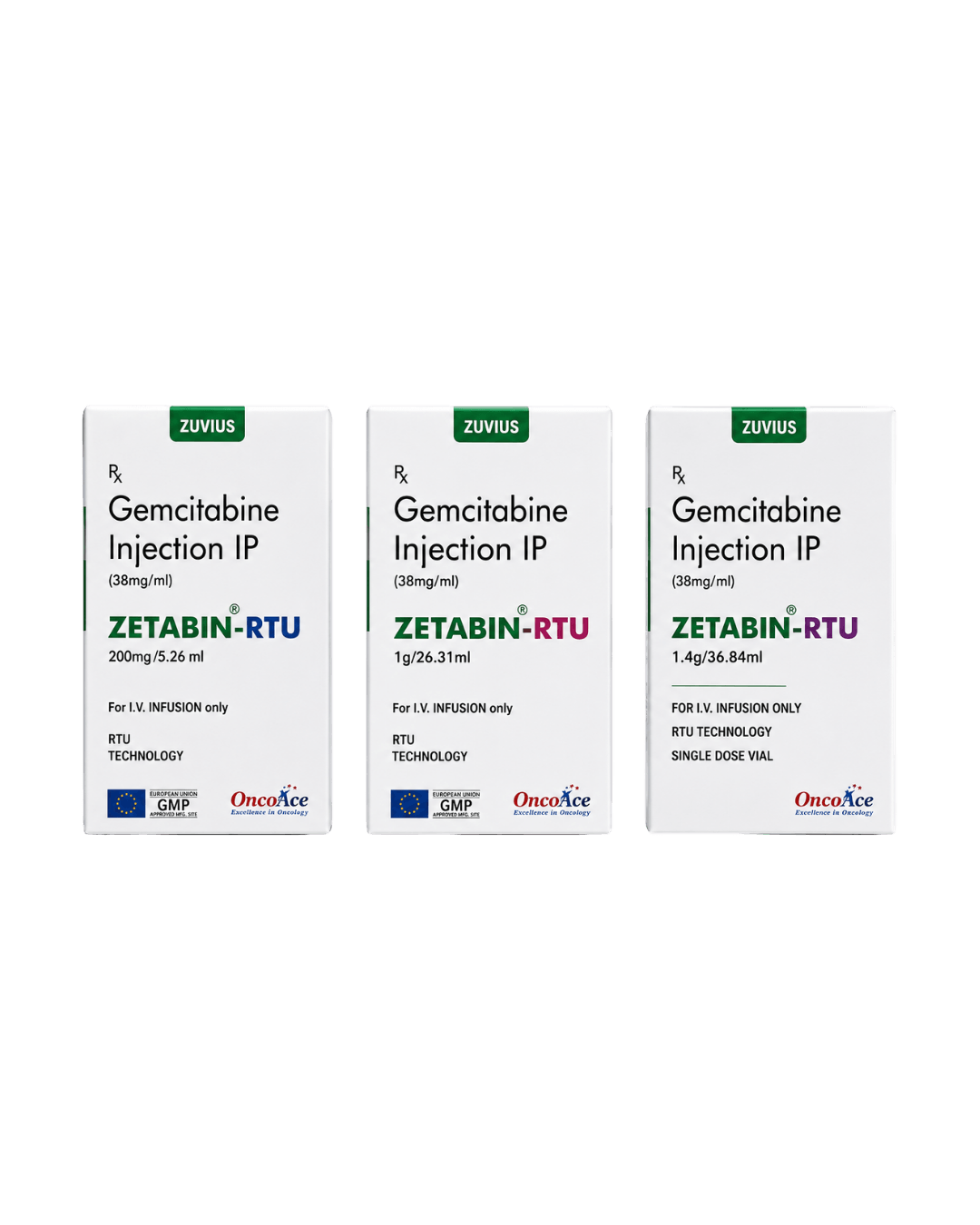
Zetabin RTU
Gemcitabine RTU Injection

Strength
✓200 mg✓1 gm✓1.4 gm

Pack Size
1 Vial

Drug Class
Anthracyclines and Related Substances

Specification
USP/BP/IH Specs offered for exports

Storage
Store at 25°C to 30°C.
Zetabin RTU contains Gemcitabine Hydrochloride, a nucleoside metabolic inhibitor with antitumour activity.
The chemical name of Gemcitabine Hydrochloride is 2'-deoxy-2',2'-difluorocytidine monohydrochloride, beta-isomer.
Its empirical formula is C9H11F2N3O4·HCl and its molecular weight is 299.66.
Gemcitabine Hydrochloride is soluble in water, slightly soluble in methanol and practically insoluble in ethanol and polar organic solvents.
Gemcitabine is supplied in sterile form for intravenous administration only.
The formulation may contain Gemcitabine Hydrochloride expressed as free base, together with mannitol and sodium acetate.
Hydrochloric acid and/or sodium hydroxide may be added for pH adjustment.
Zetabin RTU is indicated for the treatment of locally advanced or metastatic bladder cancer in combination with cisplatin.
It is indicated for the treatment of patients with locally advanced or metastatic adenocarcinoma of the pancreas.
In combination with cisplatin, Gemcitabine is indicated as first-line treatment for patients with locally advanced or metastatic non-small cell lung cancer.
Gemcitabine monotherapy may be considered in elderly patients or patients with a performance status of 2.
Gemcitabine is indicated for the treatment of patients with locally advanced or metastatic epithelial ovarian carcinoma in combination with carboplatin.
This use applies to patients with relapsed disease following a recurrence-free interval of at least 6 months after platinum-based first-line therapy.
In combination with paclitaxel, Gemcitabine is indicated for patients with unresectable, locally recurrent or metastatic breast cancer who have relapsed following adjuvant or neoadjuvant chemotherapy.
Previous chemotherapy should have included an anthracycline unless it was clinically contraindicated.
Gemcitabine kills cells undergoing DNA synthesis and blocks the progression of cells through the G1/S phase boundary of the cell cycle.
Gemcitabine is metabolised by nucleoside kinases into its active diphosphate and triphosphate nucleoside forms.
Gemcitabine diphosphate inhibits ribonucleotide reductase, an enzyme involved in the production of deoxynucleoside triphosphates required for DNA synthesis.
This reduces intracellular concentrations of deoxynucleotides, including deoxycytidine triphosphate.
Gemcitabine triphosphate competes with deoxycytidine triphosphate for incorporation into DNA.
The reduction in intracellular deoxycytidine triphosphate enhances the incorporation of Gemcitabine triphosphate into DNA, a process known as self-potentiation.
After a Gemcitabine nucleotide is incorporated into DNA, only one additional nucleotide is added to the growing DNA strand.
This eventually results in termination of DNA synthesis and initiation of apoptotic cancer cell death.
General Safety Information
- Keep Gemcitabine out of the reach of children.
- Gemcitabine should only be administered under the supervision of a healthcare professional experienced in anticancer treatment.
Allergy
Do not receive Gemcitabine if you are allergic to Gemcitabine or any other ingredient in the formulation.
Pregnancy
Gemcitabine is not recommended for use during pregnancy.
Breastfeeding
Gemcitabine is not recommended for use in breastfeeding women.
Alcohol
Avoid consuming alcohol during treatment because it may increase sleepiness or dizziness.
Kidney Disease
Gemcitabine should be used with caution in patients who have or previously had kidney disease.
Consult your doctor before receiving treatment.
Liver Disease
Gemcitabine should be used with caution in patients who have or previously had liver disease.
Consult your doctor before receiving treatment.
Heart and Vascular Disease
Gemcitabine should be used with caution in patients who have or previously had heart or blood vessel disease.
Consult your doctor before receiving treatment.
Ovarian Cancer
- The recommended dose of Gemcitabine is 1000 mg/m² administered as an intravenous infusion over 30 minutes on Days 1 and 8 of each 21-day treatment cycle.
- Gemcitabine is administered in combination with carboplatin AUC 4.
- Carboplatin should be administered intravenously after Gemcitabine on Day 1 of each 21-day cycle.
Breast Cancer
- The recommended dose of Gemcitabine is 1250 mg/m² administered intravenously over 30 minutes on Days 1 and 8 of each 21-day cycle.
- Gemcitabine is administered in combination with paclitaxel.
- Paclitaxel should be administered at a dose of 175 mg/m² on Day 1 as a 3-hour intravenous infusion before Gemcitabine administration.
Non-Small Cell Lung Cancer – Four-Week Schedule
- The recommended dose of Gemcitabine is 1000 mg/m² administered intravenously over 30 minutes on Days 1, 8 and 15.
- Gemcitabine is administered in combination with cisplatin.
- Cisplatin should be administered intravenously at a dose of 100 mg/m² on Day 1 after the Gemcitabine infusion.
Non-Small Cell Lung Cancer – Three-Week Schedule
- The recommended dose of Gemcitabine is 1250 mg/m² administered intravenously over 30 minutes on Days 1 and 8.
- Gemcitabine is administered in combination with cisplatin.
- Cisplatin should be administered intravenously at a dose of 100 mg/m² on Day 1 after the Gemcitabine infusion.
The exact dosage and treatment schedule should be determined by the treating oncologist based on the patient's condition, treatment protocol and tolerance.