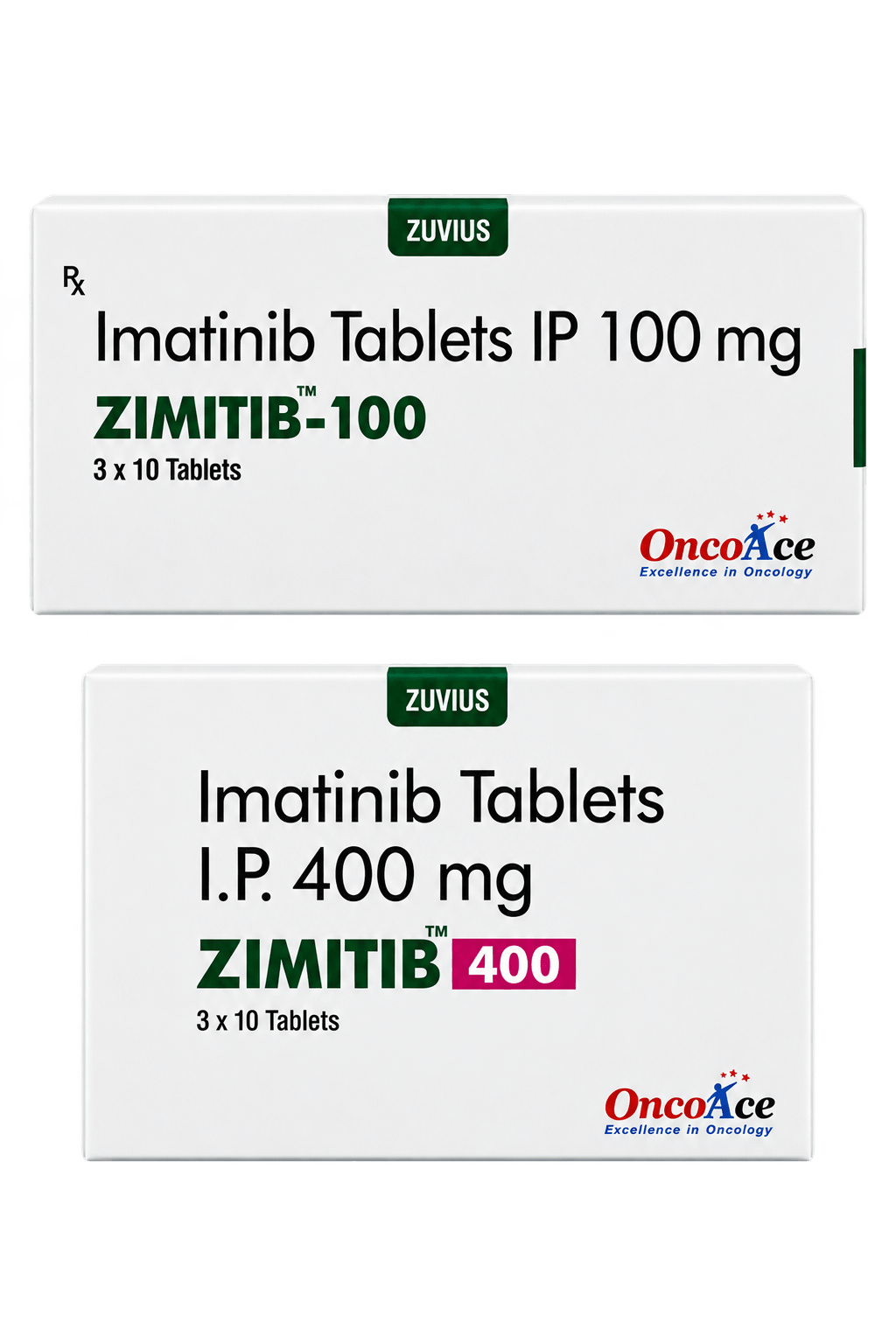
Zimitib
Imatinib Tablets

Strength
✓100mg✓400mg

Pack Size
1 x 10

Drug Class
Protein-Tyrosine Kinase Inhibitor

Specification
USP/BP/IH Specs offered for exports

Storage
Store at 25°C to 30°C.
Zimitib contains Imatinib, a small-molecule protein-tyrosine kinase inhibitor.
Each film-coated tablet contains Imatinib Mesylate equivalent to 400 mg of Imatinib free base.
Imatinib Mesylate is a white to off-white, brownish or yellowish crystalline powder.
Its chemical name is 4-[(4-Methyl-1-piperazinyl)methyl]-N-[4-methyl-3-[[4-(3-pyridinyl)-2-pyrimidinyl]amino]phenyl]benzamide methanesulfonate.
The molecular formula of Imatinib Mesylate is C29H31N7O·CH4SO3 and its molecular weight is 589.7.
Imatinib Mesylate is soluble in aqueous buffers with a pH of 5.5 or below but is very slightly soluble or insoluble in neutral and alkaline aqueous buffers.
In non-aqueous solvents, it ranges from freely soluble to very slightly soluble in dimethyl sulfoxide, methanol and ethanol.
It is insoluble in n-octanol, acetone and acetonitrile.
Zimitib is indicated for the treatment of
Newly Diagnosed Philadelphia Chromosome-Positive Chronic Myeloid Leukaemia
- Newly diagnosed adult and paediatric patients with Philadelphia chromosome-positive chronic myeloid leukaemia in the chronic phase.
Philadelphia Chromosome-Positive CML After Interferon-Alpha Therapy
- Patients with Ph-positive CML in blast crisis.
- Patients with Ph-positive CML in the accelerated phase.
- Patients with chronic-phase Ph-positive CML after failure of interferon-alpha therapy.
Philadelphia Chromosome-Positive Acute Lymphoblastic Leukaemia
- Adult patients with relapsed or refractory Ph-positive acute lymphoblastic leukaemia.
- Paediatric patients with newly diagnosed Ph-positive acute lymphoblastic leukaemia in combination with chemotherapy.
Myelodysplastic and Myeloproliferative Diseases
- Adult patients with myelodysplastic or myeloproliferative diseases associated with platelet-derived growth factor receptor gene rearrangements.
Aggressive Systemic Mastocytosis
- Adult patients with aggressive systemic mastocytosis without the D816V c-Kit mutation or where c-Kit mutational status is unknown.
Other Uses
Imatinib may also be used for certain types of leukaemia, gastrointestinal stromal tumours and other cancers or disorders involving abnormal blood cells.
Imatinib and other tyrosine kinase inhibitors have significantly changed the management of chronic myeloid leukaemia.
Imatinib inhibits abnormal tyrosine kinase signalling involved in the growth and survival of malignant cells.
Published studies evaluating generic Imatinib formulations have generally demonstrated comparable bioequivalence and bioavailability to the original branded formulation.
In most clinical studies, generic Imatinib demonstrated comparable efficacy and safety in newly diagnosed patients and in patients switched from the original formulation.
Some studies have reported variations in efficacy and toxicity between different generic products, which may be related to differences between formulations and treatment settings.
The availability of generic Imatinib has also considerably reduced treatment costs for patients and healthcare systems.
Overall, generic Imatinib has generally shown effective disease control with an acceptable safety profile.
General Safety Information
- Keep Zimitib out of the reach of children.
- Read the product label carefully before use.
- Zimitib should be used only under the supervision of a doctor experienced in treating cancer and blood disorders.
Fluid Retention and Oedema
Zimitib may cause oedema and occasionally serious fluid retention.
Patients should be monitored for
- Unexpected or rapid weight gain
- Swelling of the hands, feet or ankles
- Pleural effusion
- Pulmonary oedema
- Ascites
The likelihood of fluid retention may be greater with higher doses and in patients older than 65 years.
Haematological Toxicity
Treatment may cause
- Anaemia
- Neutropenia
- Thrombocytopenia
Complete blood counts should generally be performed
- Weekly during the first month.
- Every 2 weeks during the second month.
- Periodically thereafter according to clinical requirements.
Severe Congestive Heart Failure
Severe congestive heart failure and reduced left ventricular function have occasionally been reported.
Patients with existing heart disease, advanced age or cardiovascular risk factors should be monitored closely.
Hepatotoxicity
Severe liver toxicity may occur.
Liver function tests, including transaminases, bilirubin and alkaline phosphatase, should be performed before treatment and periodically during therapy.
Treatment interruption or dose reduction may be required.
Haemorrhage
Serious bleeding reactions have been reported, including
- Gastrointestinal bleeding
- Intratumoral bleeding
Patients should report unusual bleeding or bruising immediately.
Gastrointestinal Disorders
Zimitib may cause gastrointestinal irritation.
Take the medicine with food and a large glass of water.
Rare cases of gastrointestinal perforation, including fatal cases, have been reported.
Dermatological Toxicity
Serious skin reactions may occur, including
- Erythema multiforme
- Stevens-Johnson syndrome
Pregnancy
Zimitib can cause fetal harm.
Women of reproductive potential should avoid becoming pregnant during treatment.
Breastfeeding
It is not known whether Imatinib or its metabolites pass into human milk.
A doctor should decide whether breastfeeding or treatment should be discontinued.
Fertility
The effect of Imatinib on male fertility and sperm production has not been fully established.
Patients concerned about fertility should consult their doctor.
General Administration
- Zimitib should be taken orally with a meal and a large glass of water.
- A dose of 400 mg or 600 mg should generally be administered once daily.
- A dose of 800 mg should be administered as 400 mg twice daily.
- Treatment may be continued as long as there is no evidence of progressive disease or unacceptable toxicity.
Adult Patients with Philadelphia Chromosome-Positive CML
- The recommended dose for adult patients with chronic-phase CML is 400 mg once daily.
- The recommended dose for adult patients with accelerated-phase CML or blast crisis is 600 mg once daily.
Dose Escalation in CML
In the absence of severe adverse reactions, non-leukaemia-related neutropenia or thrombocytopenia, the dose may be increased:
- From 400 mg to 600 mg daily in patients with chronic-phase CML.
- From 600 mg to 800 mg daily, administered as 400 mg twice daily, in patients with accelerated-phase CML or blast crisis.
Dose escalation may be considered in cases of
- Disease progression at any time.
- Failure to achieve a satisfactory haematological response after at least 3 months.
- Failure to achieve a cytogenetic response after 6 to 12 months.
- Loss of a previously achieved haematological or cytogenetic response.
Paediatric Patients with Philadelphia Chromosome-Positive CML
- The recommended dose for newly diagnosed paediatric patients is 340 mg/m² per day, not exceeding 600 mg daily.
- The recommended dose for children with recurrent chronic-phase CML following stem-cell transplantation or resistance to interferon-alpha treatment is 260 mg/m² per day.
Philadelphia Chromosome-Positive Acute Lymphoblastic Leukaemia
- The recommended adult dose for relapsed or refractory Ph-positive ALL is 600 mg daily.
Gastrointestinal Stromal Tumours
- The recommended dose for adults with unresectable and/or metastatic malignant gastrointestinal stromal tumours is 400 mg or 600 mg daily.
Strong CYP3A4 Inducers
Concomitant use of strong CYP3A4 inducers should be avoided.
Examples include
- Dexamethasone
- Phenytoin
- Carbamazepine
- Rifampicin
- Rifabutin
- Phenobarbital
If concurrent administration cannot be avoided, the Zimitib dose may require an increase of at least 50%, with close monitoring of clinical response.
Hepatic Impairment
- No initial dose adjustment is generally required in patients with mild or moderate hepatic impairment.
- A 25% reduction in the recommended dose should be considered in patients with severe hepatic impairment.
Hepatotoxicity
If bilirubin rises above 3 times the institutional upper limit of normal or liver transaminases rise above 5 times the upper limit of normal:
- Withhold Zimitib until bilirubin is below 1.5 times the upper limit and transaminases are below 2.5 times the upper limit.
- Treatment may then be restarted at a reduced dose.
Examples of adult dose reductions include
- 400 mg reduced to 300 mg.
- 600 mg reduced to 400 mg.
- 800 mg reduced to 600 mg.
Severe Non-Haematological Reactions
If severe hepatotoxicity, severe fluid retention or another serious non-haematological reaction occurs, treatment should be withheld until the event resolves.
Treatment may then be restarted at an appropriate reduced dose based on the severity of the reaction.