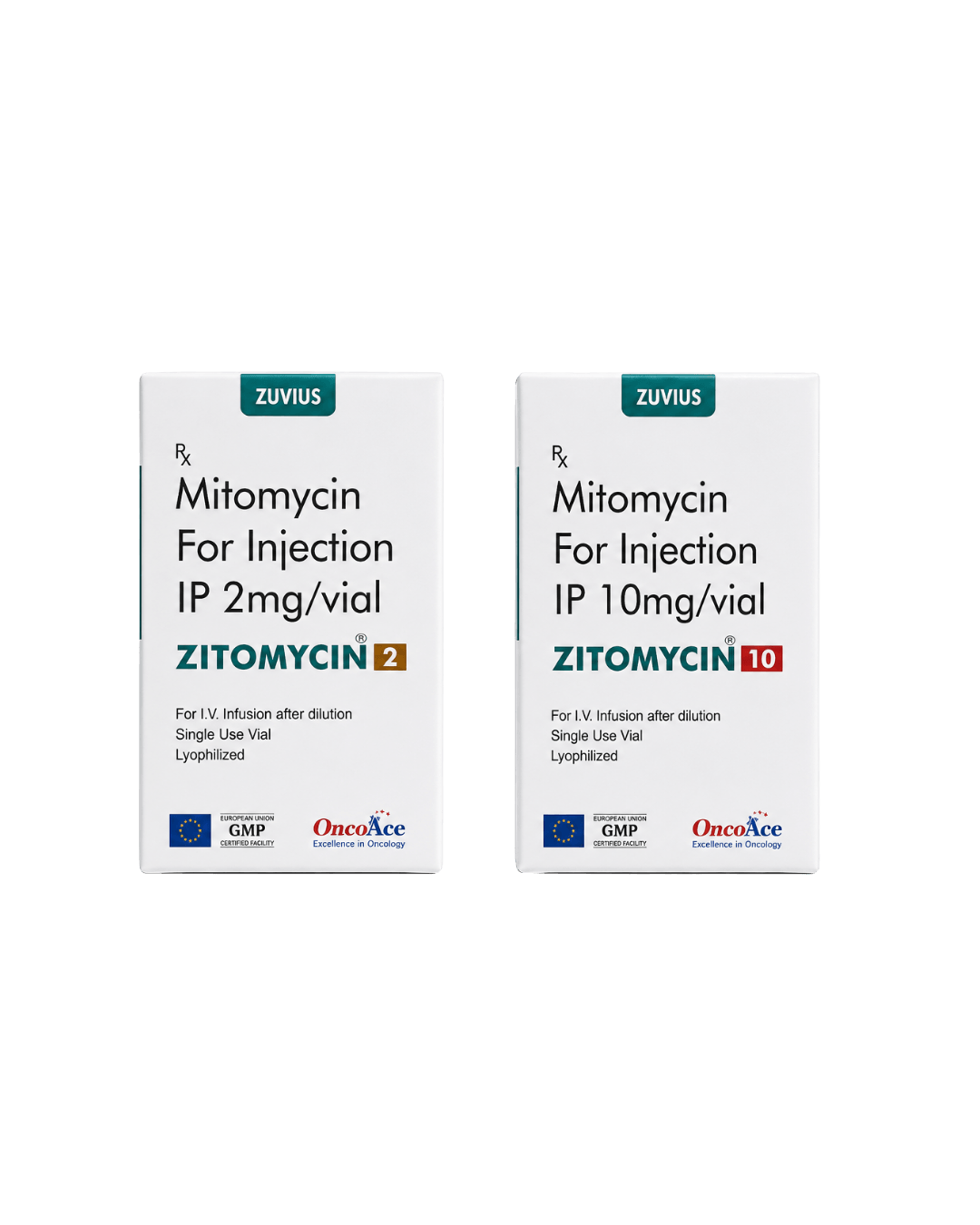
Zitomycin
Mitomycin Injection

Strength
✓2 mg✓10 mg✓40 mg

Pack Size
1 Vial

Drug Class
Antineoplastics, Antibiotic

Specification
USP/BP/IH Specs offered for exports

Storage
Store at 25°C to 30°C.
Mitomycin is an antibiotic isolated from the broth of Streptomyces verticillus Yingtanensis which has been shown to have antimetabolic activity.
Mitomycin is a blue-violet crystalline powder with the molecular formula:
C₁₅H₁₈N₄O₅
and a molecular weight of 334.33.
Its chemical name is
7-amino-9α-methoxymitosane.
Mitomycin is a sterile lyophilised mixture of mitomycin and mannitol, which, when reconstituted with sterile water for injection, provides a solution for application in glaucoma filtration surgery.
Mitomycin is supplied in vials containing 0.2 mg of mitomycin.
Each vial also contains mannitol 0.4 mg, at a 1:2 ratio of mitomycin to mannitol.
Each mL of reconstituted solution contains
- 0.2 mg mitomycin
and has a pH between
- 5.0 and 8.0
Zitomycin is not recommended as single-agent primary therapy.
It has been shown to be useful in the therapy of disseminated adenocarcinoma of the stomach or pancreas in proven combinations with other approved chemotherapeutic agents and as palliative treatment when other modalities have failed.
Zitomycin is not recommended to replace appropriate surgery and/or radiotherapy.
Usage
As directed by the physicians.
Zitomycin selectively inhibits the synthesis of deoxyribonucleic acid (DNA).
The guanine and cytosine content correlates with the degree of zitomycin-induced cross-linking.
At high concentrations of the drug, cellular RNA and protein synthesis are also suppressed.
In humans, Zitomycin is rapidly cleared from the serum after intravenous administration.
Time required to reduce the serum concentration by 50% after a 30 mg bolus injection is 17 minutes.
After injection of
- 30 mg
- 20 mg
- 10 mg IV
the maximal serum concentrations were
- 2.4 µg/mL
- 1.7 µg/mL
- 0.52 µg/mL
respectively.
Clearance is effected primarily by metabolism in the liver, but metabolism occurs in other tissues as well.
The rate of clearance is inversely proportional to the maximal serum concentration because it is thought to be due to saturation of the degradative pathways.
Approximately 10% of a dose of Zitomycin is excreted unchanged in the urine.
Since metabolic pathways are saturated at relatively low doses, the percent of a dose excreted in urine increases with increasing dose.
In children, excretion of intravenously administered Zitomycin is similar.
- Read the label carefully before use.
- Store between 15°C to 30°C.
- Protect from light.
- Keep out of the reach of children.
Zitomycin should be given intravenously only, using care to avoid extravasation of the compound.
If extravasation occurs, cellulitis, ulceration, and slough may result.
Each vial contains either
- Mitomycin 2 mg and mannitol (q.s.)
or
- Mitomycin 10 mg and mannitol (q.s.)
If the product does not dissolve immediately, allow it to stand at room temperature until a solution is obtained.
After full haematological recovery from any previous chemotherapy, the following dosage schedule may be used at 6 to 8 week intervals.
Because of cumulative myelosuppression, patients should be fully re-evaluated after each course of Zitomycin, and the dose reduced if the patient has experienced any toxicities.
Doses greater than 20 mg/m² have not been shown to be more effective and are more toxic than lower doses.