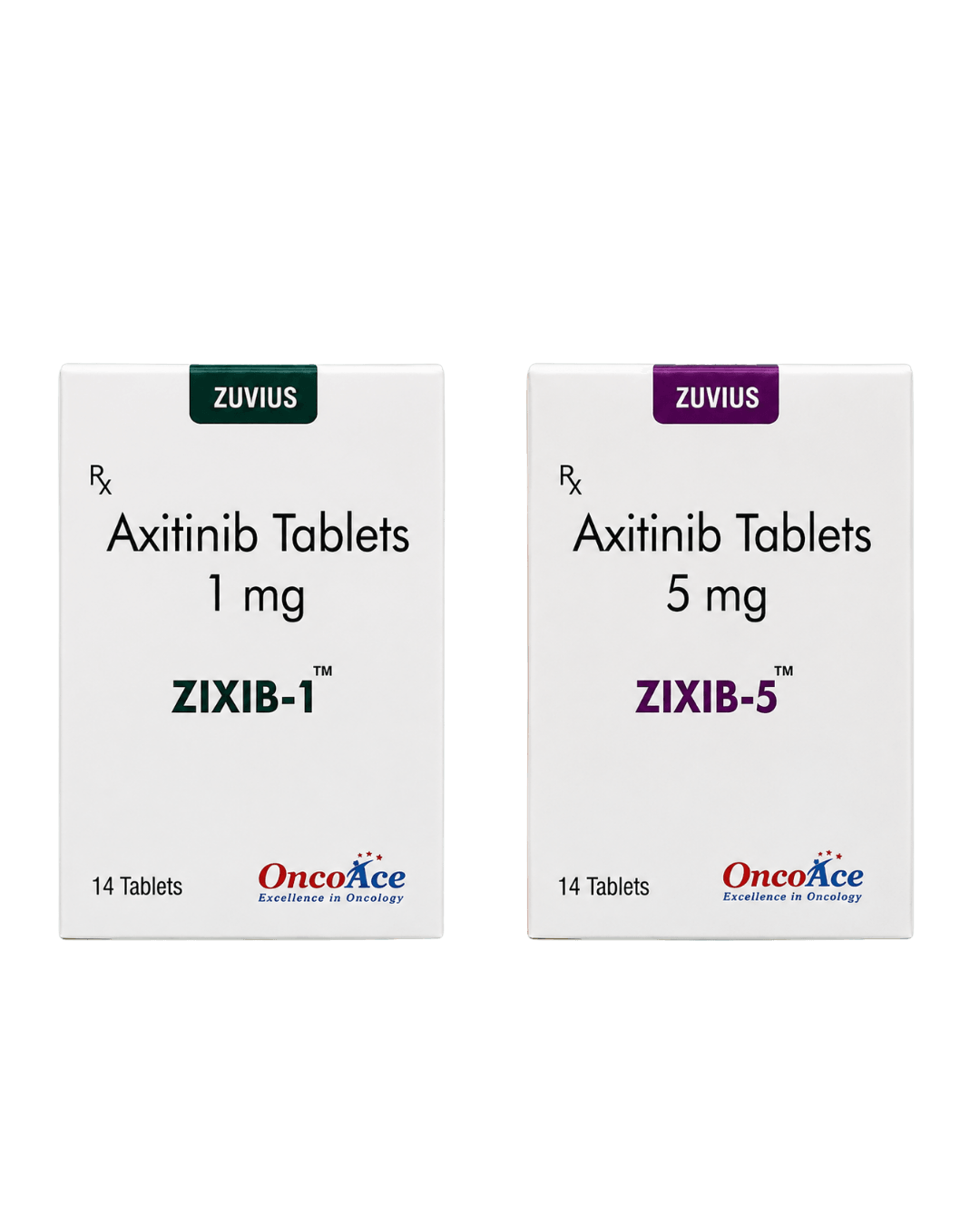
Zixib
Axitinib Tablets

Strength
✓1 mg✓5 mg

Pack Size
1 x 14

Drug Class
Antineoplastics, Tyrosine Kinase Inhibitor

Specification
USP/BP/IH Specs offered for exports

Storage
Store at 25°C to 30°C.
Axitinib is a kinase inhibitor.
Axitinib has the chemical name
N-methyl-2-[3-((E)-2-pyridin-2-yl-vinyl)-1H-indazol-6-ylsulfanyl]-benzamide.
The molecular formula is C₂₂H₁₈N₄OS, and the molecular weight is 386.47 Daltons.
Axitinib is a white to light-yellow powder with a pKa of 4.8.
The solubility of axitinib in aqueous media over the range pH 1.1 to pH 7.8 is in excess of 0.2 μg/mL.
The partition coefficient (n-octanol/water) is 3.5.
First-Line Advanced Renal Cell Carcinoma
Axitinib in combination with avelumab is indicated for the first-line treatment of patients with advanced renal cell carcinoma (RCC).
Axitinib in combination with pembrolizumab is indicated for the first-line treatment of patients with advanced renal cell carcinoma.
Second-Line Advanced Renal Cell Carcinoma
Axitinib as a single agent is indicated for the treatment of advanced renal cell carcinoma (RCC) after failure of one prior systemic therapy.
The safety and efficacy of axitinib were evaluated in a randomised, open-label, multicentre Phase 3 study.
Patients (N = 723) with advanced RCC whose disease had progressed on or after treatment with one prior systemic therapy, including sunitinib-, bevacizumab-, temsirolimus-, or cytokine-containing regimens, were randomised (1:1) to receive axitinib (N = 361) or sorafenib (N = 362).
The primary endpoint, progression-free survival (PFS), was assessed using a blinded independent central review.
Secondary endpoints included objective response rate (ORR) and overall survival (OS).
Of the patients enrolled in this study, 389 patients (53.8%) had received one prior sunitinib-based therapy, 251 patients (34.7%) had received one prior cytokine-based therapy (interleukin-2 or interferon-alpha), 59 patients (8.2%) had received one prior bevacizumab-based therapy, and 24 patients (3.3%) had received one prior temsirolimus-based therapy.
The baseline demographic and disease characteristics were similar between the axitinib and sorafenib groups with regard to age, gender, race, Eastern Cooperative Oncology Group (ECOG) performance status, geographic region, and prior treatment.
In the overall patient population and the two main subgroups (prior sunitinib treatment and prior cytokine treatment), there was a statistically significant advantage for axitinib over sorafenib for the primary endpoint of PFS.
The magnitude of the median PFS effect was different in the subgroups by prior therapy.
Two of the subgroups were too small to give reliable results (prior temsirolimus treatment or prior bevacizumab treatment).
There were no statistically significant differences between the arms in OS in the overall population or in the subgroups by prior therapy.
Major toxicity findings in mice and dogs following repeated dosing for up to 9 months were the gastrointestinal, haematopoietic, reproductive, skeletal and dental systems, with No Observed Adverse Effect Levels (NOAEL) approximately equivalent to or below expected human exposure at the recommended clinical starting dose (based on AUC levels).
Carcinogenicity
Carcinogenicity studies have not been performed with axitinib.
Genotoxicity
Axitinib was not mutagenic or clastogenic in conventional genotoxicity assays in vitro.
A significant increase in polyploidy was observed in vitro at concentrations > 0.22 µg/mL, and an elevation in micronucleated polychromatic erythrocytes was observed in vivo with a no-observed-effect level (NOEL) 69-fold the expected human exposure.
Genotoxicity findings are not considered clinically relevant at exposure levels observed in humans.
Reproduction Toxicity
Axitinib-related findings in the testes and epididymis included decreased organ weight, atrophy or degeneration, decreased numbers of germinal cells, hypospermia or abnormal sperm forms, and reduced sperm density and count.
These findings were observed in mice at exposure levels approximately 12-fold the expected human exposure and in dogs at exposure levels below the expected human exposure.
There was no effect on mating or fertility in male mice at exposure levels approximately 57-fold the expected human exposure.
Findings in females included signs of delayed sexual maturity, reduced or absent corpora lutea, decreased uterine weights and uterine atrophy at exposures approximately equivalent to the expected human exposure.
Reduced fertility and embryonic viability were observed in female mice at all doses tested, with exposure levels at the lowest dose approximately 10-fold the expected human exposure.
Pregnant mice exposed to axitinib showed an increased occurrence of cleft palate malformations and skeletal variations, including delayed ossification, at exposure levels below the expected human exposure.
Perinatal and postnatal developmental toxicity studies have not been conducted.
Toxicity Findings In Immature Animals
Reversible physeal dysplasia was observed in mice and dogs given axitinib for at least 1 month at exposure levels approximately six-fold higher than the expected human exposure.
Partially reversible dental caries were observed in mice treated for more than 1 month at exposure levels similar to the expected human exposure.
Other toxicities of potential concern to paediatric patients have not been evaluated in juvenile animals.
Recommended Dosing
First-Line Advanced RCC
The recommended dose of AXITINIB is 5 mg orally taken twice daily (12 hours apart) with or without food in combination with avelumab 800 mg administered as an intravenous infusion over 60 minutes every 2 weeks until disease progression or unacceptable toxicity.
When AXITINIB is used in combination with avelumab, dose escalation of AXITINIB above the initial 5 mg dose may be considered at intervals of two weeks or longer.
The recommended dose of AXITINIB is 5 mg orally twice daily (12 hours apart) with or without food in combination with pembrolizumab 200 mg every 3 weeks or 400 mg every 6 weeks administered as an intravenous infusion over 30 minutes until disease progression or unacceptable toxicity.
When AXITINIB is used in combination with pembrolizumab, dose escalation of AXITINIB above the initial 5 mg dose may be considered at intervals of six weeks or longer.
Second-Line Advanced RCC
When AXITINIB is used as a single agent, the recommended starting oral dose is 5 mg twice daily.
Administer AXITINIB doses approximately 12 hours apart with or without food.
Important Administration Instructions
Advise patients to swallow AXITINIB whole with a full glass of water.
If the patient vomits or misses a dose, an additional dose should not be taken.
Advise the patient to take the next prescribed dose at the usual time.