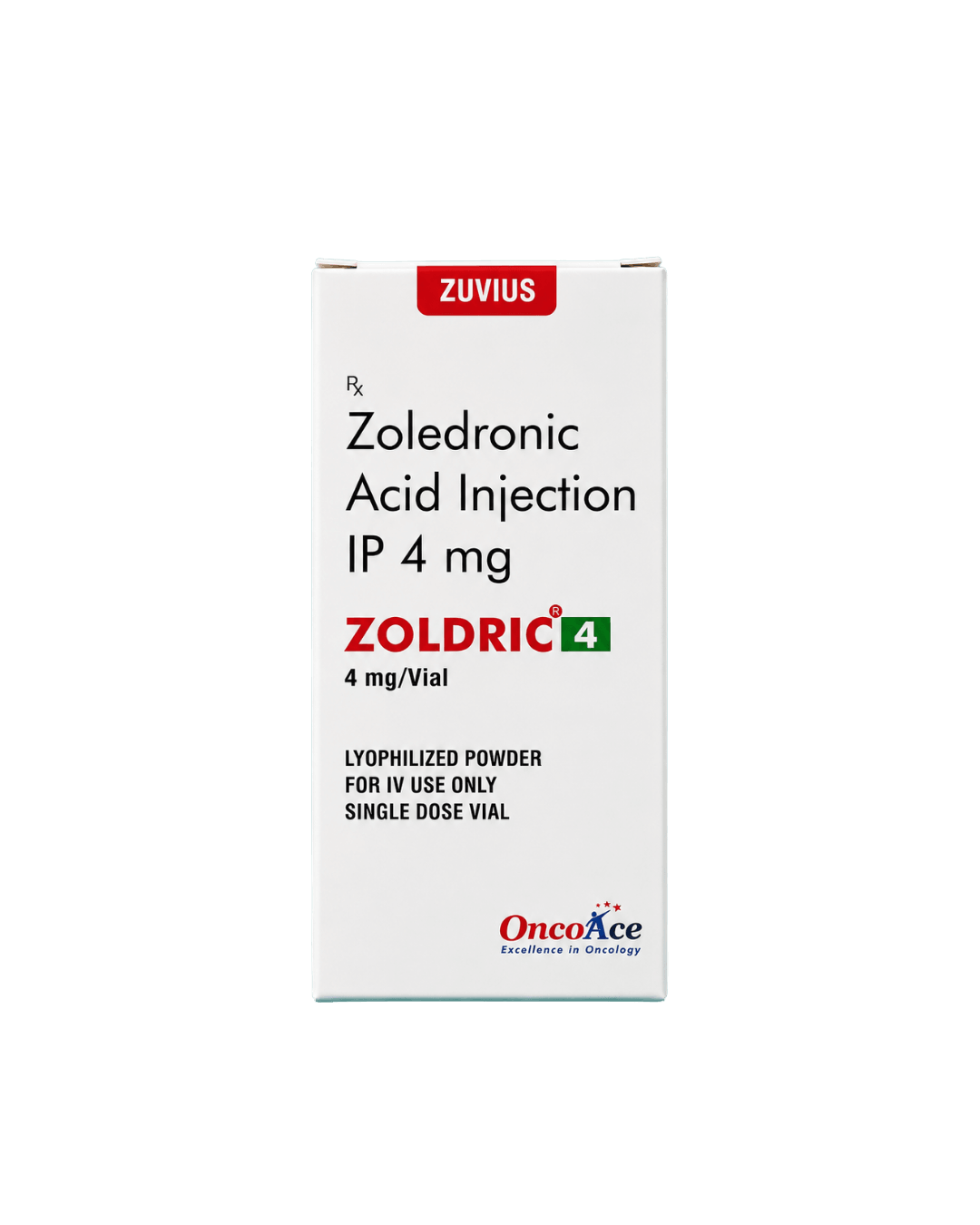
Zoldric
Zoledronic Acid Injection

Strength
✓4 mg

Pack Size
1 Vial

Drug Class
Bisphosphonate Derivatives, Calcium Metabolism Modifiers

Specification
USP/BP/IH Specs offered for exports

Storage
Store at 25°C to 30°C.
Zoledronic acid is a bisphosphonic acid which is an inhibitor of osteoclastic bone resorption.
Zoledronic acid is designated chemically as
(1-Hydroxy-2-imidazol-1-yl-phosphonoethyl) phosphonic acid monohydrate.
Zoledronic acid is a white crystalline powder.
Its molecular formula is
C₅H₁₀N₂O₇P₂•H₂O
Its molar mass is 290.1 g/mol.
Zoledronic acid is highly soluble in 0.1N sodium hydroxide solution, sparingly soluble in water and 0.1N hydrochloric acid, and practically insoluble in organic solvents.
The pH of a 0.7% solution of zoledronic acid in water is approximately 2.0.
Zoledronic acid is available in 100 mL bottles as a sterile liquid ready-to-use solution for intravenous infusion and in 5 mL vials as a sterile liquid concentrate solution for intravenous infusion.
Hypercalcemia Of Malignancy
Zoledronic is indicated for the treatment of hypercalcemia of malignancy defined as an albumin-corrected calcium (cCa) of greater than or equal to 12 mg/dL [3.0 mmol/L] using the formula:
cCa in mg/dL = Ca in mg/dL + 0.8 (4.0 g/dL - patient albumin [g/dL])
Multiple Myeloma And Bone Metastases Of Solid Tumors
Zoledronic is indicated for the treatment of patients with multiple myeloma and patients with documented bone metastases from solid tumors, in conjunction with standard antineoplastic therapy.
Prostate cancer should have progressed after treatment with at least one hormonal therapy.
Important Limitation Of Use
The safety and efficacy of Zoledronic in the treatment of hypercalcemia associated with hyperparathyroidism or with other non-tumour-related conditions have not been established.
Osteoporosis is a significant cause of morbidity and mortality in the elderly and an important public health issue.
Bisphosphonates are the primary treatment options for osteoporosis.
The oral administration of bisphosphonates may result in poor patient compliance and thence reduced treatment efficacy.
Intravenously administered bisphosphonates may therefore show better treatment efficacy.
A meta-analysis was carried out to evaluate the efficacy of zoledronic acid treatment for osteoporosis in both men and women with either vertebral or non-vertebral fracture.
Results
A significant reduction in the incidence of both vertebral and nonvertebral fracture was observed following ZOL treatment.
- Vertebral fractures: RR 0.24 (95% CI 0.15 to 0.40)
- Nonvertebral fractures: RR 0.76 (95% CI 0.67 to 0.86)
Bone mineral density (BMD) was also seen to be increased after ZOL treatment.
Conclusion
Zoledronic acid was effective in reducing the incidence of vertebral fractures as well as nonvertebral fractures, including hip fractures.
A significant increase in bone mineral density (BMD) was also observed in patients administered ZOL as compared to placebo.
Patients should be informed of the importance of
- Good dental hygiene
- Routine dental care
- Regular dental check-ups
Patients should be advised to immediately tell their doctor about any oral symptoms such as:
- Loosening of a tooth
- Pain
- Swelling
- Non-healing sores
- Oral discharge
during treatment with Zoledronic.
Zoledronic should not be given if the patient is pregnant, plans to become pregnant, or is breastfeeding.
Vials of Zoledronic concentrate for infusion contain overfill, allowing for the withdrawal of 5 mL of concentrate (equivalent to 4 mg of zoledronic acid).
This concentrate should immediately be diluted in 100 mL of sterile 0.9% sodium chloride, USP, or 5% dextrose injection, USP, following proper aseptic technique, and administered to the patient by infusion.
Do not store undiluted concentrate in a syringe to avoid inadvertent injection.
To prepare reduced doses for patients with baseline CrCl less than or equal to 60 mL/min, withdraw the specified volume of the zoledronic concentrate from the vial for the dose required.
The withdrawn concentrate must be diluted in 100 mL of sterile 0.9% sodium chloride, USP, or 5% dextrose injection, USP.
If not used immediately after dilution with infusion media, for microbiological integrity, the solution should be refrigerated at 2°C–8°C (36°F–46°F).
The refrigerated solution should then be equilibrated to room temperature prior to administration.
The total time between dilution, storage in the refrigerator, and end of administration must not exceed 24 hours.
Due to the risk of clinically significant deterioration in renal function, which may progress to renal failure:
- Single doses of Zoledronic should not exceed 4 mg
- Duration of infusion should be no less than 15 minutes
In the trials and in postmarketing experience, renal deterioration, progression to renal failure and dialysis have occurred in patients, including those treated with the approved dose of 4 mg infused over 15 minutes.
There have been instances of this occurring after the initial Zoledronic dose.