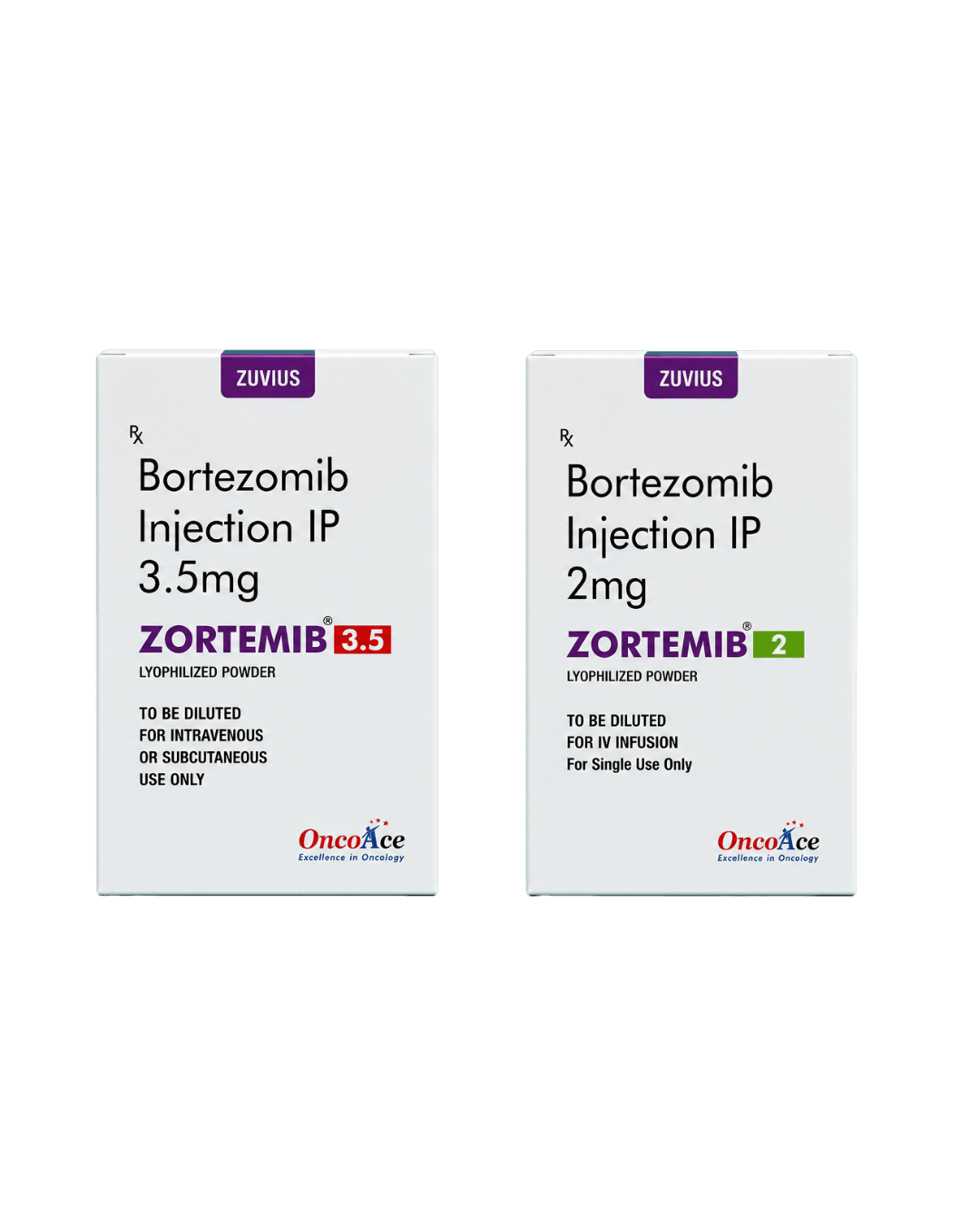
Zortemib
Bortezomib Injection

Strength
✓2 mg✓3.5 mg

Pack Size
1 Vial

Drug Class
Proteasome Inhibitor

Specification
USP/BP/IH Specs offered for exports

Storage
Store at 25°C to 30°C and protect from light.
Zortemib contains Bortezomib, an antineoplastic medicine intended for intravenous administration.
Bortezomib is a modified dipeptidyl boronic acid and belongs to the proteasome inhibitor class of anticancer medicines.
Each single-use vial contains Bortezomib as a sterile lyophilized powder.
The formulation is supplied as a mannitol boronic ester which, after reconstitution, exists in equilibrium with its hydrolysis product, the monomeric boronic acid.
The chemical name of Bortezomib is [(1R)-3-methyl-1-[[(2S)-1-oxo-3-phenyl-2-[(pyrazinylcarbonyl)amino]propyl]amino]butyl]boronic acid.
Its molecular formula is C19H25BN4O4 and its molecular weight is 384.24.
Zortemib is indicated for the treatment of
- Multiple myeloma
- Previously untreated multiple myeloma when used in combination with melphalan and prednisone
- Relapsed multiple myeloma
- Mantle cell lymphoma in patients who have received at least one previous treatment
Bortezomib is a proteasome inhibitor widely used in the treatment of multiple myeloma.
It interferes with the normal degradation of proteins within malignant cells.
The resulting accumulation of proteins disrupts several cellular signalling pathways and promotes cancer-cell death.
Clinical studies have demonstrated that Bortezomib-containing treatment regimens can provide meaningful responses in patients with multiple myeloma.
It has also demonstrated clinical activity in patients with mantle cell lymphoma who have received previous therapy.
Contraindications
Zortemib should not be used in patients with hypersensitivity to:
- Bortezomib
- Boron
- Mannitol
Peripheral Neuropathy
Zortemib may cause predominantly sensory peripheral neuropathy.
Severe sensory or motor neuropathy may also occur.
Patients should be monitored for
- Numbness
- Tingling
- Burning sensations
- Neuropathic pain
- Weakness in the hands or feet
New or worsening neuropathy may require a dosage reduction, interruption or discontinuation.
Hypotension
Postural or orthostatic hypotension may occur during treatment.
Use caution in patients who
- Have a history of fainting
- Are dehydrated
- Take medicines associated with low blood pressure
Management may include hydration and adjustment of antihypertensive medicines.
Cardiac Disorders
Treatment may cause or worsen
- Congestive heart failure
- Reduced left ventricular ejection fraction
- Pulmonary oedema
- Cardiac rhythm abnormalities
Patients with existing heart disease or cardiovascular risk factors should be monitored closely.
Pulmonary Disorders
Serious pulmonary reactions have been reported, including
- Pneumonitis
- Interstitial pneumonia
- Lung infiltration
- Acute respiratory distress syndrome
- Pulmonary hypertension
Prompt medical assessment is required if new or worsening breathing symptoms occur.
Reversible Posterior Leukoencephalopathy Syndrome
Rare cases of reversible posterior leukoencephalopathy syndrome have been reported.
Possible symptoms include
- Seizures
- Headache
- High blood pressure
- Confusion
- Lethargy
- Blindness or other visual disturbances
Treatment should be discontinued if this condition is diagnosed.
Gastrointestinal Effects
Zortemib may cause
- Nausea
- Vomiting
- Diarrhoea
- Constipation
- Intestinal obstruction or ileus
Fluid and electrolyte replacement may be required to prevent dehydration.
Thrombocytopenia and Neutropenia
Zortemib may cause cyclical reductions in platelet and neutrophil counts.
Blood counts should be monitored before each dose.
Dosage interruption, reduction or blood-product transfusion may be required.
Tumour Lysis Syndrome
Because Bortezomib can rapidly destroy malignant cells, tumour lysis syndrome may occur.
Patients with a high tumour burden should be monitored closely and receive appropriate preventive treatment.
Hepatic Effects
Cases of acute liver failure, increased liver enzymes and increased bilirubin have been reported.
Patients with moderate or severe hepatic impairment have increased exposure to Bortezomib and require a reduced starting dose.
Pregnancy
Bortezomib can cause fetal harm.
Women of reproductive potential should avoid becoming pregnant during treatment.
Previously Untreated Multiple Myeloma
Zortemib is administered as a 3 to 5-second intravenous bolus injection in combination with oral melphalan and oral prednisone for nine 6-week treatment cycles.
Cycles 1 to 4
- Bortezomib 1.3 mg/m² is administered twice weekly on Days 1, 4, 8, 11, 22, 25, 29 and 32.
Cycles 5 to 9
- Bortezomib 1.3 mg/m² is administered once weekly on Days 1, 8, 22 and 29.
- At least 72 hours should pass between consecutive doses.
Before Beginning Each Combination-Therapy Cycle
- Platelet and absolute neutrophil counts should be within acceptable limits.
- Non-haematological toxicities should have resolved to Grade 1 or the patient's baseline condition.
Relapsed Multiple Myeloma and Mantle Cell Lymphoma
- The recommended dose is 1.3 mg/m² per dose.
- Administer as a 3 to 5-second intravenous bolus injection twice weekly for 2 weeks on Days 1, 4, 8 and 11.
- This is followed by a 10-day rest period on Days 12 to 21.
Extended Treatment
- For treatment extending beyond 8 cycles, Zortemib may be administered once weekly for 4 weeks on Days 1, 8, 15 and 22.
- This is followed by a 13-day rest period on Days 23 to 35.
Dose Modification for Toxicity
- Treatment should be withheld if Grade 3 non-haematological toxicity or Grade 4 haematological toxicity occurs.
- Once the toxicity resolves, treatment may be restarted at a dose reduced by approximately 25%.
- Dose levels may be reduced from 1.3 mg/m² to 1 mg/m² and subsequently to 0.7 mg/m².
Peripheral Neuropathy
- Grade 1 without pain or loss of function: No dosage modification is generally required.
- Grade 1 with pain or Grade 2: Reduce the dose to 1 mg/m².
- Grade 2 with pain or Grade 3: Withhold treatment until symptoms resolve, then restart at 0.7 mg/m² once weekly.
- Grade 4: Discontinue treatment.
Hepatic Impairment
- No initial dose adjustment is generally required in mild hepatic impairment.
- Patients with moderate or severe hepatic impairment should begin treatment at 0.7 mg/m² during the first cycle.
- Depending on tolerance, the dose may subsequently be increased to 1 mg/m² or reduced to 0.5 mg/m².
Reconstitution and Administration
- Use proper aseptic technique.
- Reconstitute using 0.9% Sodium Chloride Injection according to the vial strength and approved prescribing instructions.
- The reconstituted solution should be clear and colourless.
- Inspect the solution for particulate matter or discolouration before administration.
- Do not use the solution if particulate matter or discolouration is present.
- The reconstituted product should be administered within 8 hours of preparation.
The exact dosage, treatment schedule and dose modifications must be determined by an oncologist experienced in antineoplastic therapy.