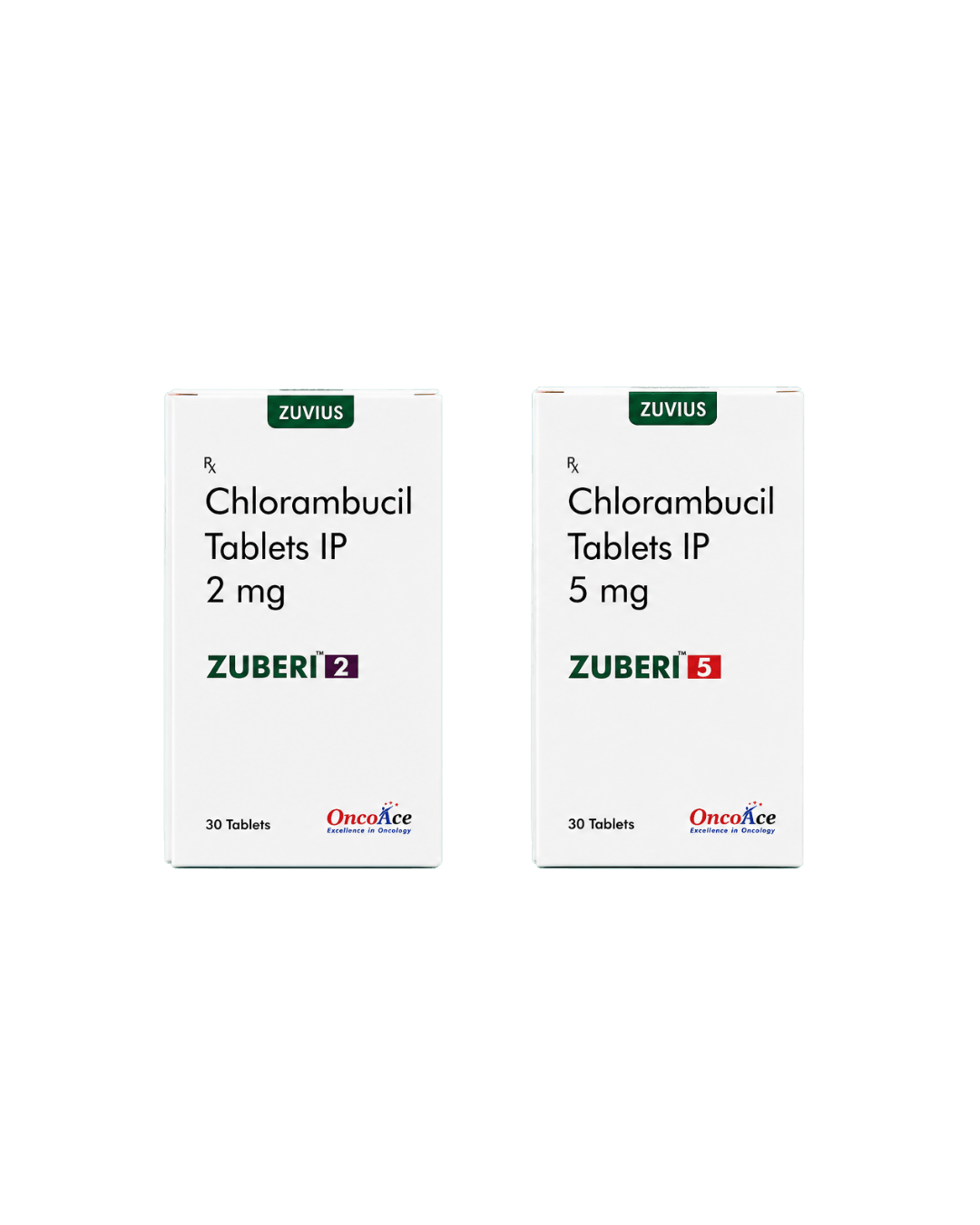
Zuberi
Chlorambucil Tablets

Strength
✓2 mg✓5 mg

Pack Size
1 x 30 Tabs

Drug Class
Alkylating agents

Specification
USP/BP/IH Specs offered for exports

Storage
Store refrigerated at 2°C to 8°C.
Chlorambucil is a bifunctional alkylating agent of the nitrogen mustard type.
It has been found active against selected human neoplastic diseases.
Chlorambucil is chemically known as
4-[bis(2-chlorethyl)amino] benzenebutanoic acid.
Chlorambucil hydrolyzes in water and has a pKa of 5.8.
Chlorambucil is indicated in treatment of
- Chronic lymphatic (lymphocytic) leukemia
- Malignant lymphomas including lymphosarcoma
- Giant follicular lymphoma
- Hodgkin’s disease
It is not curative in these disorders but may produce clinically useful palliation.
Chlorambucil was administered orally in doses ranging from 5 to 30 mg daily for five to seven weeks.
Thirty patients were treated for lymphocytic leukemias and various lymphomas.
In chronic lymphocytic leukemia
- Some patients obtained normalization of hemoglobin level and white blood cell count
- Differential count improved significantly
- Hepatosplenomegaly and lymph node enlargement disappeared in several patients
Results in lymphocytic lymphosarcoma and Hodgkin's disease were less encouraging.
In studied dosages, chlorambucil was practically without side-effects.
Pregnancy
- Adequate contraceptive precautions should be advised when either partner is receiving chlorambucil.
- Use should be avoided during pregnancy, especially during the first trimester.
Breast-feeding
- Mothers receiving chlorambucil should not breastfeed.
Fertility
- Chlorambucil may cause suppression of ovarian function and amenorrhoea.
- Azoospermia has also been observed following therapy.
Teratogenicity
- Chlorambucil is potentially teratogenic.
The usual oral dosage is 0.1 to 0.2 mg/kg body weight daily for 3 to 6 weeks as required.
This usually amounts to 4 to 10 mg per day for the average patient.
The entire daily dose may be given at one time.
These dosages are for initiation of therapy or for short courses of treatment.
The dosage must be carefully adjusted according to the response of the patient and must be reduced as soon as there is an abrupt fall in the white blood cell count.
Patients with Hodgkin’s disease usually require 0.2 mg/kg daily, whereas patients with other lymphomas or chronic lymphocytic leukemia usually require only 0.1 mg/kg daily.
When lymphocytic infiltration of the bone marrow is present, or when the bone marrow is hypoplastic, the daily dose should not exceed 0.1 mg/kg.
Alternate schedules for treatment of chronic lymphocytic leukemia employing intermittent, biweekly, or once-monthly pulse doses of chlorambucil have also been reported.
Intermittent schedules begin with an initial single dose of 0.4 mg/kg.
Subsequent doses are modified to produce mild hematologic toxicity.