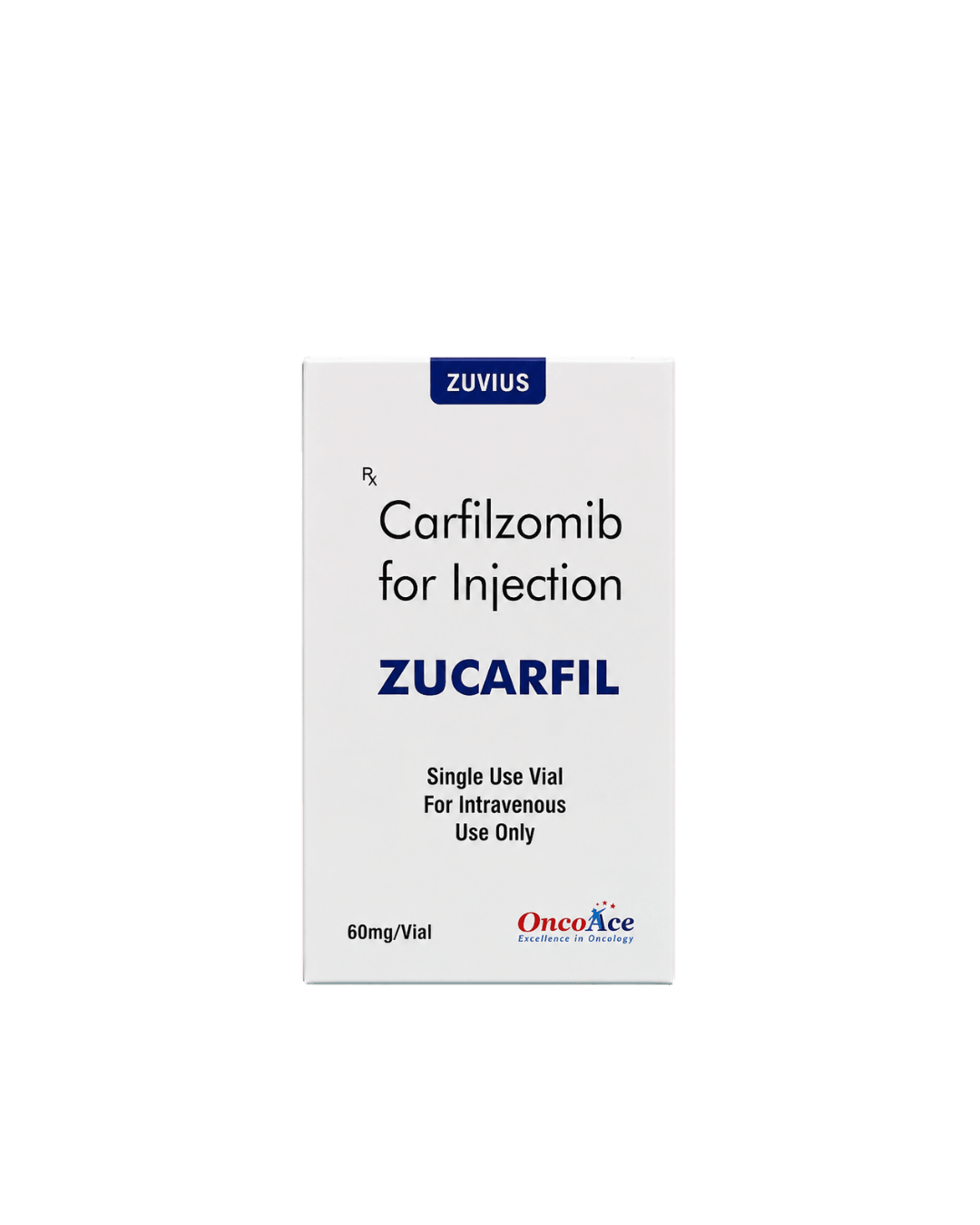
Zucarfil
Carfilzomib Injection

Strength
✓60 mg

Pack Size
1 Vial

Drug Class
Proteasome Inhibitors

Specification
USP/BP/IH Specs offered for exports

Storage
Store refrigerated at 2°C to 8°C.
Carfilzomib is an antineoplastic agent (cancer medicine).
It interferes with the growth of cancer cells, which are eventually destroyed by the body.
This medicine is to be given only by or under the supervision of your doctor.
This product is available in the following dosage form:
- Powder for Solution
Carfilzomib in combination with
- Daratumumab and dexamethasone
- Lenalidomide and dexamethasone
- Dexamethasone alone
is indicated for the treatment of adult patients with multiple myeloma who have received at least one prior therapy.
Carfilzomib (Carf) is a second-generation proteasome inhibitor approved for patients with relapsed and/or refractory multiple myeloma (RRMM) who failed prior lines of therapy.
A systematic review of Carfilzomib literature with meta-analysis was performed to determine the efficacy and safety in RRMM patients.
As lenalidomide may be used in combination with Carfilzomib, particular attention to the lenalidomide pregnancy testing and prevention requirements is needed.
New or worsening cardiac failure such as
- Congestive cardiac failure
- Pulmonary oedema
- Decreased ejection fraction
as well as
- Myocardial ischaemia
- Myocardial infarction
have occurred following the administration of Carfilzomib.
Cardiac Disorders
Death due to cardiac arrest has occurred within a day of Carfilzomib administration, and fatal outcomes have been reported with cardiac failure and myocardial infarction.
While adequate hydration is required prior to dosing in Cycle 1, all patients should be monitored for evidence of volume overload, especially patients at risk for cardiac failure.
The total volume of fluids may be adjusted as clinically indicated in patients with baseline cardiac failure or who are at risk for cardiac failure.
Stop Carfilzomib for Grade 3 or 4 cardiac events until recovery and consider whether to restart Carfilzomib at one dose level reduction based on a benefit/risk assessment.
The risk of cardiac failure is increased in
- Elderly patients (≥75 years)
- Asian patients
A thorough assessment for cardiovascular risk factors prior to starting treatment is recommended.
Patients with
- New York Heart Association (NYHA) Class III and IV heart failure
- Recent myocardial infarction
- Conduction abnormalities uncontrolled by medicinal products
may be at greater risk for cardiac complications.
Patients with signs or symptoms of
- NYHA Class III or IV cardiac failure
- Recent myocardial infarction (within the last 4 months)
- Uncontrolled angina
- Arrhythmias
should have a comprehensive cardiological assessment prior to starting treatment with Carfilzomib.
Electrocardiographic Changes
There have been cases of QT interval prolongation reported in clinical studies and post-marketing.
Cases of ventricular tachycardia have been reported in patients receiving Carfilzomib.
Pulmonary Toxicity
Acute respiratory distress syndrome (ARDS), acute respiratory failure, and acute diffuse infiltrative pulmonary disease such as:
- Pneumonitis
- Interstitial lung disease
have occurred in patients receiving Carfilzomib.
Some of these events have been fatal.
Evaluate and stop Carfilzomib until resolved and consider whether to restart Carfilzomib based on a benefit/risk assessment.
Pulmonary Hypertension
Pulmonary hypertension has been reported in patients treated with Carfilzomib.
Some of these events have been fatal.
Evaluate as appropriate.
Stop Carfilzomib for pulmonary hypertension until resolved or returned to baseline and consider whether to restart Carfilzomib based on a benefit/risk assessment.
Dyspnoea was commonly reported in patients treated with Carfilzomib.
Evaluate dyspnoea to exclude cardiopulmonary conditions, including cardiac failure and pulmonary syndromes.
Stop Carfilzomib for Grade 3 and 4 dyspnoea until resolved or returned to baseline and consider whether to restart Carfilzomib.
Carfilzomib is administered as an infusion into a vein.
The infusion may last up to 30 minutes.
Carfilzomib is given 2 days in a row each week, for 3 weeks, followed by one week without treatment.
Each 28-day period is one treatment cycle.
This means that Carfilzomib will be given on
- Day 1
- Day 2
- Day 8
- Day 9
- Day 15
- Day 16
of each 28-day cycle.
The doses on Days 8 and 9 of each cycle will not be given from Cycle 13 onwards if treated with Carfilzomib in combination with lenalidomide and dexamethasone.
Most patients will receive treatment for as long as their disease improves or remains stable.
However, Carfilzomib treatment may also be stopped if the patient experiences side effects that cannot be managed.
Together with Carfilzomib, patients may also be given
- Lenalidomide and dexamethasone
- Daratumumab and dexamethasone
- Dexamethasone alone