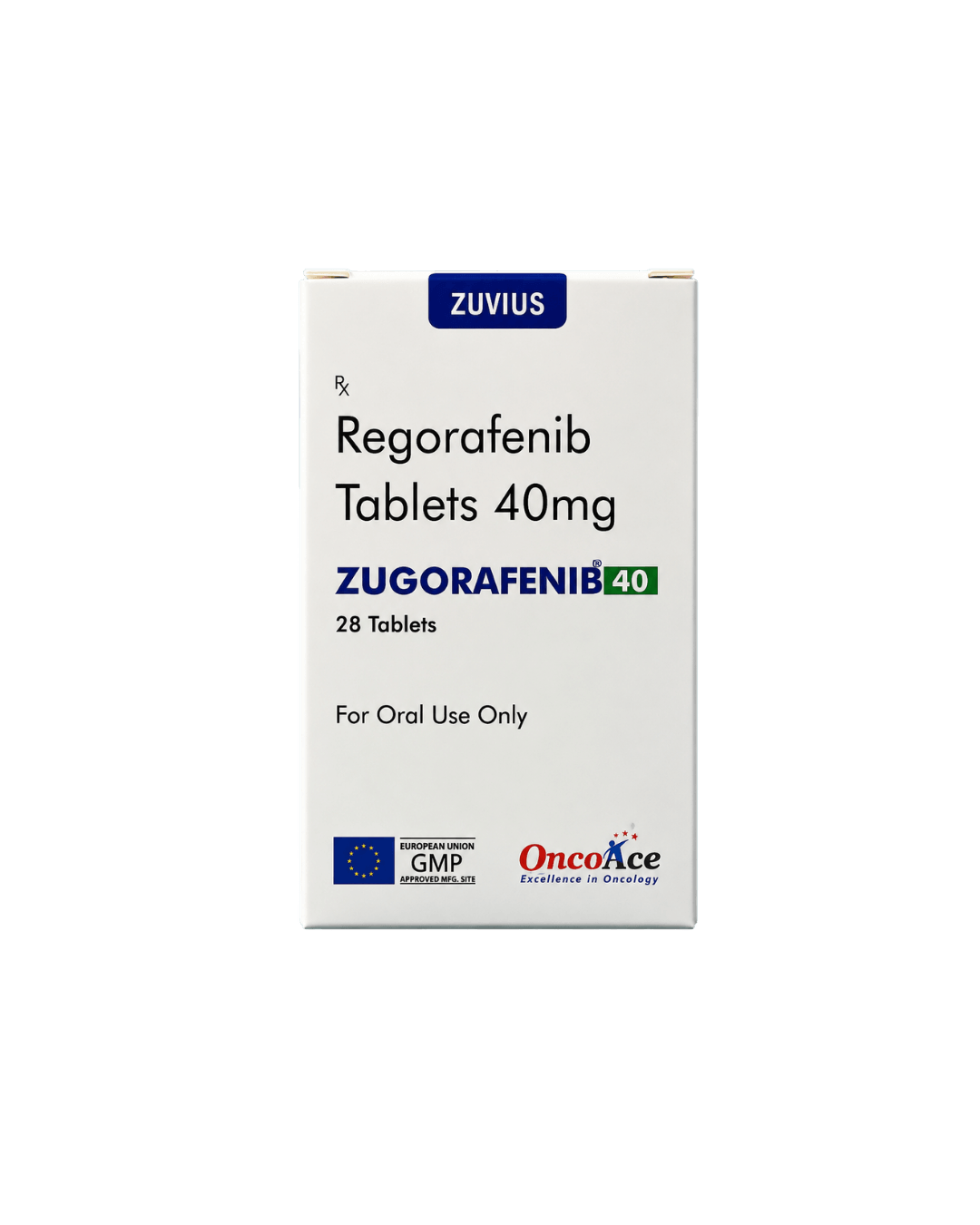
Zugorafenib
Regorafenib Tablets

Strength
✓40 mg

Pack Size
1 x 28

Drug Class
Multikinase Inhibitor

Specification
USP/BP/IH Specs offered for exports

Storage
Store at 25°C to 30°C.
Zugorafenib contains Regorafenib, an orally administered antitumour multikinase inhibitor.
Regorafenib blocks several protein kinases involved in
- Tumour angiogenesis
- Oncogenesis
- Tumour-cell proliferation
- Formation and maintenance of the tumour microenvironment
Regorafenib also inhibits mutated KIT, an important oncogenic driver in gastrointestinal stromal tumours.
By inhibiting these signalling pathways, Regorafenib reduces the formation of new blood vessels supplying the tumour and interferes with the growth and survival of malignant cells.
Zugorafenib is indicated for the treatment of
Metastatic Colorectal Cancer
- Patients with metastatic colorectal cancer who have previously received available therapies.
- Patients who are not considered suitable candidates for available treatments.
Previous treatments may include
- Fluoropyrimidine-based chemotherapy
- Anti-VEGF therapy
- Anti-EGFR therapy
Gastrointestinal Stromal Tumours
- Patients with unresectable or metastatic gastrointestinal stromal tumours.
- Patients whose disease has progressed during previous treatment with Imatinib and Sunitinib.
- Patients who are unable to tolerate previous treatment with Imatinib and Sunitinib.
Hepatocellular Carcinoma
- Patients with hepatocellular carcinoma who have previously received treatment with Sorafenib.
Regorafenib has demonstrated clinical efficacy in patients with previously treated metastatic colorectal cancer, gastrointestinal stromal tumours and hepatocellular carcinoma.
In pivotal Phase III clinical studies, Regorafenib administered with best supportive care demonstrated improvements in:
- Overall survival
- Progression-free survival
- Disease control
Regorafenib has been shown to delay disease progression and provide a survival benefit in patients whose disease progressed after standard treatments.
These findings support its use as a treatment option for patients with advanced or treatment-resistant malignancies.
Contraindications
Do not use Zugorafenib in patients with hypersensitivity to Regorafenib or any ingredient in the formulation.
Common Adverse Reactions
- Infections
- Thrombocytopenia
- Anaemia
- Leukopenia
- Hypothyroidism
- Reduced appetite
- Reduced food intake
- Low potassium levels
- Low phosphate levels
- Low calcium levels
- Low sodium levels
- Low magnesium levels
- Increased uric acid
- Dehydration
- Headache
- Tremor
- Peripheral neuropathy
- Bleeding
- High blood pressure
- Voice changes
- Stomatitis
- Vomiting
- Nausea
- Altered taste
- Dry mouth
- Gastro-oesophageal reflux
- Gastroenteritis
- Increased bilirubin
- Increased liver enzymes
- Hand-foot skin reaction
- Skin rash
- Hair loss
- Dry skin
- Exfoliative rash
- Muscle spasms
- Protein in the urine
- Weakness
- Fatigue
- Pain
- Fever
- Mucositis
- Weight loss
- Increased amylase
- Increased lipase
Recommended Dosage
- The recommended dose is 160 mg, equivalent to four 40 mg tablets, taken orally once daily.
- Treatment is administered for the first 3 weeks of each 4-week treatment cycle.
- This is followed by 1 week without treatment.
- Treatment should continue as long as the patient receives clinical benefit or until unacceptable toxicity occurs.
Administration Instructions
- Take Zugorafenib at approximately the same time every day.
- Swallow the tablets whole with water.
- Take the tablets after a light, low-fat meal containing less than 30% fat.
- Do not take more than 160 mg in one day.
Dose Modification
Dose interruption or reduction may be required according to individual tolerability and adverse reactions.
- Dose adjustments should be made in steps of 40 mg.
- The maximum recommended daily dose is 160 mg.
- The minimum recommended daily dose is 80 mg.
Hand-Foot Skin Reaction
Grade 1
- Continue the current dose.
- Begin supportive treatment immediately to relieve symptoms.
Grade 2 – First Occurrence
- Reduce the daily dose by 40 mg.
- Begin supportive treatment immediately.
- If there is no improvement, interrupt treatment for at least 7 days until toxicity improves to Grade 0 or Grade 1.
Grade 2 – Recurrent or Persistent Reaction
- Interrupt treatment until toxicity improves to Grade 0 or Grade 1.
- Restart treatment at a dose reduced by 40 mg.
- Dose escalation may later be considered according to medical assessment.
Grade 2 – Fourth Occurrence
- Permanently discontinue treatment.
Grade 3 – First Occurrence
- Begin supportive treatment immediately.
- Interrupt treatment for at least 7 days until toxicity improves to Grade 0 or Grade 1.
- Restart treatment at a dose reduced by 40 mg.
Grade 3 – Second Occurrence
- Interrupt treatment until toxicity improves to Grade 0 or Grade 1.
- Restart treatment at a dose reduced by 40 mg.
Grade 3 – Third Occurrence
- Permanently discontinue treatment.
Liver Function Abnormalities
ALT or AST up to 5 times the upper limit of normal:
- Treatment may generally continue.
- Monitor liver function weekly until values return to less than 3 times the upper limit of normal or the patient's baseline.
ALT or AST more than 5 times but not more than 20 times the upper limit of normal:
- Interrupt treatment at the first occurrence.
- Monitor liver enzymes weekly until they return to less than 3 times the upper limit of normal or baseline.
- Permanently discontinue treatment if the abnormality recurs.
ALT or AST more than 20 times the upper limit of normal:
- Permanently discontinue treatment.
ALT or AST more than 3 times the upper limit of normal with bilirubin more than 2 times the upper limit:
- Permanently discontinue treatment.
- Monitor liver function weekly until resolution or return to baseline.
The treating oncologist should determine all dose interruptions, reductions and treatment discontinuations.