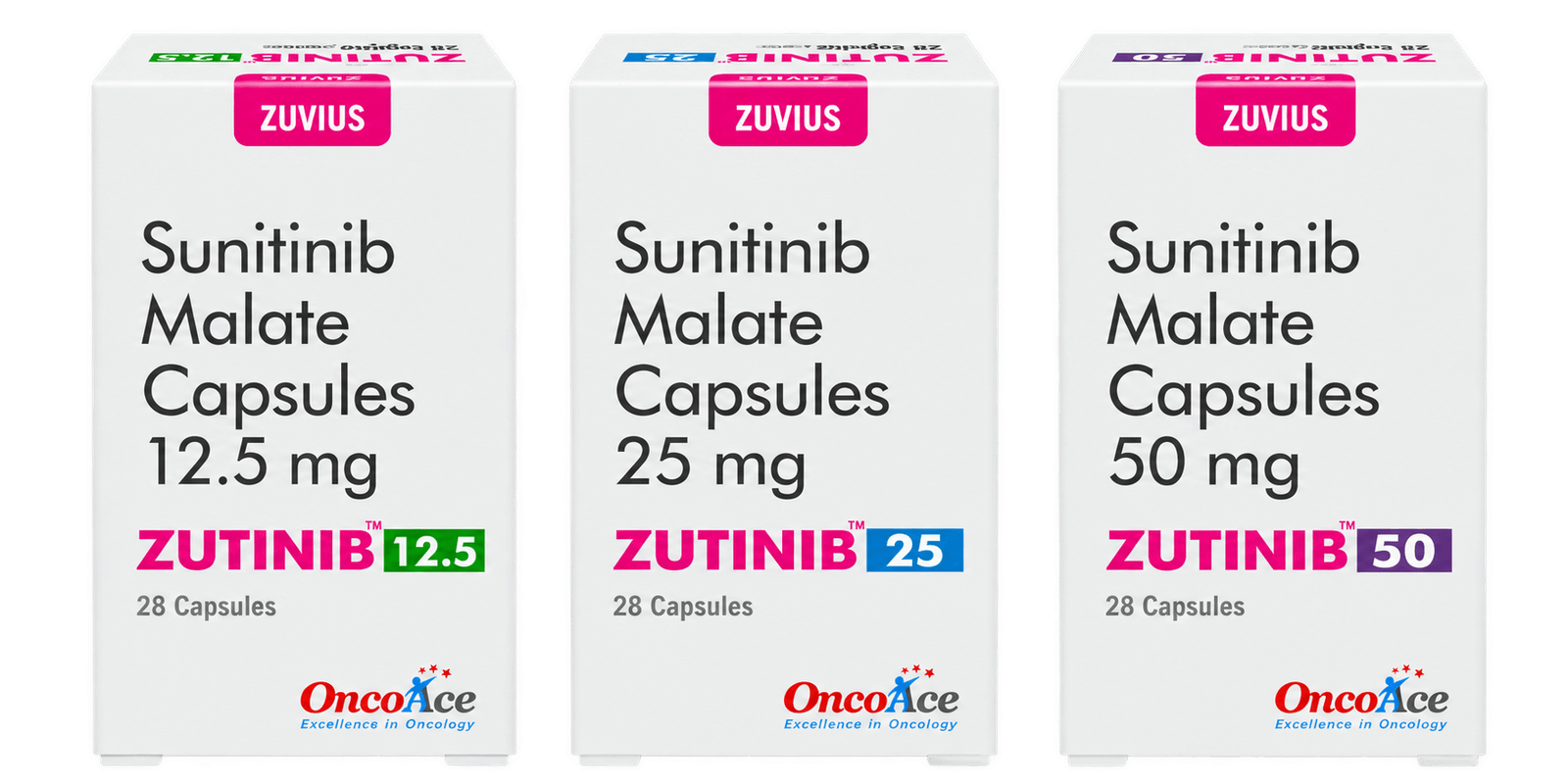
Zutinib
Sunitinib Capsules

Strength
✓12.5 mg✓25 mg✓50 mg

Pack Size
1 x 28

Drug Class
Antineoplastics, Tyrosine Kinase Inhibitor; VEGF Inhibitor

Specification
USP/BP/IH Specs offered for exports

Storage
Store at 25°C to 30°C.
Zutinib, an oral multi-kinase inhibitor, is the malate salt of sunitinib.
Sunitinib malate is described chemically as
Butanedioic acid, hydroxy-, (2S)-, a compound with N-[2-(diethylamino)ethyl]-5-[(Z)-(5-fluoro-1,2-dihydro-2-oxo-3H-indol-3-ylidine)methyl]-2,4-dimethyl-1H-pyrrole-3-carboxamide (1:1).
The molecular formula is
C₂₂H₂₇FN₄O₂ • C₄H₆O₅
and the molecular weight is 532.6 Daltons.
Sunitinib malate is a yellow to orange powder with a pKa of 8.95.
The solubility of sunitinib malate in aqueous media over the range pH 1.2 to pH 6.8 is in excess of 25 mg/mL.
The log of the distribution coefficient (octanol/water) at pH 7 is 5.2.
Gastrointestinal Stromal Tumor (GIST)
Zutinib is indicated for the treatment of gastrointestinal stromal tumor after disease progression on or intolerance to imatinib mesylate.
Advanced Renal Cell Carcinoma (RCC)
Zutinib is indicated for the treatment of advanced renal cell carcinoma.
Adjuvant Treatment Of Renal Cell Carcinoma (RCC)
Zutinib is indicated for the adjuvant treatment of adult patients at high risk of recurrent RCC following nephrectomy.
Advanced Pancreatic Neuroendocrine Tumors (pNET)
Zutinib is indicated for the treatment of progressive, well-differentiated pancreatic neuroendocrine tumors in patients with unresectable, locally advanced or metastatic disease.
Sunitinib is a small molecule that inhibits multiple receptor tyrosine kinases (RTKs), some of which are implicated in tumor growth, pathologic angiogenesis, and metastatic progression of cancer.
Sunitinib was evaluated for its inhibitory activity against a variety of kinases (>80 kinases) and was identified as an inhibitor of:
- Platelet-derived growth factor receptors
- Vascular endothelial growth factor receptors
- Stem cell factor receptor (KIT)
- Fms-like tyrosine kinase-3 (FLT3)
- Colony stimulating factor receptor Type 1 (CSF-1R)
- Glial cell-line derived neurotrophic factor receptor (RET)
Sunitinib inhibition of the activity of these RTKs has been demonstrated in biochemical and cellular assays, and inhibition of function has been demonstrated in cell proliferation assays.
- Read the label carefully before use.
- Keep out of the reach of children.
- Do not exceed the recommended dose.
Recommended Dose For GIST And Advanced RCC
The recommended dose of Zutinib for gastrointestinal stromal tumor (GIST) and advanced renal cell carcinoma (RCC) is one 50 mg oral dose taken once daily, on a schedule of 4 weeks on treatment followed by 2 weeks off (Schedule 4/2).
Zutinib may be taken with or without food.
Recommended Dose For Adjuvant Treatment Of RCC
The recommended dose of Zutinib for the adjuvant treatment of RCC is 50 mg taken orally once daily, on a schedule of 4 weeks on treatment followed by 2 weeks off (Schedule 4/2), for nine 6-week cycles.
Zutinib may be taken with or without food.
Recommended Dose For pNET
The recommended dose of Zutinib for pancreatic neuroendocrine tumors (pNET) is 37.5 mg taken orally once daily continuously without a scheduled off-treatment period.
Zutinib may be taken with or without food.