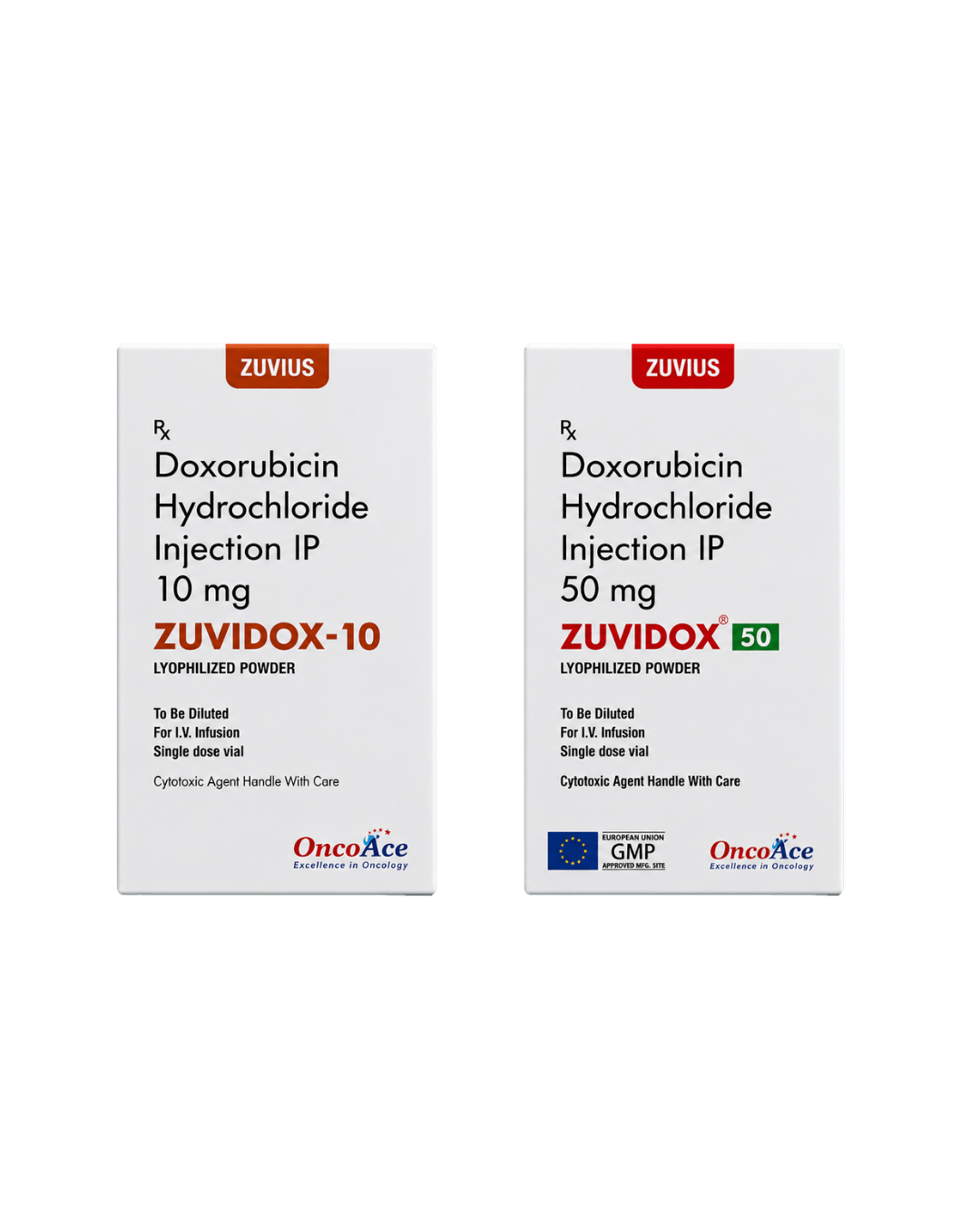
Zuvidox
Doxorubicin Injection

Strength
✓10 mg✓50 mg

Pack Size
1 Vial

Drug Class
Anthracyclines and Related Substances

Specification
USP/BP/IH Specs offered for exports

Storage
Store at 25°C to 30°C.
Doxorubicin is a cytotoxic anthracycline antibiotic isolated from cultures of Streptomyces peucetius var. Caesisus.
Doxorubicin consists of a naphthacenequinone nucleus linked through a glycosidic bond at ring atom 7 to an amino sugar, daunosamine.
Chemically, doxorubicin hydrochloride is
(8S, 10S)-10-[(3-amino-2,3,6-trideoxy-α-L-lyxo-hexopyranosyl)-oxy]-8-glycology]-7,8,9,10-tetrahydro-6,8,11-trihydroxy-1-methoxy-5,12-naphthacenedione hydrochloride [25316-40-9]
Doxorubicin is indicated in the treatment of
- Acute leukaemia
- Soft tissue sarcomas
- Bone sarcomas
- Breast cancer
- Ovarian cancer
- Hodgkin's lymphoma
- Non-Hodgkin's lymphoma
- Small cell lung cancer
- Gastric carcinoma
- Bladder carcinoma
Doxorubicin was encapsulated in canine erythrocytes, treated with 0.32% glutaraldehyde, and administered at a dosage equivalent to 30 mg of free doxorubicin/m² of body surface area to dogs with a diagnosis of lymphosarcoma.
Compared with administration of free doxorubicin, this method of drug delivery substantially reduced peak plasma concentration and prolonged higher plasma concentration of doxorubicin.
As such, this method was comparable to continuous IV infusion.
Previous studies have indicated this method’s potential for reduction in toxic side effects, particularly cardiotoxicosis, while allowing higher total doses of doxorubicin to be administered.
In this study, doxorubicin encapsulated in glutaraldehyde-treated erythrocytes induced a triphasic exponential decay of doxorubicin from plasma, the highest relative contribution to the total area of the curve being the terminal phase.
The treatment was effective in inducing complete and partial remissions of lymphosarcoma, with minimal acute toxicosis and no evidence of cardiotoxicosis.
However, substantial, unanticipated, chronic, nonregenerative myelosuppression developed and was most strikingly expressed as profound thrombocytopenia.
Efforts to ameliorate or circumvent this toxic effect will be required prior to further consideration of this doxorubicin delivery system for treatment of systemic neoplasia.
Special attention must be given to the cardiac toxicity exhibited by doxorubicin.
Although uncommon, acute left ventricular failure has occurred, particularly in patients who have received a total dosage of the drug exceeding the currently recommended limit of 550 g/m².
The limit appears to be lower in patients who received radiotherapy to the mediastinal area or concomitant therapy with other potentially cardiotoxic agents such as cyclophosphamide.
The total dose of doxorubicin administered to the individual patients should also be taken into account.
Previous or concomitant therapy with related compounds such as daunorubicin.
Congestive heart failure and/or cardiomyopathy may be encountered several weeks after discontinuation of doxorubicin therapy.
Cardiac failure is often not favourably affected by presently known medical or physical therapy for cardiac support.
Early clinical diagnosis of drug-induced heart failure appears to be essential for successful treatment with digitalis.
Diuretics, a low-salt diet, and bed rest.
Severe cardiac toxicity may occur precipitously without antecedent ECG changes.
A baseline ECG and ECGs performed prior to each dose or course after a 300 mg/m cumulative dose has been given are suggested.
Transient ECG changes consisting of T-wave flattening, ST depression and arrhythmias lasting up to two weeks after a dose or course of doxorubicin are presently not considered indications for suspension of doxorubicin therapy.
Doxorubicin cardiomyopathy has been reported to be associated with a persistent reduction in the voltage of the QRS wave, a prolongation of the systolic time interval and a reduction of the ejection fraction as determined by echocardiography or radionuclide angiography.
None of these tests have yet been confirmed to consistently identify those individual patients that are approaching their maximally tolerated cumulative dose of doxorubicin.
If test results indicate a change in cardiac function associated with doxorubicin, the benefit of continued therapy must be carefully evaluated against the risk of producing irreversible cardiac damage.
Acute life-threatening arrhythmias have been reported to occur during or within a few hours after doxorubicin administration.
There is a high incidence of bone marrow depression, primarily of leukocytes, requiring careful hematologic monitoring with the recommended dose schedule.
Leukopenia is usually transient, reaching its nadir at 10-14 days after treatment, with recovery usually occurring by the 21st day.
White blood cell counts as low as 1,000/mm³ are to be expected during treatment with appropriate doses of doxorubicin.
Red blood cell and platelet levels should also be monitored since they may also be depressed.
Haematologic toxicity may require dose reduction or suspension or delay of doxorubicin therapy.
Persistent severe myelosuppression may result in superinfection or hemorrhage.
Toxicity to recommended doses of doxorubicin is enhanced by hepatic impairment.
Prior to the individual dosing evaluation of hepatic function, it is recommended to use conventional clinical laboratory tests, such as:
- SGOT
- SGPT
- Alkaline phosphatase
- Bilirubin
Necrotizing colitis manifested by typhlitis (caecal inflammation), bloody stools and severe and sometimes fatal infection have been associated with a combination of doxorubicin given IV push daily for 3 days and cytarabine by continuous infusion daily for 7 or more days.
On intravenous administration of doxorubicin, extravasation may occur with or without an accompanying stinging or burning sensation and even if blood returns well on aspiration of the infusion needle.
If any signs or symptoms of extravasation have occurred, the injection or infusion should be immediately terminated and restarted in another vein.
Because of the progressive nature of extravasation reactions, the area of injection should be frequently examined and plastic surgery consultation obtained.
Early wide exclusion of the involved area should be considered.
Initiating treatment with doxorubicin requires close observation of the patient and extensive laboratory monitoring.
It is recommended, therefore, that patients be hospitalised at least during the first phase of treatment.
Like other cytotoxic drugs, doxorubicin may induce hyperuricemia secondary to rapid lysis of neoplastic cells.
The clinician should monitor the patient’s blood uric acid level and be prepared to use supportive and pharmacologic measures as might be necessary to control this problem.
Doxorubicin imparts coloration to the urine 1-2 days after administration and patients should be advised to expect this during active therapy.
Use During Pregnancy And Lactation
Doxorubicin can cause fetal harm when administered to a pregnant woman.
Doxorubicin was teratogenic and embryotoxic at doses of 0.8 mg/kg/day and greater (about 1/13 the recommended human dose on a body surface basis) when administered during the period of organogenesis in rats.
Teratogenicity and embryotoxicity were also seen using discrete periods of treatment.
The most susceptible was 6 to 9 days gestation period at doses of 1.25 mg/kg/day and greater.
Characteristic malformations included
- Esophageal atresia
- Intestinal atresia
- Tracheo-oesophageal features
- Hypoplasia of the urinary bladder
- Cardiovascular anomalies
Doxorubicin was embryotoxic (increase in embryofetal deaths) and abortifacient at 0.4 mg/kg/day (about 1/14 the recommended human dose on a body surface basis).
The most commonly used dosage schedule is 60-70 mg/m² as a single intravenous administration at 21-day intervals.
A lower dose may be required in patients with inadequate marrow reserves.
An alternative dosage schedule of 20 mg/m² weekly has been reported to produce a lower incidence of congestive heart failure.
Doxorubicin dosage should be reduced if the bilirubin is elevated as follows:
- Serum bilirubin 1.3 to 3.0 mg/dL: give ½ normal dose
- Bilirubin > 3.0 mg/dL: give ¼ normal dose
Reconstitution
Zuvidox 10 and 50 vials should be reconstituted with 5 mL and 25 mL respectively, of Sodium Chloride Injection, USP/IP (0.9%), to give a final concentration of 2 mg/mL of doxorubicin hydrochloride.
Bacteriostatic diluents are not recommended.
After adding the diluent, the vial should be shaken and the contents allowed to dissolve.
The reconstituted solution is stable for
- 7 days at room temperature and under normal room light
- 15 days under refrigeration (2°C-8°C / 36°F-46°F)
It should be protected from exposure to sunlight, and any unused solution should be discarded.