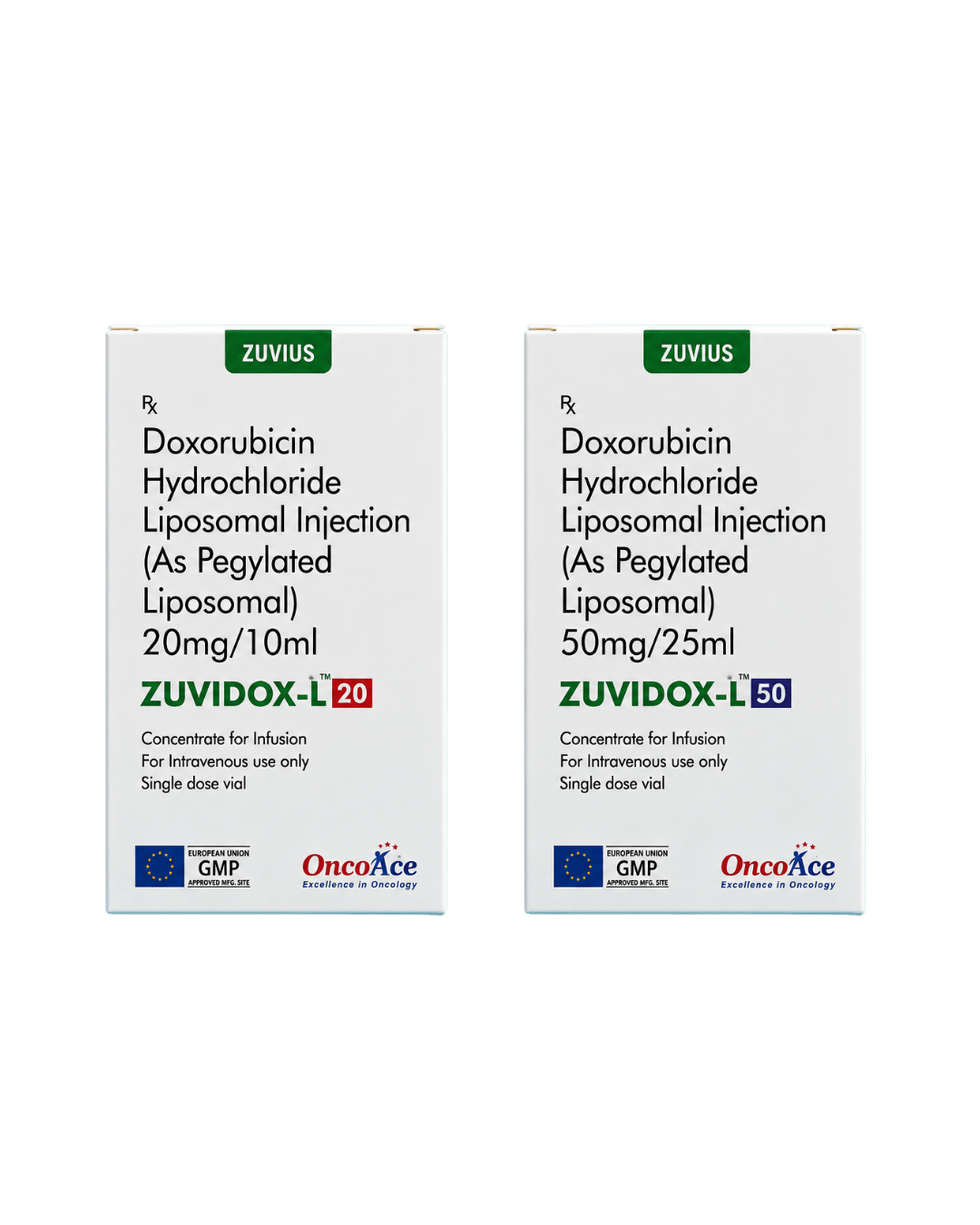
Zuvidox-L
Doxorubicin Hydrochloride Liposomal Injection

Strength
✓20 mg✓50 mg

Pack Size
1 Vial

Drug Class
Anthracycline Antineoplastic Antibiotic

Specification
USP/BP/IH Specs offered for exports

Storage
Store refrigerated at 2°C to 8°C.
Zuvidox-L contains Doxorubicin Hydrochloride encapsulated in pegylated liposomes for intravenous administration.
Doxorubicin is an anthracycline antibiotic and topoisomerase II inhibitor derived from Streptomyces peucetius var. caesius.
The active ingredient binds to DNA and inhibits nucleic acid synthesis.
It rapidly enters cells, binds to chromatin around the nucleus, inhibits mitotic activity and nucleic acid synthesis and may induce chromosomal abnormalities.
Zuvidox-L is formulated using long-circulating pegylated liposomes.
The liposome surface contains methoxypolyethylene glycol, which helps protect the liposomes from detection by the mononuclear phagocyte system and increases their circulation time in the blood.
The liposomes have an approximate half-life of 55 hours in humans and remain predominantly encapsulated during circulation.
Their small size and prolonged circulation allow them to penetrate altered tumour blood vessels and accumulate within tumour tissue, where Doxorubicin becomes available.
Zuvidox-L is indicated for the treatment of
Ovarian Cancer
- Patients with ovarian cancer whose disease has progressed or recurred following platinum-based chemotherapy.
AIDS-Related Kaposi's Sarcoma
- Patients with AIDS-related Kaposi's sarcoma following failure of previous systemic chemotherapy.
- Patients who are unable to tolerate previous systemic chemotherapy.
Multiple Myeloma
In combination with Bortezomib, Zuvidox-L is indicated for patients with multiple myeloma who:
- Have received at least one previous therapy.
- Have not previously received Bortezomib.
Pegylated liposomal encapsulation provides prolonged systemic circulation, with an approximate half-life of 55 hours.
More than 90% of Doxorubicin remains encapsulated within the liposomes during circulation, supporting controlled drug delivery.
The small size of the liposomes, approximately 100 nanometres, and their prolonged circulation allow them to pass through altered tumour vasculature and accumulate within tumour tissue.
The encapsulated Doxorubicin then becomes available within the tumour environment.
In patients with AIDS-related Kaposi's sarcoma, liposomal Doxorubicin has demonstrated higher concentrations within Kaposi's sarcoma lesions than in normal skin, indicating preferential distribution into tumour tissue.
Liposomal Doxorubicin has slower plasma clearance and greater systemic exposure than conventional Doxorubicin.
Clinical studies have established treatment schedules for ovarian cancer, AIDS-related Kaposi's sarcoma and multiple myeloma.
Contraindications
Do not use Zuvidox-L in patients with a history of hypersensitivity reactions to conventional Doxorubicin Hydrochloride formulations or any ingredient in the product.
Common Adverse Reactions
- Weakness
- Fatigue
- Fever
- Nausea
- Vomiting
- Diarrhoea
- Constipation
- Loss of appetite
- Stomatitis
- Hand-foot syndrome
- Skin rash
- Neutropenia
- Thrombocytopenia
- Anaemia
- Myelosuppression
Infusion-Related Reactions
Reported symptoms include
- Flushing
- Shortness of breath
- Facial swelling
- Headache
- Chills
- Chest pain
- Back pain
- Chest or throat tightness
- Fever
- Rapid heartbeat
- Itching
- Rash
- Bluish discolouration of the skin
- Fainting
- Bronchospasm
- Asthma-like symptoms
- Apnoea
- Low blood pressure
Serious allergic or anaphylactoid-like reactions may also occur.
Cardiac Adverse Reactions
- Cardiotoxicity
- Congestive heart failure
- Left ventricular dysfunction
- Reduced left ventricular ejection fraction
Other Reactions
- Radiation recall reaction
Pregnancy
Zuvidox-L can cause fetal harm.
Women of reproductive potential should avoid becoming pregnant during treatment.
Breastfeeding
Breastfeeding should be discontinued before starting treatment.
Paediatric Use
Safety and effectiveness have not been established in children.
Ovarian Cancer
- The recommended dose is 50 mg/m² administered intravenously once every 4 weeks.
- The initial infusion rate should be 1 mg per minute.
- A minimum of 4 treatment courses is recommended.
- Treatment may continue until disease progression, cardiotoxicity or unacceptable toxicity occurs.
AIDS-Related Kaposi's Sarcoma
- The recommended dose is 20 mg/m² administered intravenously.
- The initial infusion rate should be 1 mg per minute.
- Treatment may be repeated every 3 weeks while it remains effective and is adequately tolerated.
Multiple Myeloma
- Bortezomib is administered at 1.3 mg/m² intravenously on Days 1, 4, 8 and 11 of each 3-week treatment cycle.
- Liposomal Doxorubicin is administered at 30 mg/m² as an intravenous infusion on Day 4 after Bortezomib administration.
- The initial infusion rate should be 1 mg per minute.
- Treatment may continue for up to 8 cycles or until disease progression or unacceptable toxicity occurs.
Dose Modifications
Dosage adjustment, treatment interruption or discontinuation may be required in patients who develop:
- Hand-foot syndrome
- Haematological toxicity
- Stomatitis
- Hepatic impairment
- Other non-haematological toxicities
- Toxicity during combination treatment with Bortezomib
Administration Instructions
- Do not administer as an intravenous bolus injection.
- Do not administer the medicine undiluted.
- Do not administer intramuscularly or subcutaneously.
- Use only 5% Dextrose Injection for dilution.
- Do not mix with other medicines.
- Do not use in-line filters.
- Avoid rapidly flushing the infusion line.
The exact dose and treatment schedule should be determined by an oncologist according to the patient's condition, response and tolerance.