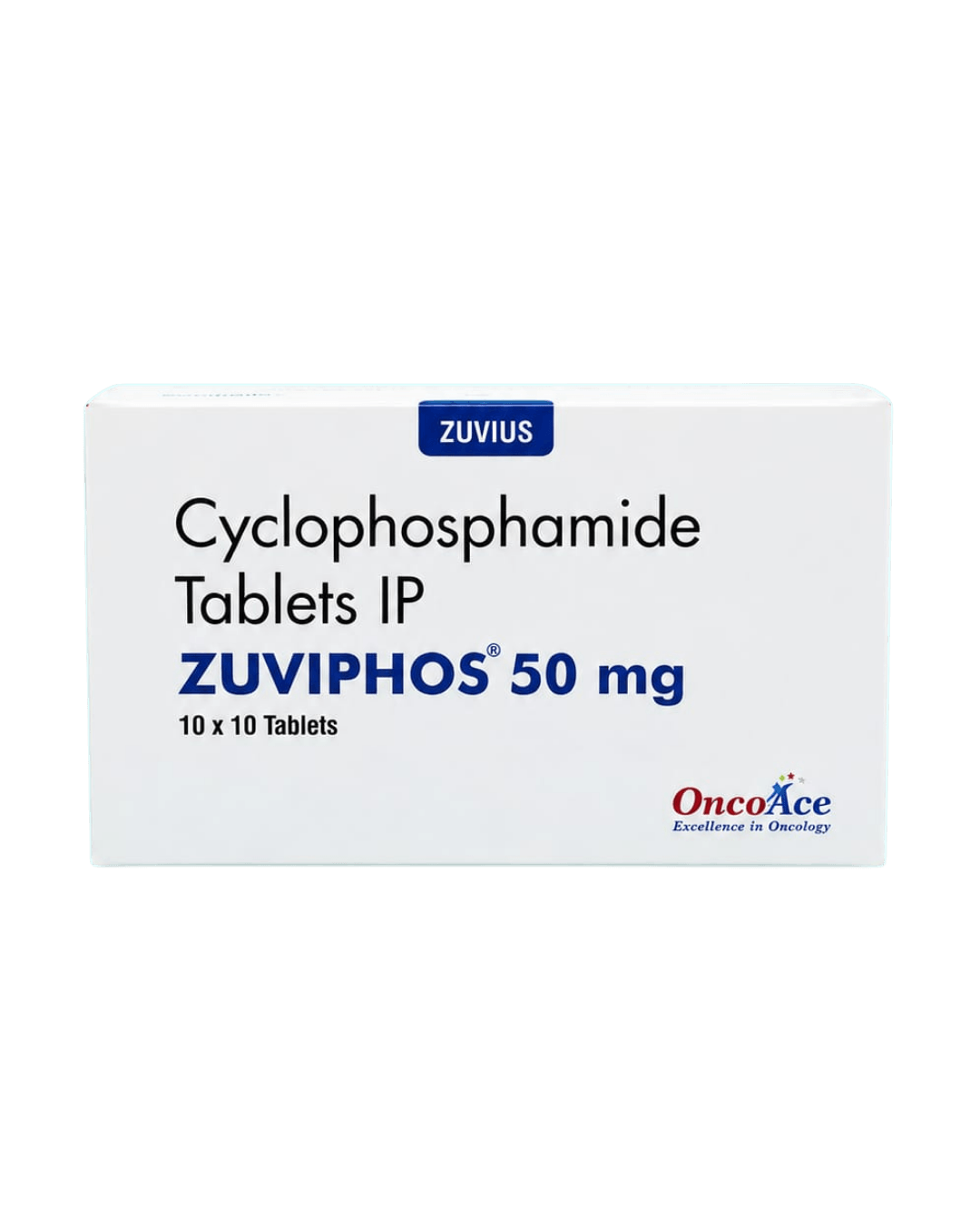
Zuviphos
Cyclophosphamide Tablets

Strength
✓50 mg

Pack Size
1 x 10

Drug Class
Antineoplastic

Specification
USP/BP/IH Specs offered for exports

Storage
Store at 25°C to 30°C.
Zuviphos (cyclophosphamide) is a synthetic antineoplastic drug chemically related to the nitrogen mustards.
The chemical name for cyclophosphamide is 2-[bis(2-chloroethyl)amino]tetrahydro-2H-1,3,2-oxazaphosphorine 2-oxide monohydrate.
Cyclophosphamide has a molecular formula of C₇H₁₅Cl₂N₂O₂P • H₂O and a molecular weight of 279.1.
Cyclophosphamide is soluble in water, saline, or ethanol.
Cyclophosphamide Tablets, USP are for oral use and contain 25 mg or 50 mg cyclophosphamide (anhydrous).
Inactive ingredients in Cyclophosphamide Tablets are
- Acacia
- FD&C Blue No. 1
- D&C Yellow No. 10 Aluminium Lake
- Lactose
- Magnesium Stearate
- Starch
- Stearic Acid
- Talc
Malignant Diseases
Cyclophosphamide is indicated for the treatment of
- Malignant lymphomas (Stages III and IV of the Ann Arbor staging system)
- Hodgkin disease
- Lymphocytic lymphoma (nodular or diffuse)
- Mixed-cell type lymphoma
- Histiocytic lymphoma
- Burkitt’s lymphoma
- Multiple myeloma
- Chronic lymphocytic leukemia
- Chronic granulocytic leukemia (usually ineffective in acute blastic crisis)
- Acute myelogenous leukemia
- Monocytic leukemia
- Acute lymphoblastic (stem-cell) leukemia
- Mycosis fungoides (advanced disease)
- Neuroblastoma (disseminated disease)
- Adenocarcinoma of the ovary
- Retinoblastoma
- Carcinoma of the breast
Cyclophosphamide, although effective alone in susceptible malignancies, is more frequently used concurrently or sequentially with other antineoplastic drugs.
Minimal Change Nephrotic Syndrome In Pediatric Patients
Cyclophosphamide is indicated for the treatment of biopsy proven minimal change nephrotic syndrome in pediatric patients who failed to adequately respond to or are unable to tolerate adrenocorticosteroid therapy.
Limitations Of Use
The safety and effectiveness for the treatment of nephrotic syndrome in adults or other renal disease has not been established.
Cyclophosphamide has been demonstrated to have a cytostatic effect in many tumour types.
The active metabolites of cyclophosphamide are alkylating agents which transfer alkyl groups to DNA during the process of cell division, thus preventing normal synthesis of DNA.
Cyclophosphamide is well absorbed following an oral dose with a mean half-life of 4-8 hours for both oral and parenteral administration.
It is an inactive prodrug with alkylating metabolites produced by hepatic metabolism, reaching peak levels 4-6 hours after an IV injection.
Hepatic enzymes may be induced.
The parent compound binds poorly to plasma protein but the active metabolites are significantly protein-bound.
The drug is widely distributed, crosses the blood-brain barrier and the placental barrier and is found in ascites.
The metabolites are excreted renally.
Cyclophosphamide can cause myelosuppression (leukopenia, neutropenia, thrombocytopenia and anaemia), bone marrow failure, and severe immunosuppression, which may lead to serious and sometimes fatal infections, including sepsis and septic shock.
Latent infections can be reactivated.
Cyclophosphamide should not be administered to patients with neutrophils ≤ 1,500/mm³ and platelets < 50,000/mm³.
Cyclophosphamide treatment may not be indicated or should be interrupted or the dose reduced in patients who have or who develop a serious infection.
Cyclophosphamide should be used with caution, if at all, in patients with active urinary tract infections.
Dosage Forms and Strengths
Powder for injection 50 mg
Dosage Considerations – Should be Given as Follows
Malignant Diseases
Adult and Pediatric
Intravenous (IV) (intermittent therapy)
40-50 mg/kg (400-1800 mg/m²) divided over 2-5 days; may be repeated at intervals of 2-4 weeks.
IV (continuous daily therapy)
60-120 mg/m²/day (1-2.5 mg/kg/day).
Oral (intermittent therapy)
400-1000 mg/m² divided over 4-5 days.
Oral (continuous daily therapy)
50-100 mg/m²/day or 1-5 mg/kg/day.
Nephrotic Syndrome
2-3 mg/kg/day for up to 12 weeks when corticosteroids unsuccessful.
Non-Hodgkin Lymphoma
600-1500 mg/m² intravenously (IV) with other antineoplastics (part of CHOP regimen); dose intensification possible.
Breast Cancer
600 mg/m² intravenously (IV) with other antineoplastics; dose intensification possible.
Systemic Lupus Erythematosus, Pediatric
500-750 mg/m² intravenously (IV) monthly; not to exceed 1 g/m².
Juvenile Idiopathic Arthritis/Vasculitis (Off-label)
10 mg/kg intravenously (IV) every 2 weeks.
Lupus Nephritis (Off-Label)
Induction therapy for lupus nephritis (American College of Rheumatology Guidelines 2012)
Low-dose
500 mg intravenously (IV) every 2 weeks for 6 doses plus corticosteroids, then maintenance with mycophenolate mofetil or azathioprine.
High-dose
500-1000 mg/m² IV monthly for 6 doses plus corticosteroids.
Dosing Modifications
Hepatic impairment
Give 75% of normal dose if transaminase levels are greater than 3 times upper limit of normal (ULN) or bilirubin is 3.1-5 mg/dL.
Renal impairment
CrCl less than 10 mL/minute, give 75% of normal dose.
CrCl greater than 10 mL/minute, give full dose.