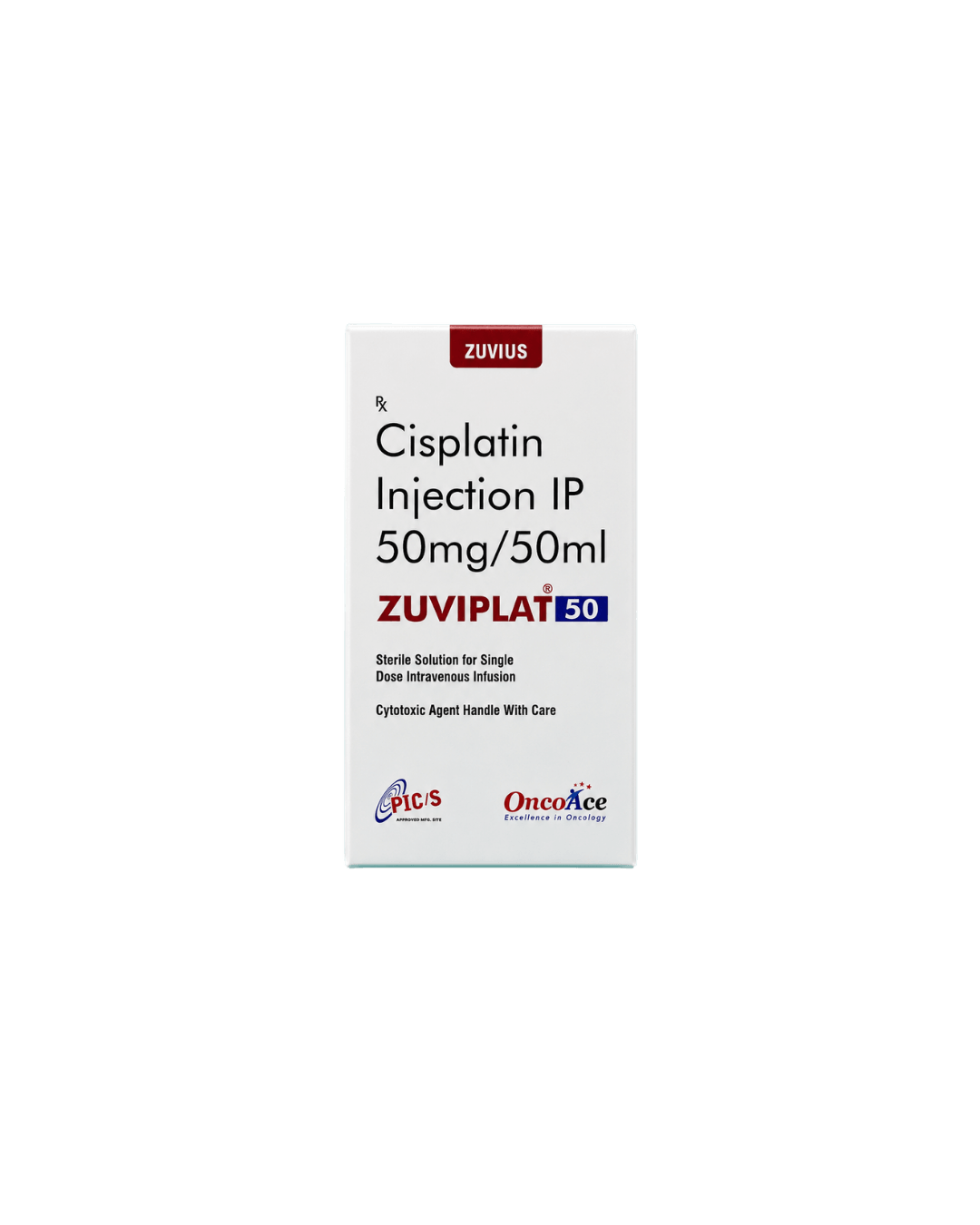
Zuviplat
Cisplatin Injection

Strength
✓10 mg✓50 mg

Pack Size
1 Vial

Drug Class
Antineoplastic Agents / Platinum Compounds

Specification
USP/BP/IH Specs offered for exports

Storage
Store at 25°C to 30°C.
ZUVIPLAT is an anticancer drug of an entirely new category for antitumor activity and low toxicity from among a variety platinum compounds developed according to the discovery by Barnett Rosenberg in the U.S.A that platinum compound inhibits the mitosis of Escherichia coli.
ZUVIPLAT can be used itself or in addition to other modalities or preferably in established combination therapy with other approved chemotherapeutic agents.
It is indicated in
- Metastatic ovarian tumors
- Squamous cell carcinoma of the head and neck
- Advanced bladder carcinoma
Cisplatin is considered one of the most effective anticancer drugs used widely for the treatment of solid tumours.
One of the most prominent and effective clinical applications of cisplatin is the treatment of lung cancer.
PRECAUTION SPECIAL
- Patients with renal disorder
- Patients with hepatic disorder
- Patients with myelosuppression
- Patients with auditory disorder
ZUVIPLAT solution should be used intravenously only and should be administered by i.v. dose every 3-4 weeks.
An alternative regimen is
- 15-20 mg per sq. i.v daily for 5 days every 3-4 weeks
In clinical use of ZUVIPLAT injection, take the following measures for reducing the nephrotoxicity of the drug:
- Administer 1000-2000 ml of an adequate fluid deficit replacement over 4 hours or more prior to the administration of the ZUVIPLAT injection.
- Administer ZUVIPLAT injection as a mixture with 500-1000 ml of physiological saline or a dextrose-saline solution by intravenous drip over 2 hours or more.
- When it takes the intravenous drip over 2 hours or more, keep the dripping bottle away from light.
- After the administration of ZUVIPLAT injection, administer 1000-2000 ml of an adequate fluid deficit replacement over 4 hours or more.
- During the administration of ZUVIPLAT injection, exercise care so as to maintain the urinary output and administer diuretics such as mannitol and furosemide.