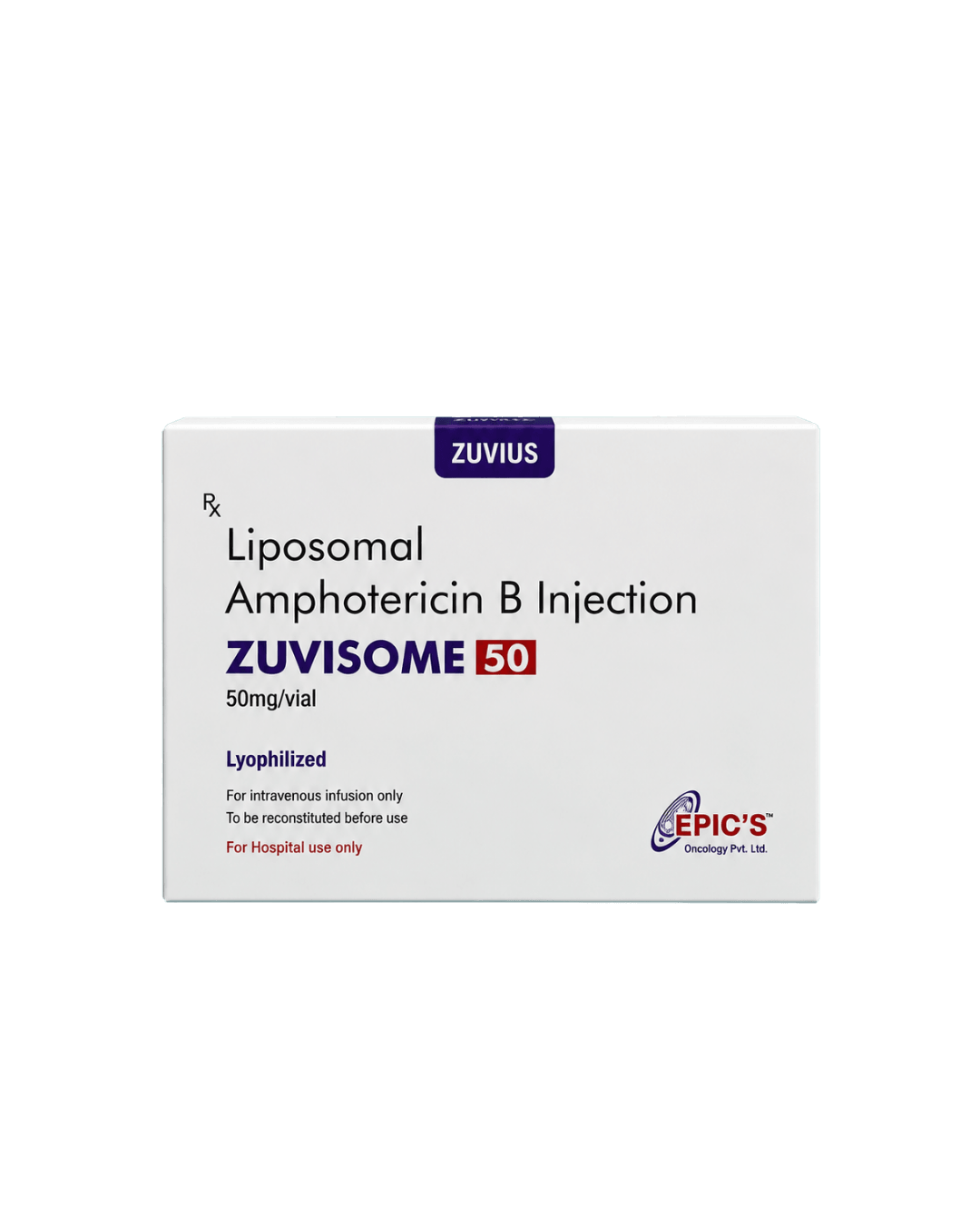
Zuvisome
Liposomal Amphotericin B Injection

Strength
✓50 mg

Pack Size
1 Vial

Drug Class
Polyene Antifungal

Specification
USP/BP/IH Specs offered for exports

Storage
Store at 25°C to 30°C.
Zuvisome is a sterile powder for dispersion for intravenous infusion.
It is supplied as a yellow lyophilised cake or powder.
Amphotericin B is a macrocyclic polyene antifungal antibiotic produced by Streptomyces nodosus.
It may act as either a fungistatic or fungicidal agent depending on the concentration achieved in body fluids and the susceptibility of the fungal organism.
Amphotericin B acts primarily by binding to sterols in fungal cell membranes.
This binding changes membrane permeability and allows leakage of small intracellular molecules, resulting in fungal cell damage.
Mammalian cell membranes also contain sterols, and the damage caused by Amphotericin B to human cells and fungal cells may involve similar mechanisms.
The lipophilic portion of Amphotericin B allows the molecule to become incorporated into the lipid bilayer of liposomes.
Liposomes are closed spherical vesicles formed from amphiphilic substances such as phospholipids.
When exposed to aqueous solutions, phospholipids arrange themselves into membrane bilayers.
Liposomal Amphotericin B Injection 50 mg is indicated in adults and children aged from 1 month to 18 years for:
- Treatment of severe systemic and/or deep fungal infections.
- Treatment of visceral leishmaniasis in immunocompetent adults and children.
- Empirical treatment of presumed fungal infections in febrile neutropenic patients when fever has failed to respond to broad-spectrum antibiotics and investigations have not identified a bacterial or viral cause.
Infections successfully treated with Liposomal Amphotericin B include
- Disseminated candidiasis
- Aspergillosis
- Mucormycosis
- Chronic mycetoma
- Cryptococcal meningitis
- Visceral leishmaniasis
Liposomal Amphotericin B should not be used to treat common clinically inapparent forms of fungal disease that are identified only through positive skin or serological tests.
The efficacy of Amphotericin B has been established in several clinical trials for the treatment of systemic fungal infections.
It has also been evaluated as empirical therapy for fever of unknown origin in neutropenic patients and for the treatment of visceral leishmaniasis.
Comparative randomized studies of liposomal Amphotericin B and conventional Amphotericin B in confirmed Aspergillus and Candida infections demonstrated equivalent efficacy.
In adult and paediatric febrile neutropenic patients with presumed fungal infection, a randomized double-blind clinical trial demonstrated that Amphotericin B administered at 3 mg/kg/day was as effective as conventional Amphotericin B.
Visceral Leishmaniasis
The efficacy of Amphotericin B in visceral leishmaniasis has been demonstrated in large populations of both immunocompetent and immunocompromised patients.
Invasive Filamentous Fungal Infections
The efficacy of Amphotericin B was demonstrated in a prospective, randomized, multicentre study as first-line treatment in immunocompromised, mainly neutropenic adults and children older than 30 days with proven or probable invasive filamentous fungal infections.
Invasive Candidiasis
Amphotericin B administered at 3 mg/kg/day was shown to be as effective as micafungin as first-line treatment for candidaemia and invasive candidiasis in a randomized, double-blind, multinational non-inferiority study involving adults and children.
Invasive Mucormycosis
Patients receiving liposomal Amphotericin B as first-line treatment for zygomycosis demonstrated favourable survival outcomes in cases collected prospectively by the European Confederation of Medical Mycology.
Contraindications
- Hypersensitivity to Amphotericin B or any component of the formulation.
- Treatment may still be considered when the condition is life-threatening and, in the physician's opinion, can only be treated with Liposomal Amphotericin B.
Anaphylaxis and Anaphylactoid Reactions
Anaphylaxis and anaphylactoid reactions have been reported during Amphotericin B infusion.
Infusion-Related Reactions
Other severe infusion-related reactions may occur during the administration of amphotericin-containing products.
Renal Toxicity
Liposomal Amphotericin B is substantially less nephrotoxic than conventional Amphotericin B.
However, renal adverse reactions may still occur and renal function should be monitored.
Pulmonary Toxicity
Acute pulmonary toxicity has been reported in patients receiving Amphotericin B during or shortly after leukocyte transfusions.
Diabetic Patients
Each vial contains approximately 900 mg of sucrose.
Very Common Adverse Reactions
- Hypokalaemia
- Nausea
- Vomiting
- Rigors
- Pyrexia
Common Adverse Reactions
- Hyponatraemia
- Hypocalcaemia
- Hypomagnesaemia
- Hyperglycaemia
- Headache
- Tachycardia
- Hypotension
- Vasodilatation
- Flushing
- Dyspnoea
- Diarrhoea
- Abdominal pain
- Abnormal liver function tests
- Hyperbilirubinaemia
- Increased alkaline phosphatase
- Rash
- Back pain
- Increased serum creatinine
- Increased blood urea
- Chest pain
Uncommon Adverse Reactions
- Thrombocytopenia
- Anaphylactoid reaction
- Convulsions
- Bronchospasm
Adverse Reactions With Unknown Frequency
- Anaemia
- Anaphylactic reactions
- Hypersensitivity
- Cardiac arrest
- Arrhythmia
- Angioneurotic oedema
- Rhabdomyolysis
- Musculoskeletal pain
- Renal failure
- Renal insufficiency
Overdosage
The toxicity of Amphotericin B following acute overdose has not been clearly defined.
If overdose occurs, administration should be stopped immediately.
The patient's clinical condition, renal and hepatic function, serum electrolytes and haematological status should be closely monitored.
Haemodialysis and peritoneal dialysis do not appear to significantly affect the elimination of Amphotericin B.
Different amphotericin products are not equivalent and should not be used interchangeably.
Administration of a test dose is advisable before beginning a new course of treatment.
Administration
- Amphotericin B should be administered by intravenous infusion over 30 to 60 minutes.
- For doses greater than 5 mg/kg/day, intravenous infusion over a 2-hour period is recommended.
Instructions for Reconstitution and Dilution
- Reconstitute using Sterile Water for Injection only.
- Dilute only with Dextrose solution 5%, 10% or 20% for infusion.
- Do not use saline solution.
- Do not mix with other medicinal products or electrolytes.
- Strict aseptic technique must be observed during preparation and administration.