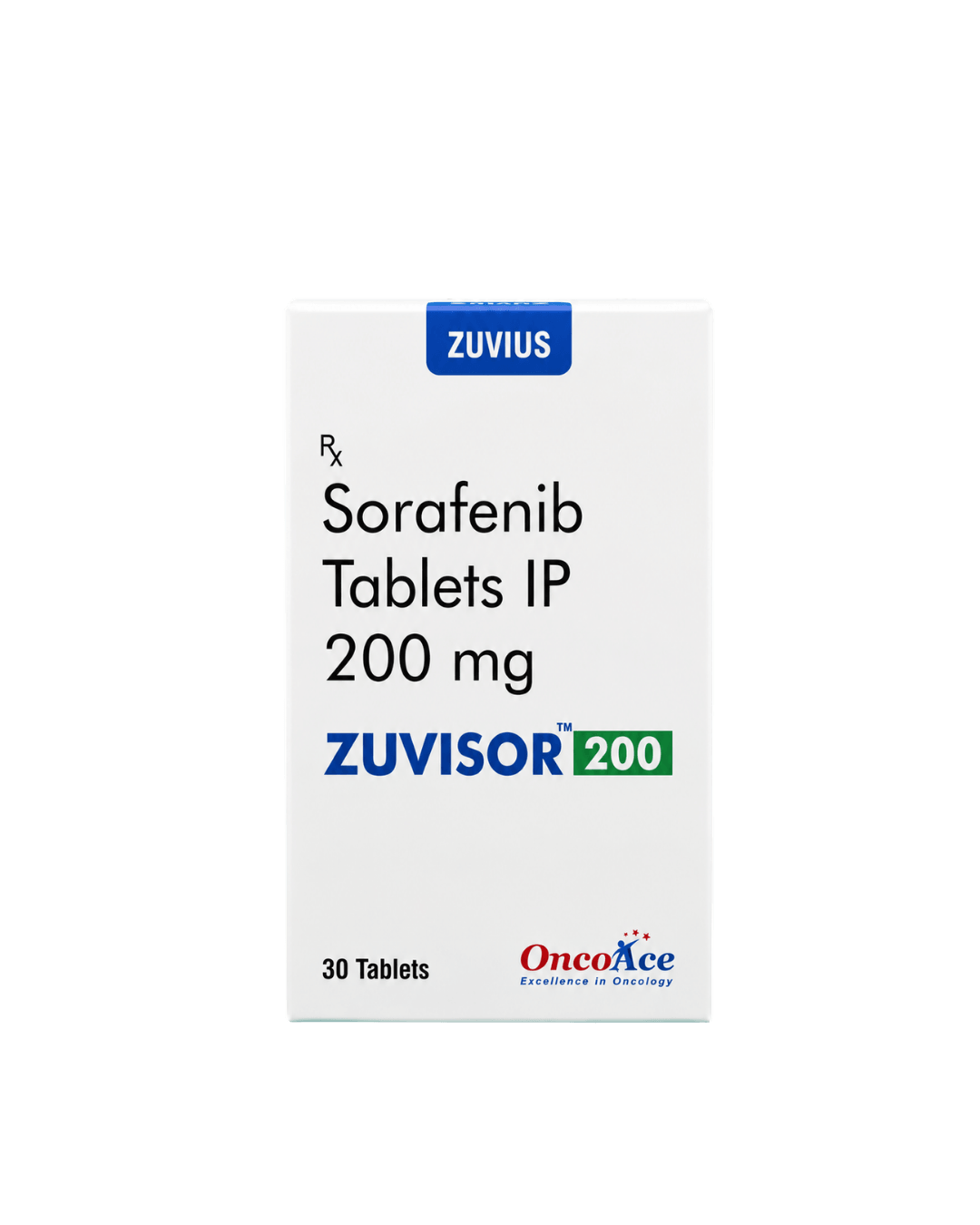
Zuvisor
Sorafenib Tablets

Strength
✓200 mg

Pack Size
1 x 30 / 1 x 120
Drug Class
Antineoplastic Agents, Protein Kinase Inhibitors

Specification
USP/BP/IH Specs offered for exports
Storage
Store at 25°C to 30°C.
ZUVISOR is Sorafenib tablets for oral use.
It is a multikinase inhibitor targeting several serine/threonine and receptor tyrosine kinases and is the tosylate salt of sorafenib.
Sorafenib tosylate has the chemical name
4-(4-{3-[4-Chloro-3-(trifluoromethyl)phenyl] ureido}phenoxy)-N2-methylpyridine-2-carboxamide 4-methyl benzenesulfonate.
Sorafenib is indicated for the treatment of
- Hepatocellular carcinoma
- Advanced renal cell carcinoma who have failed prior interferon-alpha or interleukin-2-based therapy or are considered unsuitable for such therapy
- Progressive, locally advanced or metastatic, differentiated (papillary/follicular/Hürthle cell) thyroid carcinoma, refractory to radioactive iodine
Usage
Sorafenib is used to treat late-stage kidney cancer (advanced renal cell carcinoma), liver cancer (hepatocellular carcinoma) that cannot be treated by surgery, and differentiated thyroid cancer that has come back or spread to other parts of your body.
Sorafenib is an antineoplastic (cancer) agent.
Sorafenib is a kinase inhibitor that decreases tumor cell proliferation in vitro.
Sorafenib was shown to inhibit multiple intracellular (c-CRAF, BRAF and mutant BRAF) and cell surface kinases (KIT, FLT-3, RET, RET/PTC, VEGFR-1, VEGFR-2, VEGFR-3, and PDGFR-ß).
Several of these kinases are thought to be involved in tumor cell signaling, angiogenesis and apoptosis.
Sorafenib inhibited tumor growth of HCC, RCC, and DTC human tumor xenografts in immunocompromised mice.
Reductions in tumor angiogenesis were seen in models of HCC and RCC upon sorafenib treatment, and increases in tumor apoptosis were observed in models of HCC, RCC, and DTC.
Sorafenib may cause a condition that affects the heart rhythm (QT prolongation).
QT prolongation can rarely cause serious (rarely fatal) fast/irregular heartbeat and other symptoms (such as severe dizziness, fainting) that need medical attention right away.
The recommended dose of Sorafenib in adults is 400 mg sorafenib (two tablets of 200 mg) twice daily (equivalent to a total daily dose of 800 mg) given at least 1 hour before or 2 hours after food.
Treatment is continued until no clinical benefit is seen or until unacceptable toxicity occurs.
Doses are reduced to 400 mg once daily if toxicity occurs; further reduction to a single dose of 400 mg every other day may be necessary.
Dose Adjustments
Management of suspected adverse drug reactions may require temporary interruption or dose reduction of sorafenib therapy.
When dose reduction is necessary during the treatment of hepatocellular carcinoma (HCC) and advanced renal cell carcinoma (RCC), Sorafenib dose should be reduced to two tablets of 200 mg sorafenib once daily.
When dose reduction is necessary during the treatment of differentiated thyroid carcinoma (DTC), Sorafenib dose should be reduced to 600 mg sorafenib daily in divided doses (two tablets of 200 mg and one tablet of 200 mg twelve hours apart).
If additional dose reduction is necessary, Sorafenib may be reduced to 400 mg sorafenib daily in divided doses (two tablets of 200 mg twelve hours apart), and if necessary, further reduced to one tablet of 200 mg once daily.
After the improvement of non-hematological adverse reactions, the dose of Sorafenib may be increased.
Pediatric Population
The safety and efficacy of Sorafenib in children and adolescents aged <18 years have not yet been established.
No data are available.
Elderly Population
No dose adjustment is required in the elderly (patients above 65 years of age).
Renal Impairment
No dose adjustment is required in patients with mild, moderate, or severe renal impairment.
No data is available in patients requiring dialysis.
The monitoring of fluid balance and electrolytes in patients at risk of renal dysfunction is advised.
Renal Impairment | Creatinine Clearance (CC) | Recommended Starting Dose
Mild
Between 59 to 40 mL/min → 400 mg twice daily
Moderate
Between 39 and 20 mL/min → 200 mg twice daily
Severe
Less than 20 mL/min → The dose could not be defined due to low patient numbers enrolled in this cohort
Patients on Hemodialysis
200 mg daily
Hepatic Impairment
Sorafenib is mainly metabolized in the liver.
Hepatic impairment might reduce exposure to Sorafenib.
No dose adjustment is required in patients with Child-Pugh A or B (mild to moderate) hepatic impairment.
No data is available on patients with Child-Pugh C (severe) hepatic impairment.
However, a study involving patients with varying degrees of hepatic impairment recommended the following empirical starting doses of oral sorafenib, based on tolerability and the development of dose-limiting toxicity.
Hepatic Dysfunction | Bilirubin Levels | Recommended Starting Dose
Mild
Between ULN and 1.5X ULN and/or AST > ULN → 400 mg twice daily
Moderate
Between 1.5 and 3X ULN, any value of AST → 200 mg twice daily
Severe
Over 3X ULN, any value of AST → Patients unable to tolerate even 200 mg every third day
(ULN: Upper Limit of Normal)
Method Of Administration
For oral use.
It is recommended that sorafenib be administered without food or with a low or moderate fat meal.
If the patient intends to have a high-fat meal, sorafenib tablets should be taken at least 1 hour before or 2 hours after the meal.
The tablets should be swallowed with a glass of water.