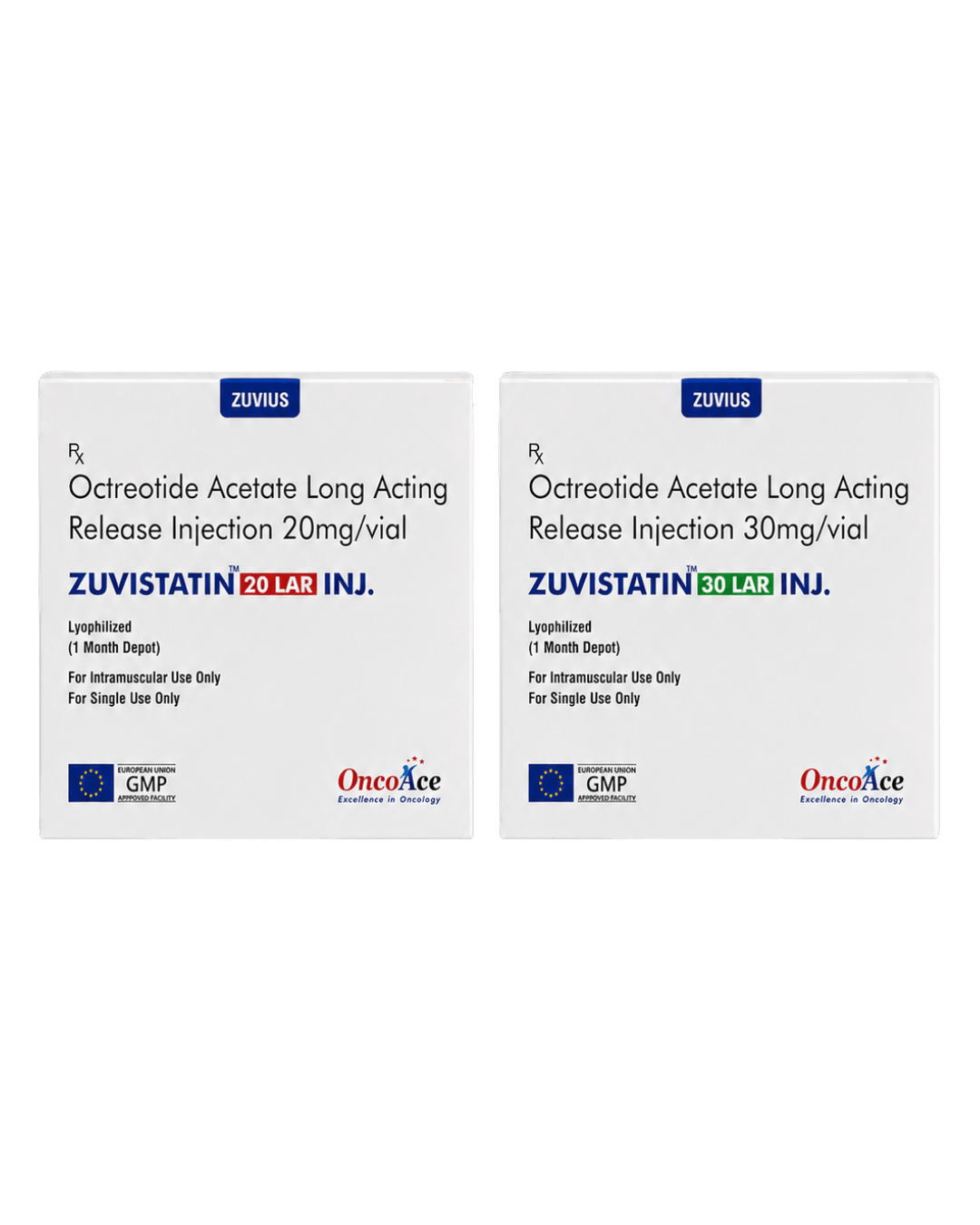
Zuvistatin
Octreotide Acetate Injection

Strength
✓20mg✓30 mg

Pack Size
1 Vial

Drug Class
Antidiarrheals; Somatostatin Analogs

Specification
USP/BP/IH Specs offered for exports

Storage
Store refrigerated at 2°C to 8°C.
Octreotide is the acetate salt of a cyclic octapeptide.
It is a long-acting octapeptide with pharmacological properties similar to the naturally occurring hormone somatostatin.
Octreotide is chemically described as L-Cysteinamide, D-phenylalanyl-L-cysteinyl-L-phenylalanyl-D-tryptophyl-L-lysyl-L-threonyl-N-[2-hydroxy-1-(hydroxymethyl)propyl]-, cyclic disulfide.
The molecular weight of octreotide is 1019.3 and its molecular formula is C49H66N10O10S2.
Zuvistatin LAR is indicated in patients in whom initial treatment with immediate-release octreotide injection has been shown to be effective and well tolerated.
Acromegaly
- Long-term maintenance treatment in patients who have had an inadequate response to surgery or radiotherapy.
- It may also be used when surgery or radiotherapy is not an option.
- The goal of treatment is to reduce growth hormone and IGF-1 levels toward normal.
Carcinoid Tumors
- Long-term treatment of severe diarrhea and flushing episodes associated with metastatic carcinoid tumors.
Vasoactive Intestinal Peptide Tumors
- Long-term treatment of profuse watery diarrhea associated with VIP-secreting tumors.
Zuvistatin is a long-acting formulation consisting of biodegradable microspheres containing octreotide.
It maintains the clinical and pharmacological properties of immediate-release octreotide while providing slow and sustained release from the intramuscular injection site.
The polymer gradually biodegrades, primarily through hydrolysis, allowing octreotide to be released over an extended period.
This long-acting formulation reduces the need for frequent injections and is designed for intramuscular administration once every 4 weeks.
Keep out of reach of children.
Use only as directed by a qualified healthcare professional.
Zuvistatin should be prepared and administered by trained medical personnel.
Zuvistatin should be administered only by a trained healthcare professional.
The mixing instructions included with the product must be followed carefully. The injection must be administered immediately after mixing.
Do not inject the diluent directly without first preparing the suspension.
The recommended needle is a 1½-inch, 19-gauge safety injection needle supplied with the product kit.
For patients with greater skin-to-muscle depth, a 2-inch, 19-gauge needle may be used.
Zuvistatin should be administered by deep intramuscular injection into the gluteal region once every 4 weeks.
Administration at intervals longer than 4 weeks is not recommended.
Injection sites should be rotated systematically to reduce irritation.
Deltoid injections should be avoided because they may cause significant discomfort.
Zuvistatin must not be administered intravenously or subcutaneously.