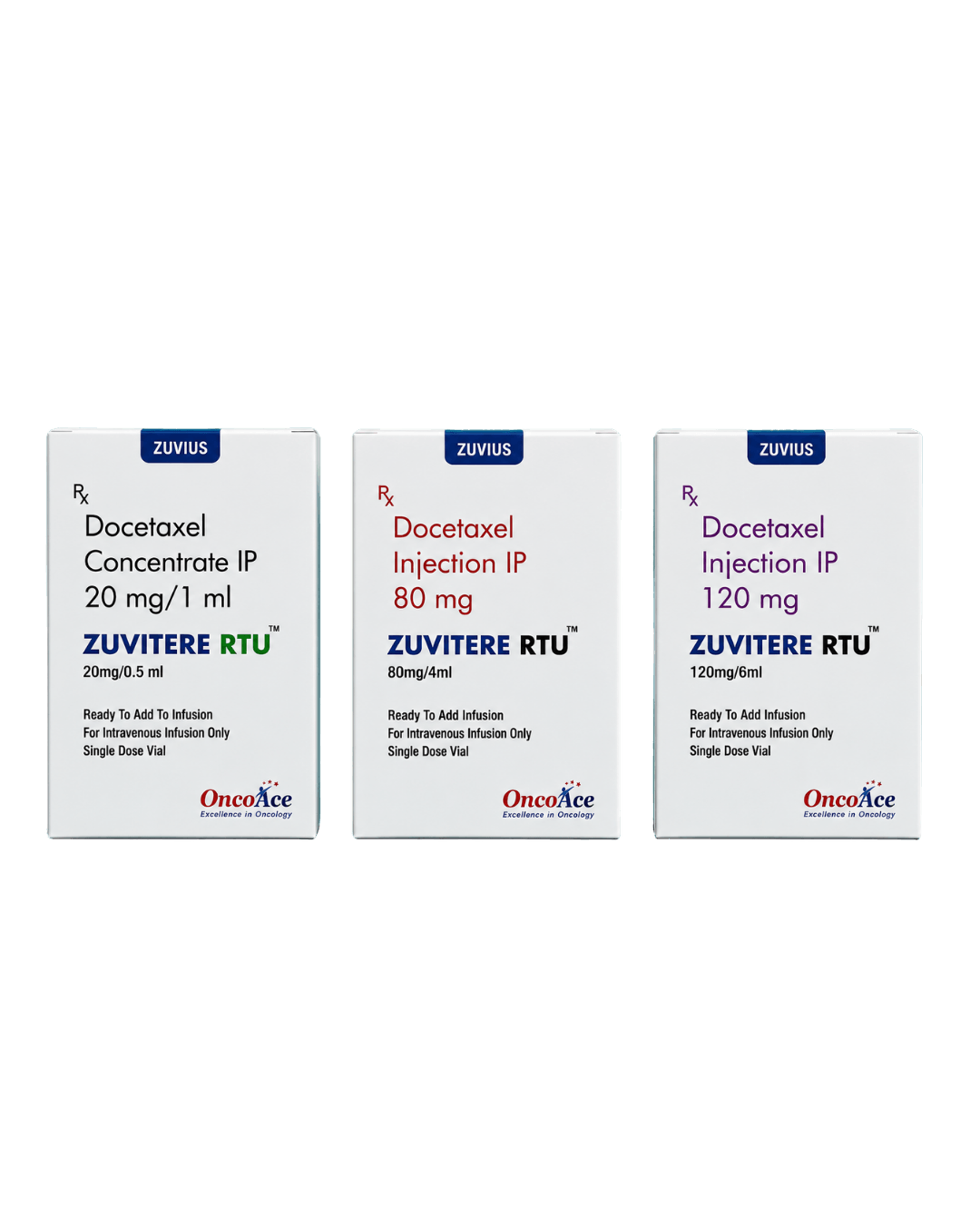
Zuvitere RTU
Docetaxel RTU Injection

Strength
✓20 mg✓80 mg✓120 mg

Pack Size
1 Vial

Drug Class
Taxane

Specification
USP/BP/IH Specs offered for exports

Storage
Store at 25°C to 30°C.
Docetaxel is an antineoplastic agent belonging to the taxoid family.
It is prepared by semisynthesis using a precursor extracted from the renewable needle biomass of yew plants.
Zuvitere RTU is a sterile solution for intravenous infusion containing Docetaxel at a concentration of 20 mg/mL.
It is a colorless to pale yellow, slightly viscous liquid that is free from visible particulate matter.
Each mL contains 20 mg of anhydrous Docetaxel along with Polysorbate 80 and diluent.
Zuvitere RTU is available in single-dose vials containing
- 20 mg in 1 mL
- 80 mg in 4 mL
- 120 mg in 6 mL
Zuvitere RTU requires no prior dilution with a separate diluent and is ready to be added directly to the infusion solution.
Docetaxel is indicated for the treatment of patients with locally advanced or metastatic breast cancer after failure of prior chemotherapy.
Docetaxel in combination with doxorubicin and cyclophosphamide is indicated for the adjuvant treatment of patients with operable node-positive breast cancer.
Docetaxel as a single agent is indicated for the treatment of patients with locally advanced or metastatic non-small cell lung cancer after failure of prior platinum-based chemotherapy.
Docetaxel in combination with cisplatin is indicated for the treatment of patients with unresectable, locally advanced or metastatic non-small cell lung cancer who have not previously received chemotherapy for this condition.
Docetaxel in combination with prednisone is indicated for the treatment of patients with androgen-independent or hormone-refractory metastatic prostate cancer.
Docetaxel in combination with cisplatin and fluorouracil is indicated for the treatment of patients with advanced gastric adenocarcinoma, including adenocarcinoma of the gastroesophageal junction, who have not received prior chemotherapy for advanced disease.
Docetaxel in combination with cisplatin and fluorouracil is also indicated for the induction treatment of patients with locally advanced squamous cell carcinoma of the head and neck.
Docetaxel is a CYP3A4 substrate.
The metabolism and systemic exposure of Docetaxel may be altered by medicines that induce, inhibit or are metabolized by cytochrome P450 3A4.
The exposure of Docetaxel increased approximately 2.2-fold when it was coadministered with ketoconazole, a potent CYP3A4 inhibitor.
Protease inhibitors, particularly ritonavir, may also increase the exposure of Docetaxel.
Concomitant use of Docetaxel with medicines that strongly inhibit CYP3A4 should generally be avoided.
When the systemic administration of a potent CYP3A4 inhibitor cannot be avoided, patients should be closely monitored for toxicity and a reduction in the Docetaxel dose may be considered.
Contraindications
- Docetaxel is contraindicated in patients with a history of severe hypersensitivity reactions to Docetaxel or other medicines formulated with Polysorbate 80.
- Severe reactions, including anaphylaxis, have occurred.
- Docetaxel should not be administered to patients with neutrophil counts below 1,500 cells/mm³.
Toxic Deaths
Treatment-related deaths have occurred in patients receiving Docetaxel, particularly in patients with abnormal baseline liver function.
Sepsis accounted for a significant proportion of treatment-related deaths.
Hepatic Impairment
Patients with combined abnormalities of transaminases and alkaline phosphatase should not be treated with Docetaxel.
Docetaxel should not be administered to patients with bilirubin above the upper limit of normal or AST and/or ALT greater than 1.5 times the upper limit of normal together with alkaline phosphatase greater than 2.5 times the upper limit of normal.
Hematologic Effects
- Frequent peripheral blood cell counts should be performed.
- Patients should not receive subsequent treatment cycles until neutrophils recover to more than 1,500 cells/mm³ and platelets recover to more than 100,000 cells/mm³.
- A 25% dose reduction is recommended following severe neutropenia lasting 7 days or longer, febrile neutropenia or Grade 4 infection.
- Patients receiving combination treatment should be closely monitored for febrile neutropenia and neutropenic infection.
Hypersensitivity Reactions
Patients should be closely observed for hypersensitivity reactions, especially during the first and second infusions.
Severe reactions may include generalized rash, erythema, hypotension, bronchospasm and, rarely, fatal anaphylaxis.
Severe hypersensitivity reactions require immediate discontinuation of the infusion and appropriate emergency treatment.
Patients who experience severe hypersensitivity reactions should not be rechallenged with Docetaxel.
Fluid Retention
Severe fluid retention has been reported following Docetaxel therapy.
Patients should receive oral corticosteroid premedication before each administration.
Patients with pre-existing effusions should be closely monitored for worsening fluid accumulation.
Peripheral edema may be managed with salt restriction and oral diuretics.
Acute Myeloid Leukemia
Treatment-related acute myeloid leukemia or myelodysplasia has occurred in patients receiving anthracyclines and/or cyclophosphamide, including Docetaxel-containing breast cancer treatment regimens.
Cutaneous Reactions
Localized redness and swelling of the extremities followed by skin peeling may occur.
Dose adjustment should be considered in cases of severe skin toxicity.
Neurologic Reactions
Severe neurosensory symptoms including paresthesia, dysesthesia and pain have been reported.
Dose adjustment may be required, and treatment should be discontinued if severe symptoms persist.
Asthenia
Severe fatigue and weakness may occur and may persist for several days or weeks.
Common Adverse Reactions
- Infection
- Neutropenia
- Anemia
- Febrile neutropenia
- Hypersensitivity reactions
- Thrombocytopenia
- Neuropathy
- Taste disturbance
- Shortness of breath
- Constipation
- Loss of appetite
- Nail disorders
- Fluid retention
- Fatigue
- Pain
- Nausea
- Diarrhea
- Vomiting
- Mucositis
- Hair loss
- Skin reactions
- Muscle pain
Overdosage
There is no known antidote for Docetaxel overdosage.
Patients should be monitored in a specialized medical unit where vital functions can be closely observed.
Potential complications include bone marrow suppression, peripheral neurotoxicity and mucositis.
Therapeutic G-CSF and other appropriate supportive measures should be administered as clinically required.
Premedication Regimen
All patients should be premedicated with oral corticosteroids such as dexamethasone 16 mg per day, for example 8 mg twice daily, for 3 days starting 1 day before Docetaxel administration.
This helps reduce the incidence and severity of fluid retention and hypersensitivity reactions.
For hormone-refractory metastatic prostate cancer, the recommended premedication regimen is oral dexamethasone 8 mg given at 12 hours, 3 hours and 1 hour before the Docetaxel infusion.
Breast Cancer
- For locally advanced or metastatic breast cancer after failure of prior chemotherapy, the recommended dose is 60 mg/m² to 100 mg/m² administered intravenously over 1 hour every 3 weeks.
- For adjuvant treatment of operable node-positive breast cancer, the recommended dose is 75 mg/m² administered over 1 hour after doxorubicin 50 mg/m² and cyclophosphamide 500 mg/m² every 3 weeks for 6 courses.
- Prophylactic G-CSF may be used to reduce the risk of hematological toxicity.
Non-Small Cell Lung Cancer
- After failure of prior platinum-based chemotherapy, the recommended dose is 75 mg/m² administered intravenously over 1 hour every 3 weeks.
- For chemotherapy-naive patients, the recommended dose is 75 mg/m² administered intravenously over 1 hour, immediately followed by cisplatin 75 mg/m² over 30 to 60 minutes every 3 weeks.
Prostate Cancer
- For hormone-refractory metastatic prostate cancer, the recommended dose is 75 mg/m² every 3 weeks as a 1-hour intravenous infusion.
- Prednisone 5 mg orally twice daily is administered continuously.
Gastric Adenocarcinoma
- The recommended dose is 75 mg/m² as a 1-hour intravenous infusion, followed by cisplatin 75 mg/m² over 1 to 3 hours on Day 1.
- This is followed by fluorouracil 750 mg/m² per day as a 24-hour continuous intravenous infusion for 5 days.
- Treatment is repeated every 3 weeks.
- Patients should receive antiemetic premedication and appropriate hydration for cisplatin administration.
Head and Neck Cancer – Induction Chemotherapy Followed by Radiotherapy:
- Docetaxel 75 mg/m² is administered as a 1-hour intravenous infusion.
- This is followed by cisplatin 75 mg/m² intravenously over 1 hour on Day 1.
- Fluorouracil 750 mg/m² per day is administered as a continuous intravenous infusion for 5 days.
- The regimen is repeated every 3 weeks for 4 cycles, followed by radiotherapy.
Head and Neck Cancer – Induction Chemotherapy Followed by Chemoradiotherapy:
- Docetaxel 75 mg/m² is administered as a 1-hour intravenous infusion on Day 1.
- This is followed by cisplatin 100 mg/m² administered over 30 minutes to 3 hours.
- Fluorouracil 1000 mg/m² per day is administered as a continuous infusion from Day 1 to Day 4.
- The regimen is repeated every 3 weeks for 3 cycles, followed by chemoradiotherapy.
Preparation and Administration
- Zuvitere RTU contains Docetaxel 20 mg/mL and requires no prior dilution with a separate diluent.
- Using a calibrated syringe and a 21-gauge needle, withdraw the required amount and inject it into a 250 mL infusion bag or bottle containing either 0.9% Sodium Chloride solution or 5% Dextrose solution.
- If a dose greater than 200 mg is required, use a larger infusion volume so that the final concentration does not exceed 0.74 mg/mL.
- Mix the infusion thoroughly by gentle manual rotation.
- Inspect the solution visually for particulate matter, precipitation or discoloration before administration.
- Administer the final diluted solution intravenously over 1 hour.
- The prepared infusion solution should be used within 4 hours, including the 1-hour administration time.