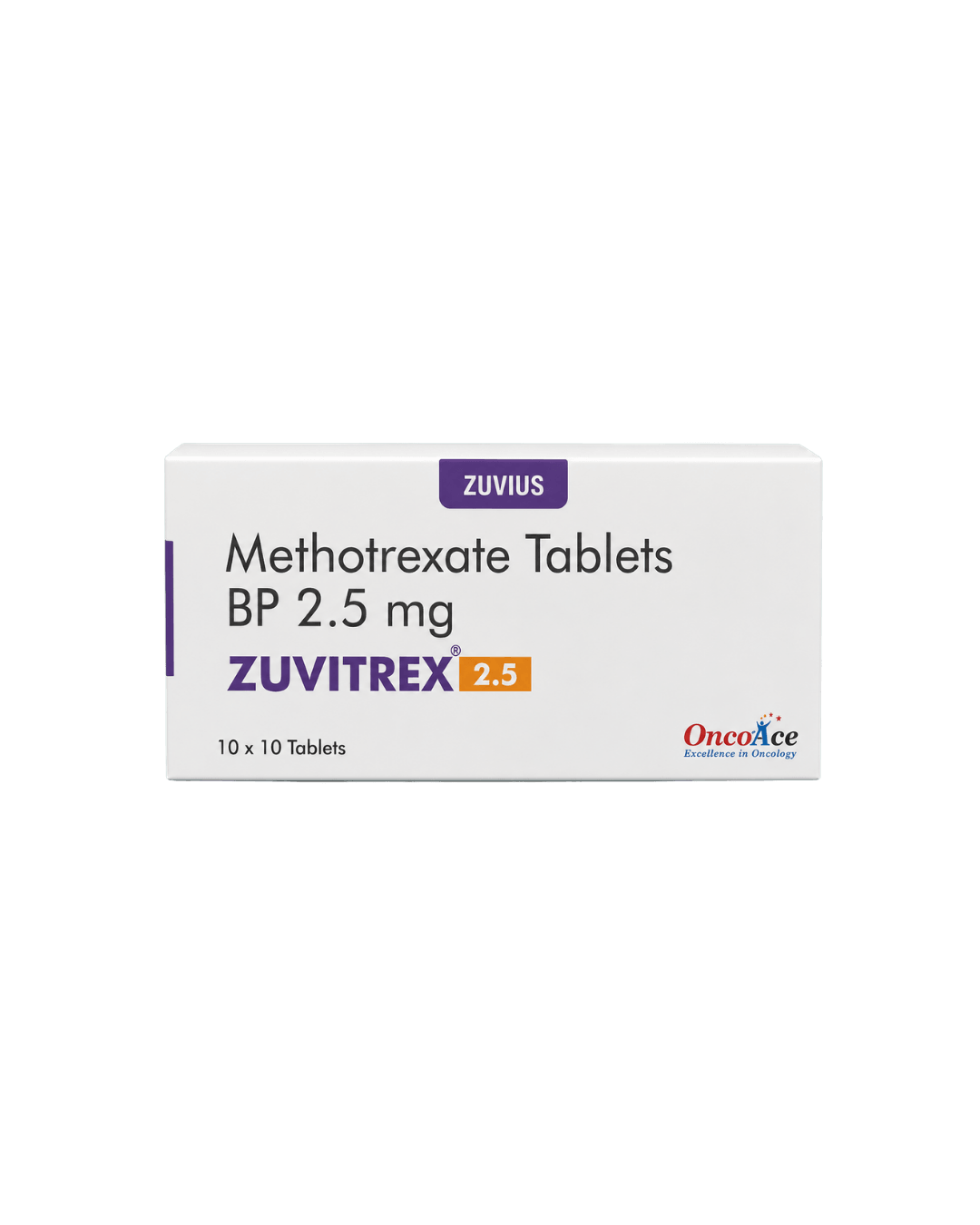
Zuvitrex Tab
Methotrexate Tablets

Strength
✓2.5 mg✓5 mg✓7.5 mg✓10 mg

Pack Size
1 x 10

Drug Class
Other Immunosuppressive Agents

Specification
USP/BP/IH Specs offered for exports

Storage
Store at 25°C to 30°C.
Methotrexate (formerly amethopterin) is an antimetabolite used in the treatment of certain neoplastic diseases, severe psoriasis, and adult rheumatoid arthritis.
Chemically methotrexate is N-[4-[[(2,4-diamino-6-pteridinyl)methyl]methylamino] benzoyl]-L-glutamic acid.
Methotrexate Tablets USP for oral administration are available in a packaging system.
Methotrexate Tablets USP Dose Pack for therapy with a weekly dosing schedule of 5 mg, 7.5 mg, 10 mg, 12.5 mg, 15 mg, 17.5 mg and 20 mg.
Methotrexate Tablets USP contain an amount of methotrexate sodium equivalent to 2.5 mg of methotrexate and the following inactive ingredients:
- Lactose
- Magnesium Stearate
- Pregelatinized Starch
Methotrexate is indicated in the treatment of choriocarcinoma, chorioadenomadestruens and molahydatidosa.
In molar hydatidosis primary therapy consists of the evacuation of the uterus.
Methotrexate is used in prophylactic therapy.
In the treatment of low-risk trophoblastic tumors, methotrexate is used as a single agent.
It is indicated in Psoriasis and Rheumatoid arthritis.
In the treatment of high-risk trophoblastic tumors methotrexate is applied as a part of the multidrug regimen.
Methotrexate is used in a normal dose or high dose as a single agent or as part of a multidrug regimen in the treatment of:
- Acute lymphoblastic leukemia (CNS Leukemia and maintenance therapy)
- Osteosarcoma
- Hodgkin’s lymphoma
- Burkitt lymphoma
- Advanced cancer of the head and the neck
- Invasive tumors of the bladder
- Advanced stages of mycosis fungoides
Methotrexate is a well-established antimetabolite and antifolate agent with proven efficacy across a broad range of malignancies.
By inhibiting dihydrofolate reductase (DHFR), Methotrexate disrupts DNA synthesis, repair, and cellular replication, particularly in rapidly proliferating cells.
Clinical studies and decades of therapeutic use have demonstrated the effectiveness of Methotrexate in the treatment of acute lymphoblastic leukemia (ALL), non-Hodgkin lymphoma, osteosarcoma, gestational trophoblastic neoplasia, and various solid tumors.
High-dose Methotrexate with leucovorin rescue has significantly improved survival outcomes in patients with osteosarcoma and is an integral component of curative treatment regimens for pediatric and adult ALL.
Methotrexate also plays a critical role in central nervous system (CNS) prophylaxis and treatment due to its ability to achieve therapeutic concentrations within the cerebrospinal fluid when administered intrathecally or at high doses.
Its established efficacy, predictable pharmacology, and versatility have made Methotrexate a cornerstone of modern oncology treatment protocols worldwide.
Methotrexate may increase the risk of problems with your liver or lungs, especially if you take a high dose.
However, your doctor will monitor you very closely while you’re taking methotrexate.
Any concerns or problems will be found during routine check-ups.
The dose of methotrexate to be given, the frequency of dosing, the total dose and the combination with other cytostatic drugs and/or folinic acid are subject to frequent modification as our knowledge improves.
Methotrexate should be only applied by Physician’s experience in the area.
Head and Neck Cancer
Methotrexate at a dose of 40mg/m² body surface area is given at weekly intervals, until progression.
This dosage is used without folinic acid therapy.
Trophoblastic Tumours
The treatment of trophoblastic tumors has to be strictly supervised by as assigned committee of exports.
In patients with non-metastatic and low risk metastatic trophoblastic tumors a methotrexate dose of 15 to 30 mg daily is administered orally or intramuscularly for 5 days.
A repeat course may be given after a period of one or more weeks.
Three to five courses are usually employed.
Patients with high risk trophoblastic tumours are often treated with a combination therapy, including 300 mg methotrexate/m² body surface followed by folinic acid therapy.
The therapy has to be evaluated on the basis of hCG (Human Chornic gonadotropin) plasma concentrations.
Leukaemia
Methotrexate is used as part of the maintenance therapy, in acute lymphoblastic leukemia at a dose of 15-30 mg/m² orally, intramuscularly or intravenously once a week.
Psoriasis
The treatment of psoriasis in women should start immediately following a menstrual period.
Once week prior initiation of methotrexate therapy a test dose of 5-10 mg is given parenterally to detect idiosyncratic reactions of the patients.
In adults weekly dosage schedule of 10-25 mg orally intramuscularly or intravenously is used.
In most patients an improvement occurs usually within 4 week and an optimal results is reached in 2-3 months.
Discontinuation of the methotrexate treatment gives relapse symptoms within 2 weeks to 6 months.
After optional clinical result has been reached the dose should be reduced to the lowest possible with the longest intermediate time span possible.
Conventional topical therapy should be restarted as soon as possible.
Rheumatoid Arthritis
A single test dose of methotrexate may be given prior to initiation of therapy to detect possible sensitivity to adverse effect to the drugs.
A weekly regimen is used.
The recommended starting dosage schedule is either
a) Single oral dosage of 7.5 mg once weekly
or
b) An oral dose of 2.5 mg at 12 hours intervals for three dosages given as a course once weekly.
Although an upward gradual modification in either the single or divided dosage schedule may be done for optimisation of response, the total dosage usually should not exceed beyond 20 mg per week so as to avoid severe toxicity particularly bone marrow suppression associated with.
After the optimum response is achieved the dose in each schedule should be preferably reduced to the lowest possible effective dose.
The response, which is apparent by between 3-6 weeks may continue for three months or more.
The optimal duration of therapy is not known.
However limited response for at least 2 years with continued therapy.
On discontinuation of therapy arthritis usually worsens within a span of 3-6 weeks.
For Intrathecal Use
Leukemia Meningeal
Only preservative free methotrexate diluted with preservative free 0.9% Sodium Chloride Injection USP or other suitable medium to a concentration of 1 mg/ml should be used for intrathecal administration.
For the treatment of meningeal leukemia, intrathecal methotrexate may be administered at intervals of 2 to 5 days.
Caution should be exercised as intrathecal methotrexate administered at intervals of less than once week may increase subacute toxicity.
Intrathecal methotrexate should be given until the cell count of the CSF returns to normal, and then one additional dose.
Intrathecal methotrexate adds significantly to the systemic methotrexate drug level, therefore concurrent systemic antileukemic therapy should be appropriately adjusted.
Dose Modifications
If the number of leukocytes is 2500-35000/mm³ and/or the number of thrombocytes is 75000-125000, it is preferred to discontinue the treatment for one week.
If the blood count has shown a recovery, the treatment can be continued.
If the blood count is not recovered, a dose reduction can be applied.
Methotrexate should not be given to patients with a creatinine clearance less than 60 ml/min.
Therapy with high dose methotrexate should be postponed in case of liver toxicity.
Route Of Administration
For intramuscular, intravenous and intrathecal use.